

Referring a patient for robotic or minimally invasive heart surgery
How to refer, which patients to consider, what to send — and how your patient comes back to you.
The best decisions in cardiac surgery are made together. When you refer a patient, I review the case with you, we decide on the approach as a Heart Team, and your patient returns to your care after surgery.
This page is for cardiologists and other physicians who are considering whether a patient may benefit from robotic, minimally invasive or conventional heart surgery. If you are not sure whether a case is suitable, that is exactly when a conversation is most useful.
What I offer
Robotic surgery with the Da Vinci Xi system
- Mitral valve repair and, when repair is not possible, mitral valve replacement
- Tricuspid valve surgery
- Hybrid coronary revascularisation, in coordination with interventional cardiology
- Removal of cardiac tumours such as myxoma
- Closure of atrial septal defects (ASD)
Minimally invasive surgery
- Mitral, tricuspid and aortic valve repair, and replacement of any heart valve
- Bentall procedure through a mini-sternotomy
- Closure of atrial and ventricular septal defects
- Endocarditis and cardiac tumours
Conventional and complex surgery, including complex aortic surgery (aneurysms and acute aortic syndrome), valve-sparing aortic root surgery (David and Yacoub procedures) and total arterial coronary bypass — and the structural cardiology background to discuss surgical and transcatheter options side by side.
Which patients are worth discussing
Any patient with surgical valve or coronary disease is worth discussing. These patients are often particularly good candidates for a robotic or minimally invasive approach:
- Degenerative mitral regurgitation, especially when the valve looks repairable
- Isolated mitral or tricuspid disease, without the need for several combined procedures
- Active, working patients for whom a faster return to normal life matters
- Patients who are reluctant to have surgery because of the prospect of a sternotomy
Some factors can make a robotic approach unsuitable, and they are worth mentioning when you refer: previous right-chest surgery or significant pleural disease, severe disease of the aorta or the iliac and femoral arteries, lung disease that limits ventilation of one lung, significant chest-wall deformity, and the need for multiple procedures in the same operation. None of these rule out surgery — they help us choose the right approach.
What to send
Send whatever you already have. More can be requested later, and nothing needs to be repeated for the first review.
- Transthoracic echocardiogram — and transoesophageal echocardiogram if one has been done
- Coronary angiography or coronary CT, depending on age and risk
- CT angiography of the chest, abdomen and pelvis, if available, to assess the aorta and peripheral access
- Recent ECG and basic laboratory results
- Pulmonary function tests in patients with lung disease
- Operative notes from any previous chest or cardiac surgery
How it works
- You send the case — the studies and a brief clinical summary, by email.
- I review it and we talk. I call you to discuss the case and the options before anything is said to the patient.
- The patient is assessed in person or by video consultation, and we agree on the approach as a Heart Team.
- Surgery takes place at a hospital equipped for the procedure.
- Your patient returns to you. You receive the operative report and discharge summary, and follow-up stays with you as the treating cardiologist.
Your patient remains your patient. My role is the operation and the surgical recovery; long-term cardiological care stays with you.
Where I operate
- Guadalajara: Hospital Ángeles del Carmen, and Hospital Ángeles Andares for robotic and complex minimally invasive surgery
- Querétaro: Hospital Ángeles Centro Sur, Hospital H+ Querétaro and Hospital Moscati
- Hermosillo: Hospital CIMA Hermosillo
To see what a robotic case looks like from the patient’s side, read about the first robotic heart surgery in Guadalajara, or our guides to robotic heart surgery and minimally invasive cardiac surgery.
How to reach me
Email: [email protected]
Guadalajara: 33 3813 0042, ext. 4431
Querétaro: +52 442 611 1775
About the author
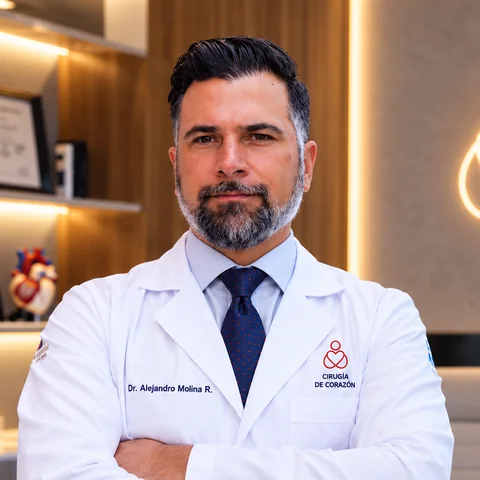
Dr. Alejandro Molina Romo is a cardiovascular surgeon practising in Guadalajara, Querétaro and Hermosillo. He trained in cardiothoracic surgery at the Universidad de Guadalajara, completed advanced training in cardiac surgery, minimally invasive surgery, robotic surgery and structural interventions at the University of Montreal, and a fellowship in structural cardiology and TAVR at CHU Bordeaux, France.
Medical degree: Universidad Autónoma de Guadalajara, Cédula Profesional 5757260 · Cardiothoracic surgery: Universidad de Guadalajara, Cédula de Especialidad 10768871 · Current certification, Consejo Nacional de Cirugía del Tórax, no. 447
This page is intended for physicians. Every case is assessed individually, and the choice of surgical approach depends on the patient’s anatomy, clinical condition and studies.
