


Redo Heart Surgery: Risks of a Second Operation
Redo heart surgery risks rise with scar tissue and age.
What Is Redo Heart Surgery?
When a patient who has already had one open-heart operation needs another, the risks of redo heart surgery become the central question for the whole family. The operation itself is often called a Redo Surgery or cardiac reoperation: reopening the chest through the same breastbone (sternum) to repair or replace a valve, redo a bypass graft, or address the aorta, the large vessel that carries blood from the heart.
The first operation is usually the hardest to go through. A second one, however, carries its own technical challenges because the surgeon is operating inside a chest that has already been opened, where tissue has scarred and stuck together. Understanding these challenges ahead of time — rather than hearing them for the first time in a hospital corridor — is one of the best things a patient and family can do.
We are a multidisciplinary team of cardiac surgeons led by Dr Alejandro Molina, with consulting rooms in Guadalajara, Querétaro and Hermosillo. This guide explains, in plain language, when a second operation is considered, why it is riskier, what the real complications are, and how a good team lowers them.
When Is a Second Heart Operation Needed?
Nobody plans a redo operation at the first surgery. It becomes necessary months or — more often — years later, for reasons the patient did nothing to cause. The common triggers include:
- A valve that failed over time: a repaired or replaced valve can narrow or leak again, sometimes because biological tissue valves naturally wear out after many years.
- New blockages: bypass grafts placed in the first operation can narrow or close, especially vein grafts, and new blockages can form in arteries that were clean before.
- An aorta that has grown: the aortic wall can dilate over the years. Teams generally act when the aortic diameter exceeds 5.5 cm, or earlier in some genetic conditions.
- A complication from the first surgery: for example, an infection of the breastbone or an abnormal connection between an artery and a vein (a fistula) that must be repaired.
Often the trigger is not a dramatic event but a routine test. A routine echocardiogram — an ultrasound of the heart — shows the replaced valve is leaking more than before, or a CT scan shows the aorta has grown. The patient may feel almost nothing. That quiet gap between "the images look worse" and "I feel fine" is exactly where careful judgement matters, and where a second opinion is worth its weight in gold.
In our first contact — a free video consultation — we review the patient's own images and studies, explain what they actually show in plain words, and say which additional tests are genuinely needed so no unnecessary ones are ordered.
Why Is Redo Heart Surgery Riskier Than the First?
The honest answer is: because the anatomy has changed. The Surgical Risk of any heart operation depends on how difficult the access is, how much tissue must be handled, and how much reserve the patient's organs have. In a redo operation, all three factors shift against the surgeon.
The chest is no longer virgin territory. After the first sternotomy — splitting the breastbone — the pericardium, the membrane that wraps the heart, often adheres to the back of the sternum. Freeing the heart from these adhesions takes time and care, and it is the step where most redo-specific complications can occur. Published series of reoperative aortic surgery confirm that outcomes are worse than first-time surgery on average, but that they have improved substantially in experienced centres.
The patient is usually older and has more conditions. Ten or fifteen years have often passed since the first operation. Diabetes, kidney function decline, atrial fibrillation, or previous stroke change the equation. Teams use validated tools such as the EuroSCORE II — a scoring system that estimates surgical risk from the patient's age, kidney function, urgency, and the type of operation — to make this estimate visible and debatable rather than a gut feeling. The BMJ has published extensively on how risk models are used and how imperfect they remain, which is one reason experienced teams combine the numbers with clinical judgement.
Time on the heart-lung machine tends to be longer. Dissecting adhesions and dismantling old grafts or prosthetic material adds time to the operation. The longer the heart is stopped and the body supported artificially, the higher the risk of bleeding, kidney strain, and postoperative confusion. This does not mean a redo operation should be avoided — it means the plan must account for it.
Scar Tissue Heart Surgery Risks
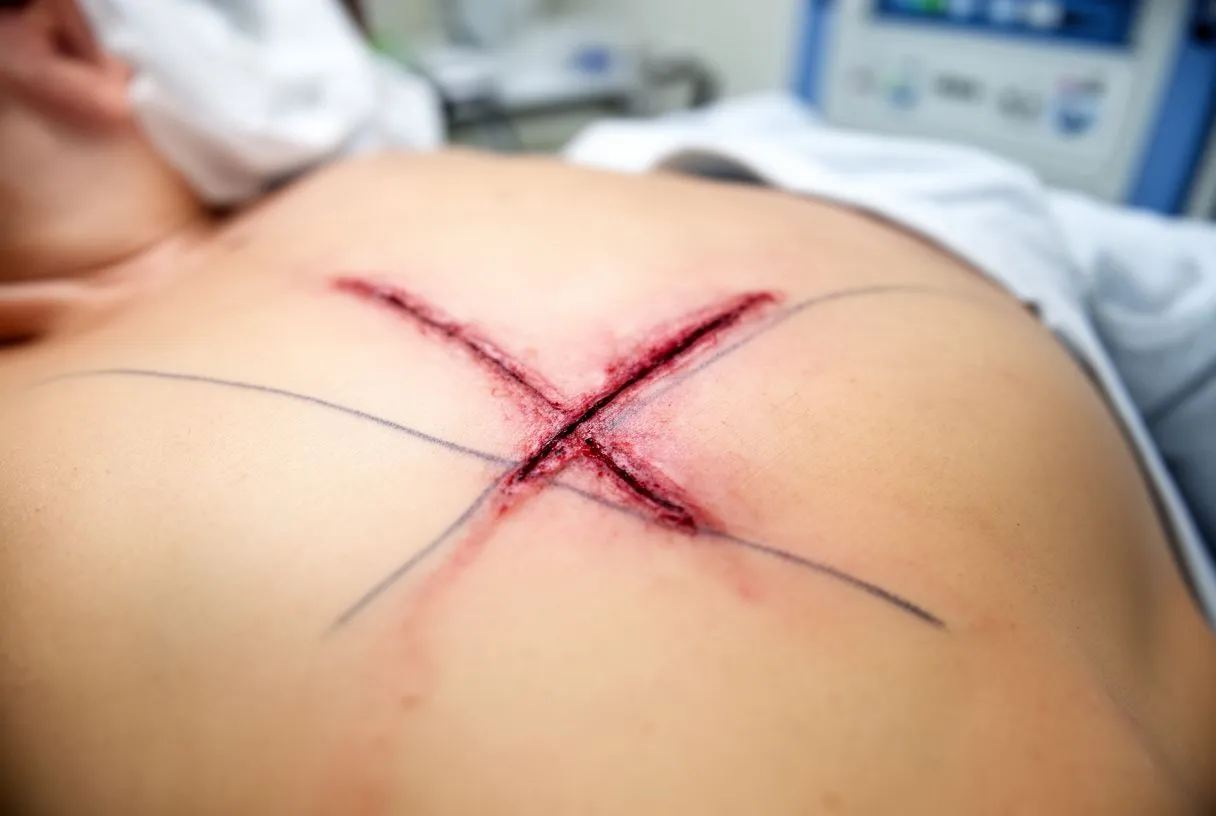
Scar tissue deserves its own section, because it is the single feature that most distinguishes a second operation from the first. During healing, the surfaces inside the chest — sternum, pericardium, heart, and old grafts — fuse together in ways that vary enormously between patients. Two people who had identical first operations can have completely different anatomy when they are reopened.
Adhesions make access unpredictable. The surgeon must identify and protect the right ventricle (the heart's front chamber), the old bypass grafts that may now be keeping the heart alive, and the great vessels — all through a curtain of scar. In some patients the tissue peels cleanly; in others it is dense and vascular. Modern teams reduce this risk by doing a peripheral cannulation strategy: placing the tubes for the heart-lung machine in the groin or neck vessels before opening the sternum, so that the heart can be supported quickly if an unexpected problem occurs.
Old grafts can be injured. A patent bypass graft, one that is still delivering blood to the heart muscle, can be accidentally cut during dissection. Experienced redo surgeons map the location of every old graft on a preoperative CT angiogram before entering the operating room. In our team, every redo case is reviewed by the full multidisciplinary group against international practice guidelines before a recommendation is made, including a study-by-study map of the old grafts and prosthetic material.
Bleeding risk rises with dissection. Raw, scarred surfaces bleed more, and the longer dissection needed for reoperation increases exposure to heparin — the blood thinner used during heart-lung bypass — which amplifies Bleeding Risk. This is managed, not eliminated: careful haemostasis, cell salvage (re-transfusing the patient's own blood), and sometimes a staged dissection in very difficult cases.
Are Redo Heart Surgery Risks the Same for Everyone?
No — and this is the most reassuring and the most useful fact in this article. Risk Stratification is the process of placing each patient on the spectrum from low to Prohibitive Risk (a risk so high that surgery is not recommended) using objective factors, and it has transformed how redo operations are offered.
Age and organ function matter more than the fact of a previous operation. A 58-year-old with normal kidney function and no lung disease who needs a redo valve replacement is in a very different category from an 84-year-old with severe kidney impairment and prior stroke. The previous sternotomy raises the baseline risk, but it does not define it.
Urgency matters. An operation done electively, after full planning, carries materially lower risk than the same operation done emergently after the patient deteriorates. One of the clearest findings across reoperative surgery literature is that waiting until symptoms become severe worsens outcomes. The lesson is practical: if imaging shows a problem is progressing, the conversation should happen early, not after an emergency admission.
Frailty is being recognised as a key factor. Beyond age in years, teams now assess grip strength, walking speed, and weight loss — markers of frailty that predict recovery capacity. Studies of postoperative delirium after major surgery in elderly patients show that frail, older patients face higher rates of postoperative confusion and worse outcomes, and that identifying these patients beforehand allows measures that reduce the risk (PLOS ONE). We evaluate every candidate this way, and we recommend the less invasive route only where the evidence supports it for that specific patient.
What Are the Main Complications After a Second Heart Operation?
Patients and families deserve a candid list rather than vague reassurance. The complications specific to — or amplified by — redo operations include:
- Injury to the heart or old grafts during re-entry: rare in experienced hands, but it is the complication that defines redo surgery; prevention depends on preoperative imaging and cannulation strategy.
- Bleeding and transfusion: more common than in first-time surgery because of the longer dissection; teams mitigate it with cell salvage and meticulous technique.
- Postoperative delirium and stroke: confusion after surgery is common in older patients and frailty predicts it; most delirium resolves over days, though it lengthens recovery.
- Kidney and lung strain: longer pump time stresses both organs; most cases recover, but pre-existing kidney disease raises the stakes.
- Sternal wound infection: the breastbone has been operated on before; diabetes and lung disease increase this risk, and it needs prolonged treatment when it occurs.
None of these are reasons to refuse a needed operation. They are reasons to have the operation in a centre that does them often, with a team that plans for each one. In experienced centres, elective redo surgery in selected patients has outcomes that approach first-time surgery — the difference lies in patient selection and preparation, not in luck.
It is also true that patients describe a specific emotional experience after major heart surgery. What are the signs of depression after open-heart surgery? Low mood in the first weeks, poor sleep, loss of appetite, and tearfulness are common and usually improve; persistent low mood beyond several weeks, hopelessness, or thoughts of self-harm need prompt professional attention. Families should treat mood as a vital sign after surgery, not an afterthought.
Is There a Less Invasive Alternative to Repeat Open Heart Surgery?
Often, yes — and this is where the conversation has changed dramatically in the last decade. When a previously replaced aortic valve wears out, a catheter-based replacement known as TAVR (transcatheter aortic valve replacement) can frequently be offered instead of reopening the chest. The valve is delivered through the groin artery — the femoral artery — without splitting the sternum at all. In fact, landmark low-risk TAVR trials showed that for selected patients, TAVR could be offered at low surgical risk, expanding the option well beyond the inoperable.
How long does it take to recover from a heart valve replacement through the groin artery? Recovery is measured in days rather than weeks for the procedure itself: most patients walk the same or next day and go home within a few days. But "less invasive" is not the same as "no risk" — groin artery complications, pacemaker need, and valve durability questions all matter, and the choice depends on the patient's age, anatomy, and which valve they already have.
It is not always available. A failing mitral valve repair, a degenerating bypass graft, or a dilated aorta still require conventional surgery, sometimes minimally invasive through a small right-side incision, sometimes robotic. Our team performs conventional, minimally invasive, robotic and transcatheter procedures — Dr Molina performed the first robotic mitral valve repair in the Ángeles Health System and the first robotic heart surgery in Guadalajara — and every case is reviewed by the whole team before we propose one approach over another.
The guiding principle patients should hold onto: the question is never "operation versus no operation," but "which approach carries the lowest risk for my situation." A team that offers only one method tends to find reasons to use it; a team that offers all of them finds reasons to choose.
How to Prepare for Redo Cardiac Surgery
Preparation is where patients and families have real leverage. Most redo complications cannot be fully prevented, but many can be anticipated and their consequences reduced — and that starts weeks before the operation date.
Gather your complete history before the first consultation. The team will need the original operation report, the type of valve or graft used, every echocardiogram since, and any recent CT or catheterisation. Patients who arrive with this packet move through planning weeks faster and avoid repeating studies unnecessarily.
Optimise what can be optimised. Blood sugar control in diabetes, blood pressure control, quitting smoking, dental clearance before valve surgery (infected teeth can seed the new valve), and gentle conditioning exercise all measurably affect recovery. What type of exercise is recommended after open-heart surgery with valve replacement? After recovery, the standard is progressive aerobic activity — daily walking that extends week by week, then supervised cardiac rehabilitation — with heavy lifting restricted until the breastbone has healed, usually around eight to twelve weeks. Building baseline fitness before surgery shortens the distance to that goal.
Ask for a second opinion without apologising for it. A second heart operation is exactly the kind of decision where a second opinion changes plans in a meaningful minority of cases — sometimes confirming the plan, sometimes revealing a less invasive alternative. We encourage second opinions and treat seeking one as a normal part of deciding about heart surgery; we would rather a patient decide with full information than sign quickly. If you want a structured approach to this, it is worth reading about Five reasons to ask for a second opinion before high-risk surgery before choosing where to be operated.

What Recovery After a Second Heart Operation Really Looks Like
Families usually plan for the operation and underestimate the recovery. A second operation is, for most patients, a slower recovery than the first — not because the technique is worse, but because the patient is older and the body has less reserve.
Expect the hospital phase to be longer. First-time valve patients may go home in five to seven days; redo patients often need a few more days, especially if blood transfusion was needed or the lungs were slow to clear. This is normal, not a sign that something went wrong.
Expect a steeper early week and a gentler later course. The first two weeks at home are typically the hardest: fatigue, appetite loss, disrupted sleep, and low mood. From week three onward, most patients improve steadily, and by week six to eight many are doing their own shopping, cooking, and walking several kilometres a day. Full sternal healing takes about three months.
Watch for warning signs rather than worrying about everything. Fever, a new or worsening wound drainage, sudden leg swelling, breathlessness at rest, or a heart rhythm that feels erratic deserve a call to the surgical team the same day. Most problems caught early are managed with medication; caught late, they become readmissions.
Cardiac rehabilitation — a supervised programme of progressive exercise and education — is the single most valuable post-surgery service, and it matters even more after a redo operation.
How to Choose a Team for Redo Heart Surgery
The strongest predictor of a good outcome in redo heart surgery is not the city or the building — it is the experience of the specific team and the honesty of the conversation you have with them.
Ask about volume and approach. How many redo operations does the surgeon do each year? Does the team offer all four approaches — conventional, minimally invasive, robotic, and transcatheter — or only one? A team that performs only open surgery will tend to propose open surgery for everyone, which is precisely the situation a second opinion is designed to catch.
Ask who decides. In a multidisciplinary model, a cardiac surgeon, a cardiologist, and an imaging specialist review the case together before anything is proposed to the patient. In a single-opinion model, one person weighs everything alone. The first model is slower and more expensive to run; it is also the model behind the better outcomes reported in modern heart teams.
Ask what happens if surgery is not the answer. Some patients referred for redo surgery are better served by medical management, further monitoring, or a catheter-based option. A trustworthy team says so plainly. In our consultation in Guadalajara, Querétaro or Hermosillo, we take the time to explain what the studies actually show and to present the alternatives with their trade-offs — the final decision is always the patient's.
The risks of redo heart surgery are real, but they are also measurable, predictable, and reducible. If your own situation involves a failing valve, a deteriorating graft, or a growing aorta, the worst decision is the one made in panic. Book a consultation with a qualified cardiac team, bring your studies, ask every question — and decide with the full picture in front of you.






