Exercise Ergometry: Measuring Heart Fitness
An exercise ergometry heart test reveals how your heart performs under controlled stress.
An exercise ergometry heart test is one of the most informative studies cardiology offers: it measures how your heart, lungs and circulation respond to controlled physical effort, while a full medical team watches. If you have been experiencing chest discomfort, breathlessness, or unusual fatigue during activity, this test can reveal whether your heart is struggling to keep up with demand. It is also used to check fitness before surgery, to guide cardiac rehabilitation, and to reassure people whose symptoms turn out to be harmless. This guide walks you through what the test involves, how to prepare, what the results mean, and when it is worth discussing with a heart specialist.
What Is Exercise Ergometry?
The word itself. "Ergometry" comes from the Greek ergon (work) and metron (measure) — literally, the measurement of work. An ergometer is any device that lets you exercise at a precisely known workload: a stationary bicycle, a treadmill, or even an arm crank. The word "ergometer" has been in medical use since the 19th century, when early researchers attached recording devices to stationary bikes to study human effort in the laboratory.
What it measures. During exercise ergometry, your heart rate, blood pressure, breathing and electrical heart activity (an electrocardiogram, or ECG) are recorded continuously while the workload increases in steps. The central question is simple: does your heart respond to effort the way a healthy heart should? A healthy heart pumps more blood, keeps a steady rhythm and delivers enough oxygen to the working muscles. A heart with narrowed coronary arteries or a diseased valve may fall short in one or more of those respects — and the shortfall shows up on the tracing.
Why effort matters. Your heart may look entirely normal while you sit in a chair. Coronary arteries can be partly narrowed and still supply enough blood at rest. Only when you demand more — walking up stairs, cycling, climbing a hill — does the imbalance appear. Exercise is therefore the most natural way to bring a hidden problem to light, without invasive procedures. If you have felt exercise intolerance (breathlessness or fatigue that arrives earlier than it should), ergometry turns that experience into measurable data.
How Does an Exercise Ergometry Heart Test Work?
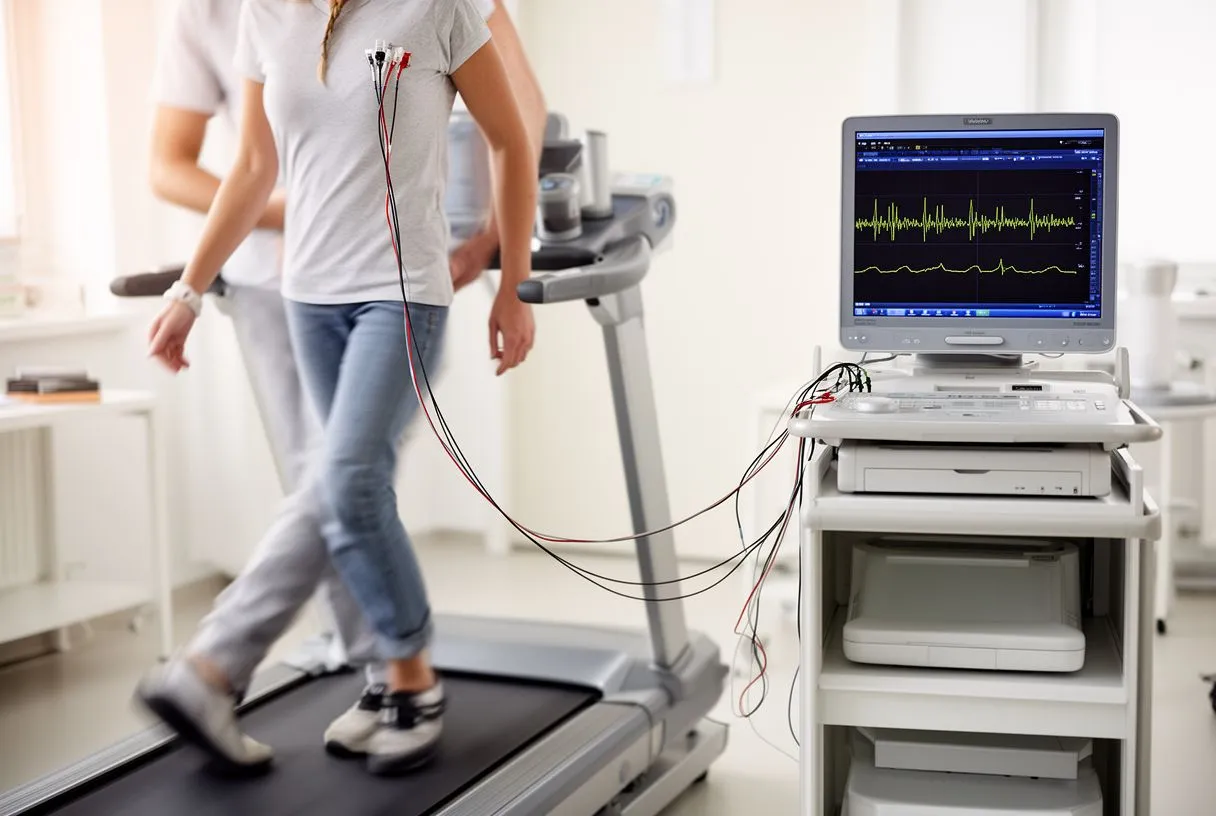
The basic protocol. You begin seated or standing still, so the team can record your resting ECG and blood pressure. You then start exercising at a light workload. Every one to three minutes, the machine increases the effort — the treadmill speeds up and steepens, or the bicycle adds resistance. Meanwhile, electrodes on your chest track your heart's electrical signals and the team watches the screen in real time.
When the test stops. The test continues until you reach a target heart rate (usually a percentage of your age-predicted maximum), until you develop symptoms, or until the doctor sees a concerning change on the ECG or blood pressure. It is a symptom-limited or goal-limited test, not an endurance contest. You are never asked to push past what is safe, and you can ask to stop at any moment. Most people finish in six to twelve minutes of actual exercise.
The recovery phase. After the effort ends, you are watched during a cool-down and rest period, typically five to ten minutes, while your heart rate and blood pressure return toward normal. This recovery data matters as much as the exercise itself: how quickly your heart rate falls after effort is one of the strongest signals of cardiovascular health, and delayed recovery is a finding in its own right.
Treadmill or Bicycle Ergometer: Which One Will I Get?
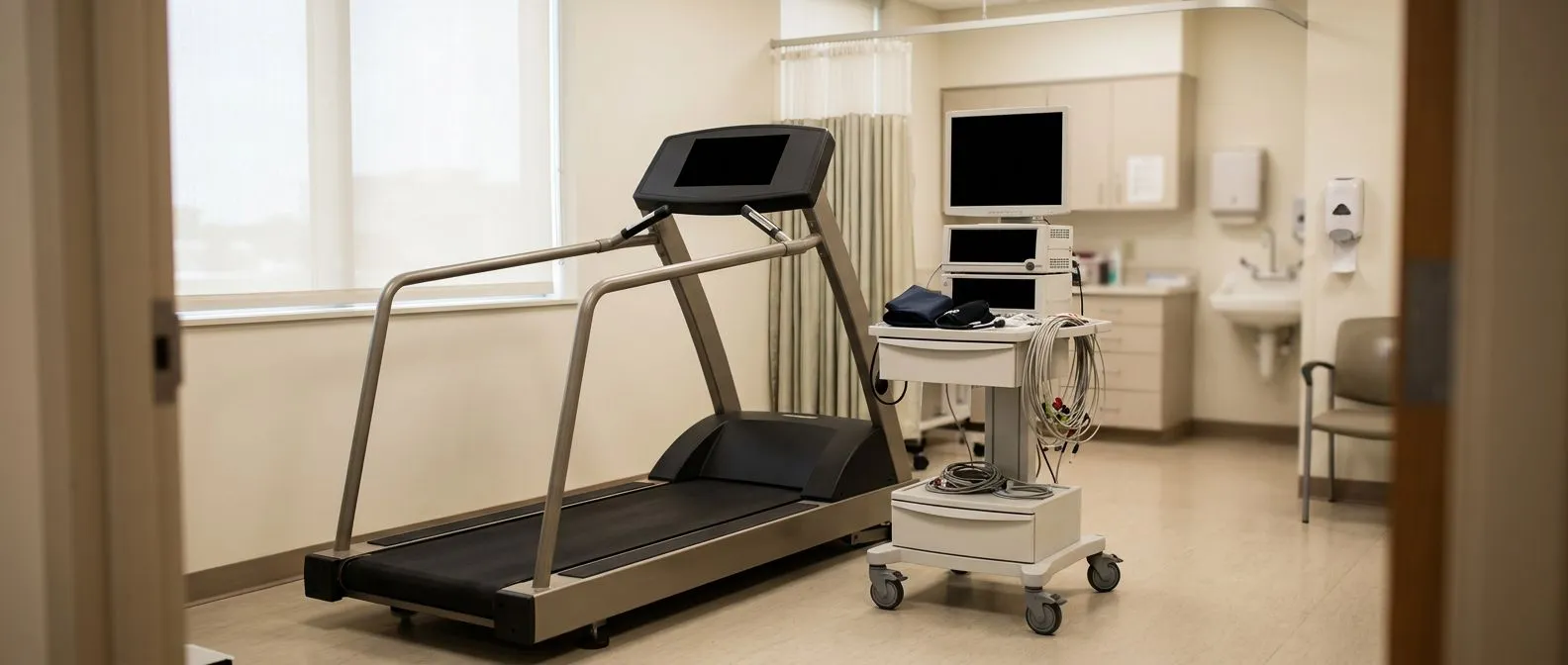
The treadmill test. The treadmill is the most widely used ergometer for cardiac screening, especially in North America and Latin America. Walking is natural for almost everyone, so no learning curve interferes with the result. A standard protocol (the Bruce protocol, named for cardiologist Robert Bruce) increases speed and slope every three minutes. Peak workload on a treadmill is generally higher than on a bicycle, which suits screening people who can walk comfortably.
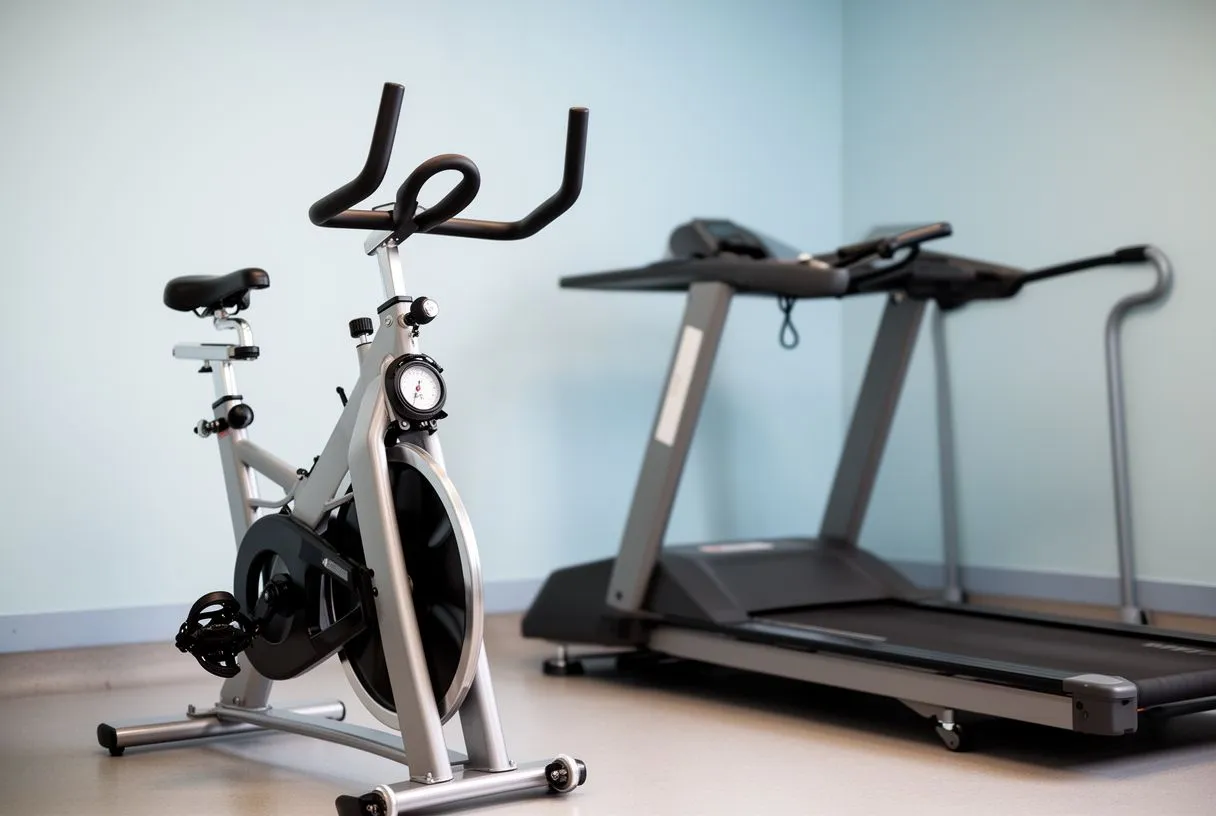
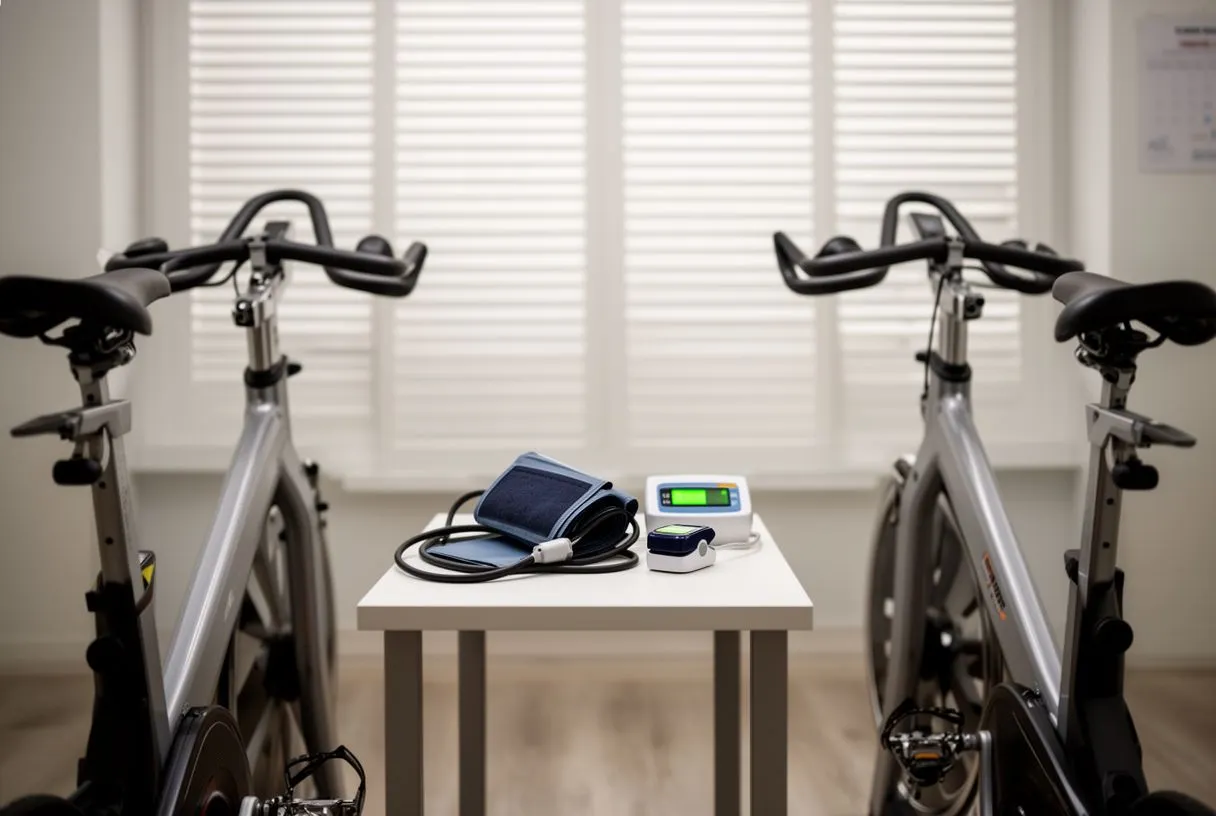
The bicycle ergometer. A cycle ergometer asks a different question: what is a bike ergometer? It is a stationary bicycle whose pedalling resistance is set in precisely measured watts, so the exact amount of work you perform is known at every second. Cycling keeps the upper body still, which produces a cleaner ECG recording, and it is easier for people with balance problems, obesity, or joint pain. In much of Europe and in cardiopulmonary exercise testing (CPET), the bicycle is the preferred machine.
Two types, one purpose. So what are two types of ergometers? In practice: the treadmill and the cycle — with arm ergometry (cranking with the arms) as a third option for patients who cannot use their legs. Choosing between them is a matter of your condition, mobility and the information sought, not of one being "better." Is cycling better than the gym for testing? For diagnostic ergometry, the bicycle's precise, reproducible workload is actually a scientific advantage; for a general walk-in stress screening, the treadmill remains the classic choice.
Why Do Doctors Order Exercise Ergometry?
Diagnosing the cause of symptoms. The most common reason is chest pain or breathlessness that a doctor suspects may come from the heart. An exercise stress test for chest pain can show whether the discomfort reproduces during effort and whether the ECG changes in the pattern typical of reduced blood flow (ischemia). A negative, well-sustained test is genuinely reassuring; a positive one directs further study, such as imaging or a coronary angiogram.
Assessing fitness and risk before operations. Non-cardiac surgery places real demands on the heart. An exercise test done beforehand helps the surgical team judge whether your heart can tolerate the planned procedure, or whether further cardiac evaluation should come first. The same logic applies to patients with known valve disease or coronary disease who are being considered for heart surgery: functional capacity is part of every serious decision.
Guiding treatment and rehabilitation. After a heart attack, a stent, or valve surgery, a structured exercise test sets the safe starting point for supervised exercise in cardiac rehabilitation. It is repeated over time to document progress, adjust medication, and confirm that the heart is coping. For people who feel limited by unexplained fatigue, the test also distinguishes cardiac limitation from deconditioning, anemia, or lung causes — the latter formally assessed with pulmonary function tests, which are sometimes ordered alongside.
In our practice, every exercise test is reviewed by the multidisciplinary team against international practice guidelines before we frame it as part of a recommendation, and we take the time in the consultation to explain in plain words what the tracing actually shows — and what it does not.
How Do I Prepare for an Ergometry Test?
Medications and your doctor's instructions. Some heart medicines — particularly beta-blockers, which slow the heart — may need to be paused before a diagnostic test, because they blunt the heart rate response the doctor wants to observe. Never stop any medication on your own; the ordering physician will tell you exactly which ones to hold and when. Bring a complete list of everything you take, including supplements.
Food, drink and clothing. Practical preparation matters more than most patients expect:
- Eat lightly: avoid a heavy meal for 2–4 hours before the test; a light snack is usually fine.
- Watch caffeine: skip coffee, strong tea and energy drinks on the day of the test, as caffeine can alter heart rhythm and rate.
- Dress for effort: comfortable walking shoes, loose clothing; women should ideally wear a top without an underwire, which can interfere with chest electrodes.
- Stay hydrated: drink water normally, but avoid strenuous exercise the day before so your effort reflects your true baseline.
What to tell the team beforehand. Mention any recent chest pain, dizziness, worsening breathlessness, or a change in your symptoms — the team may adjust the protocol. If you have diabetes, ask how to handle your medication and breakfast. If you use inhalers or have asthma, bring them. Honest answers here make the result more useful and the test safer.
What Happens During the Test?
Arrival and setup. Expect the whole visit to take 30–45 minutes, though the exercise portion itself is short. A technician cleans small patches of skin, applies ten sticky electrodes to your chest, and fits a blood-pressure cuff. If the test includes breathing analysis (a cardiopulmonary exercise test), you will breathe through a mouthpiece or mask connected to a gas analyzer — this is how VO2 max, your maximum oxygen uptake, is measured. How long does a cardiopulmonary exercise test take? Roughly 45–60 minutes from walk-in to walk-out, with about 10–15 minutes of actual effort and recovery.
During the effort. The exercise begins gently and becomes steadily harder. You should expect to feel warm, breathe harder, and reach genuine exertion — a meaningful test requires a meaningful effort. The team will ask you to rate how hard it feels (the Borg scale, from 6 to 20) and will keep talking with you to monitor symptoms. If you develop chest pain, severe breathlessness, dizziness, or leg exhaustion, say so immediately; the test stops right away.
Afterwards. You will rest while the electrodes are removed, drink some water, and usually be able to leave and resume normal activity the same day. If you have had no complications, there is no real recovery period — though a light schedule for the rest of the day is sensible, and someone should drive you home if you received any sedating medication (rare for this test).
What Do Exercise Stress Test Results Mean?
The three possible outcomes. A stress test is typically reported as normal (negative), abnormal (positive), or inconclusive. A normal result means you reached an adequate workload with no concerning ECG changes, a normal blood-pressure response, and no symptoms — a strong signal that significant flow-limiting coronary disease is unlikely. An abnormal result shows, for example, the characteristic ST-segment depression on the ECG, an inappropriate blood-pressure drop, chest pain during effort, or a heart rhythm disturbance.
What "positive" really means. A positive test does not by itself diagnose blocked arteries; no test is perfect. Roughly speaking, exercise ECG testing detects most but not all significant coronary narrowings, and some positive results are false alarms. That is why an abnormal test almost always leads to a next step — often a stress test with imaging (echocardiogram or nuclear perfusion scan) or a coronary angiogram, which shows the arteries directly. Ask your doctor to explain what the finding means for you specifically, and what the proposed next step would prove.
Capacity and recovery numbers. Beyond the ECG, your results include how long you exercised, the workload you reached in metabolic equivalents (METs), your peak heart rate and blood pressure, and how quickly your heart rate recovered. Exercise capacity is one of the most powerful predictors of long-term health in cardiology — higher measured capacity is consistently associated with better survival. Your doctor can use these numbers to tailor your exercise prescriptions and follow-up plan.
Are Exercise Ergometry Tests Safe?
Overall safety. Exercise ergometry is a routine, well-established procedure performed daily in cardiology units worldwide. Serious complications — heart attack or dangerous rhythm disturbances during testing — are rare, on the order of a few per ten thousand tests. The presence of a physician, continuous ECG monitoring, and a working defibrillator in the room make the test substantially safer than unsupervised exertion by someone with undiagnosed heart disease. A supervised exercise test is in fact often the safest way to find out how a heart behaves under load.
Rare events. The medical literature documents uncommon complications, including heart rhythm problems and even rare stress-induced cardiomyopathy. One published case report describes a mid-left ventricular ballooning variant of Takotsubo syndrome (a temporary stress-related weakening of the heart muscle) triggered by treadmill exercise stress testing (Case Reports in Cardiology). Such events are exceptional, but they are exactly why the test is done with a doctor watching, never as a self-administered workout.
Who needs extra caution. Certain situations change the risk-benefit balance: unstable chest pain at rest, a very recent heart attack, severe aortic stenosis, uncontrolled rhythm disturbances, or acute inflammation of the heart muscle (myocarditis). In these settings, doctors either postpone the test or choose an alternative. Before we ever order an exercise test, our team checks each patient's history against international guideline criteria, and if a safer study exists for that person's situation, that is the one we propose.
Is Ergometry Used for Athletes and Before Surgery?
Screening athletes. Competitive athletes train intensely, and intense training occasionally unmasks conditions that rest testing misses. An ergometry test for athletes documents peak performance (heart rate, blood pressure, VO2 max) and screens for exercise-induced rhythm disturbances or ECG changes suggesting a hidden cardiomyopathy. It is a standard part of pre-participation cardiac evaluation in many sports medicine programs.
The post-COVID question. Since the pandemic, exercise testing has taken on a new role: assessing athletes and active people returning to sport after COVID-19, when myocarditis (inflammation of the heart muscle) is a concern that rest examinations can miss. A dedicated review published in 2022 examines the utility of exercise testing — including ECG changes, heart-rate responses and capacity measurements — for assessing athletes for post-COVID-19 myocarditis (Reviews in Cardiovascular Medicine). The principle generalizes: when the heart has been inflamed or injured, effort must be evaluated under supervision before it is resumed freely.
Before major surgery. For patients facing heart surgery — valve repair or replacement, coronary bypass, or structural procedures — exercise ergometry contributes to the overall picture alongside imaging and surgical risk scores such as EuroSCORE II. Functional capacity shapes the choice between open, minimally invasive, robotic and transcatheter approaches, including TAVR (transcatheter aortic valve replacement), which is delivered through the arteries rather than through open chest surgery. When Dr Molina and our team review a surgical candidate, we look at the exercise test together with the anatomy and the patient's own goals, and we recommend the less invasive route only where the evidence genuinely supports it for that person.
When Should I Talk to a Cardiac Team About Exercise Ergometry?
Signs worth investigating. Consider seeking evaluation if you experience chest pain or pressure during activity, breathlessness that limits you more than your peers, fainting or near-fainting with exertion, a racing or irregular heartbeat during exercise, or a steady decline in how far you can walk without stopping. These symptoms deserve a proper explanation — not a guess, and not a lifetime of avoidance. Regular exercise heart rate monitoring at home cannot substitute for a supervised diagnostic test.
Getting the workup right. An exercise ergometry heart test is powerful, but it is one instrument in an orchestra. Depending on your case, the same team may arrange an echocardiogram (an ultrasound of the heart), imaging-based stress testing, bloodwork including liver function tests when medications need monitoring, and — where indicated — invasive studies. What matters is that the studies chosen answer the specific question about you, with none ordered out of habit. Our first contact is a free video consultation: we get to know you, talk through your condition, and tell you exactly which studies are still needed so that no unnecessary ones are ordered — and we welcome a second opinion as a normal part of any serious decision about heart surgery.
Making the decision yours. A test is only as valuable as the plan built on it. Insist that any result — reassuring or concerning — is explained in plain language, with the alternatives laid out and the reasoning visible. In our consultations we take the time to explain what each study actually shows, answer every question, and then present a clear proposal with its alternatives — the final decision always rests with the patient, where it belongs.
In summary: an exercise ergometry heart test is a safe, widely used, information-rich study that reveals how your heart performs under real demand. It clarifies symptoms, quantifies fitness, guides rehabilitation, supports decisions before surgery, and screens athletes — but it is a guide, not a verdict, and it works best inside a careful, multidisciplinary evaluation. If any of the symptoms described here sound familiar, discuss your own situation with a qualified cardiac team and book a consultation rather than self-diagnosing. Your heart deserves answers based on evidence, and a conversation is the best first step.