
Haller Index: Measuring Pectus Excavatum Severity
Haller index pectus excavatum explained: learn how doctors calculate severity, what numbers mean mild, moderate, or severe, and when surgery is needed.
Parents and adults who first hear about the Haller index for pectus excavatum usually do so after noticing a sunken chest — the child's own, or their own. This measurement turns something you can see into a number a doctor can use. In this guide, we explain what the Haller index means, how it is calculated, what counts as normal, and when the number actually changes what happens next. Our goal is that by the end, you can sit down with a cardiac team and understand every word of the conversation.
What Is the Haller Index for Pectus Excavatum?
The basic definition. The Haller index is a simple ratio used to measure how deep the chest is sunken in pectus excavatum, sometimes called "funnel chest." You take the width of the chest from one side to the other, divide it by the shortest distance from the breastbone to the spine, and the result is a single number. A deeper chest makes the bottom number smaller, so the index goes up as the deformity gets worse.
Why one number matters. Doctors need a way to compare severity between patients and over time — the Springer clinical literature treats the Haller index as the standard reference for exactly this purpose. Without it, decisions about whether to watch, exercise-monitor, or operate would rest on impression alone. The index also appears in the medical record in a way that insurance reviewers can check.
The measure was described in the 1980s and has been used ever since as the primary pectus excavatum severity scale. It does not tell the whole story — a person's heart and lung function can be affected even with a moderate number — but it is the starting point of almost every evaluation.
How to Measure the Haller Index: Step by Step
The imaging comes first. The Haller index calculation is done on a chest CT scan, or occasionally on a chest MRI. The patient lies still, usually on their back, while the scanner takes thin cross-sectional images of the chest. No contrast dye or needles are involved for this purpose, and the scan itself takes only a few minutes.
The radiologist picks the deepest slice. From the scan, the radiologist finds the single image where the sternum — the breastbone — dips closest to the spine. On that slice they measure the inner width of the rib cage and the distance from the back of the sternum to the front of the spine. Dividing the first number by the second gives the index.
A chest wall deformity measurement taken this way is reliable and repeatable, which is why it has outlasted other methods. In our consultations we always review the actual images with the patient, not just the number, because the same index can look very different in a wide adult chest and a narrow teenage one.
What Is a Normal Haller Index?
Normal ranges vary a little by age and sex. In most reference studies, a normal Haller index falls between roughly 2.0 and 2.5. Children tend to sit at the lower end, and some healthy adults measure slightly higher without any deformity at all. Values up to about 3.0 are generally considered within normal limits, though a radiologist takes body shape into account before calling anything normal.
What a borderline number means. An index between roughly 3.0 and 3.2 is often described as borderline or mild. Many people in this range have no symptoms and need nothing more than periodic observation. We see patients in Guadalajara, Querétaro and Hermosillo who arrive worried about a borderline scan, and our first job is to explain whether the number is actually abnormal for their chest.
- Below ~2.5: normal chest shape for most people
- ~3.0–3.2: borderline — usually watched, not treated
- Above ~3.2: abnormal, and severity rises with the number
Haller Index Mild, Moderate, Severe: What the Numbers Mean
How doctors sort the scale. A commonly used grading is: mild from about 3.2 to 3.5, moderate from about 3.5 to 3.9, and severe at 4.0 or above. A Haller index of 3.25, for example, lands right at the edge of mild — enough to confirm a real deformity, but not automatically a reason for surgery. These cutoffs are conventions, not laws; teams weigh symptoms alongside them.
Why severity grading is not the same as impact. Two patients with identical numbers can feel very differently. One may have no limitations at all; the other may feel short of breath on stairs or notice the heart working harder. That is why the pectus excavatum diagnosis criteria combine the index with exercise testing, lung function tests, and an echocardiogram — an ultrasound of the heart — before any recommendation is made.
It is also worth saying plainly: a severe number does not mean emergency care. Pectus excavatum rarely demands urgent surgery. The schedule is elective, which gives families time to think, get second opinions, and choose deliberately.
What Haller Index Requires Surgery?
The usual threshold. Most surgical teams consider repair when the Haller index is above about 3.25 to 3.5 and the patient has symptoms, or when the deformity is clearly progressing. The index alone almost never drives the decision. Cardiopulmonary testing — how the heart and lungs perform under exercise — carries as much weight as the scan, and studies correlating the Haller index with cardiopulmonary findings show the two do not always match.
When the index is high but symptoms are absent. Some patients with a deep chest feel fine and stay fine for decades. Others with moderate numbers develop fatigue, exercise intolerance, or pressure on the heart. In our practice, every case is reviewed by the multidisciplinary team against international practice guidelines before a recommendation is given, and the patient receives a clear proposal with the alternatives — the final decision is always theirs.
Surgery is also considered for cosmetic or psychological reasons when the patient themselves wants it, even with a moderate index. That conversation is legitimate, and a good team will treat it as such rather than dismissing it.
How to Check the Haller Index at Home and in Clinic
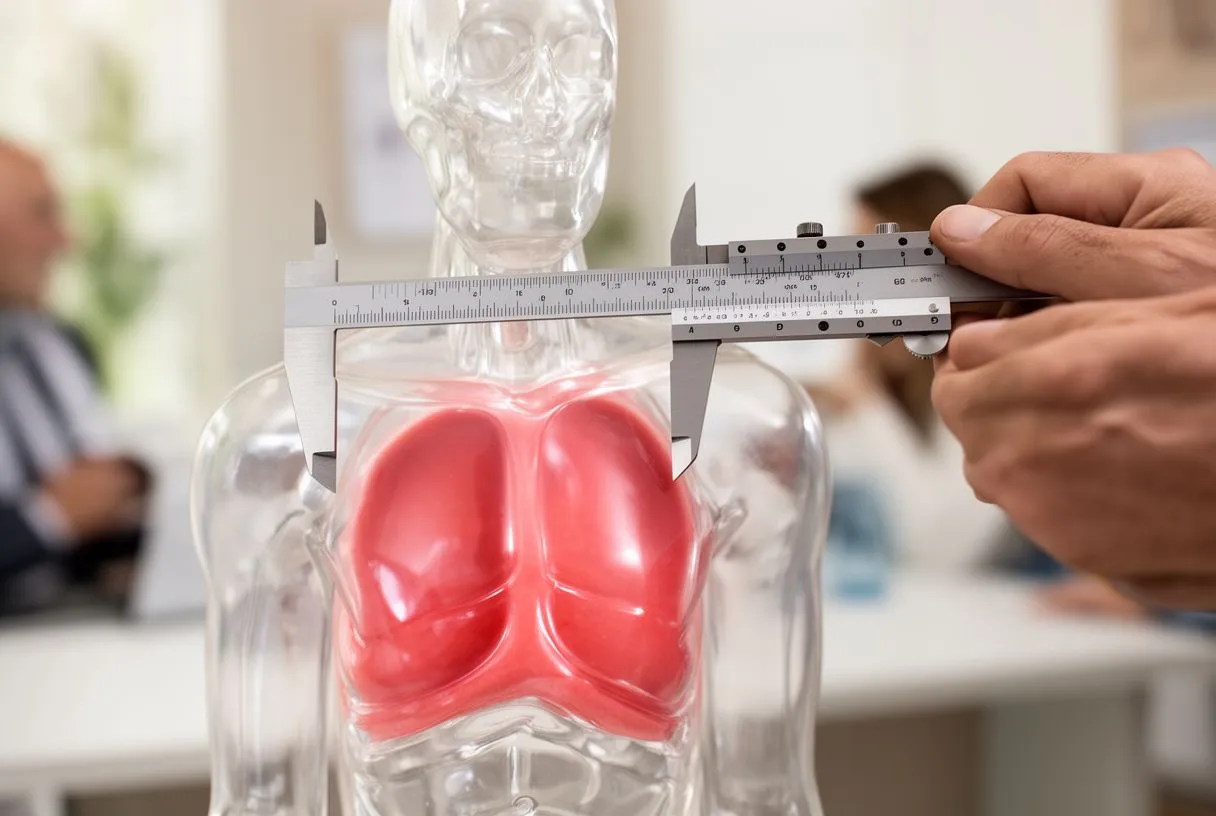
You cannot calculate it at home. The Haller index requires cross-sectional imaging, so any online "index calculator" that asks for tape-measure numbers is an approximation at best. What you can do at home is the simple deep-chest test: fill a cup with water, put it on your breastbone, and see how much it tilts or how deeply it sits. A cup that holds more than a certain amount of water against a deeply sunken chest suggests it is worth getting scanned.
What the clinic visit looks like. A proper evaluation starts with history and examination, moves to the CT scan, and then adds an echocardiogram and possibly a pulmonary function test or a stress test. In the consultation we take the time to explain what the studies actually show, in plain words, and to answer every question before any decision. Nobody should leave an appointment unsure what their own numbers mean.
For families in Mexico and abroad, the first step is simply a conversation. Our first contact is a free video consultation: we get to know the patient, talk through the condition, and say which studies are still needed so no unnecessary ones are ordered. A face-to-face visit at the consulting rooms follows only when the patient decides to go ahead.
Haller Index vs Pectus Index: Which Measurement Matters?
Two ratios, one question. The pectus index — also called the correction index — flips the Haller logic around: it measures how much of the chest depth is taken up by the depression, expressed as a percentage. The Haller index compares total width to depth; the pectus index estimates how much of that depth is the defect itself. Teams often report both.
Why some teams prefer one over the other. The Haller index can overestimate severity in patients with a naturally wide or flat chest, and it changes with age. The pectus index handles some of those cases better. Neither is "right"; they answer slightly different questions, and for pectus excavatum: understanding and treating "funnel chest" in the fullest sense, most teams use the Haller index as the primary figure and the pectus index as a supporting one.
When you receive a report, look for which index your team used and ask why. A team that can explain its own measurements is a team that has thought about your case.
What Happens if Pectus Excavatum Is Left Untreated?
The honest answer: often nothing dramatic. Many people with pectus excavatum live full lives without surgery. The deformity does not usually worsen sharply after growth stops, and untreated severe cases are not automatically fatal. What untreated deformity can do is shift the heart and limit lung expansion, which shows up as reduced exercise tolerance and, in some patients, palpitations or chest discomfort.
Heart and lung effects worth knowing. The sternum can press the heart toward the left side of the chest, and in a few severe cases the compression is significant enough to be addressed during other cardiac surgery — there are published case reports of pectus excavatum repair combined with aortic root replacement and valve procedures in the same operation. Aortic root replacement and valvuloplasty in a woman with severe pectus excavatum is one such example, and simultaneous pectus excavatum repair using sternal plate in a patient undergoing the Bentall procedure is another. These cases matter because they show that when the chest wall is severe enough to complicate heart surgery, the two problems can be solved together.
Our team's work covers valve disease, coronary disease, the aorta and structural heart conditions, and we occasionally see patients whose chest deformity intersects with their cardiac condition. When that happens, the plan is built jointly, not separately.
Pectus Excavatum Treatment Options and Minimally Invasive Surgery Candidacy
The main options. For patients who need repair, the two established operations are the Nuss procedure — a minimally invasive pectus surgery candidacy question in itself — which places one or more curved metal bars behind the sternum through small side incisions, and the Ravitch procedure, an open operation that reshapes the cartilage directly. The Nuss approach is usually preferred in younger patients with flexible cartilage; the Ravitch approach suits older patients or unusually complex anatomy.
What determines candidacy. Age, cartilage flexibility, the index, symptom burden, and whether the deformity is symmetric all matter. The Nuss procedure works best in adolescents and young adults; older patients with stiffer chest walls may do better with the Ravitch repair. In every case we recommend the less invasive route only where the evidence supports it for that patient — a principle we apply to every procedure we perform, from conventional to robotic and transcatheter work.
- Nuss: minimally invasive, bar placed behind the sternum, removed after 2–3 years
- Ravitch: open repair, cartilage reshaped directly, often chosen for older or asymmetric cases
- Observation: the right plan for many mild and some moderate deformities
Haller Index Insurance Coverage and When to Talk to a Cardiac Team
What insurers usually ask for. When a Haller index is used to support insurance coverage, reviewers typically want the CT report itself, documentation of symptoms, and results of cardiopulmonary testing. A high index with no supporting symptom documentation is a common reason for denial, so the full workup protects you. Keep copies of every study from the start.
The value of a second opinion. Because repair is elective, you have the luxury of time. We encourage second opinions and treat seeking one as a normal part of deciding about heart surgery — it is what a careful person does with a big decision. The Haller index is also useful here precisely because it is a number: a second team can review the same images and the same figure.
When to seek help. If you or your child has a visibly sunken chest, new shortness of breath on exertion, palpitations, or a scan result you do not understand, that is the moment to talk to a qualified team rather than waiting for the number to change. The Haller index for pectus excavatum is a measurement, not a verdict — what it means depends on the whole person, and only a proper consultation can put the two together.

To summarize: the Haller index is the width-to-depth ratio that turns a sunken chest into a number — normal below about 3.0, mild above 3.2, severe at 4.0 and beyond. It is measured on a chest CT, it guides but does not dictate the decision to operate, and it is most useful when read alongside symptoms and heart-lung testing. If you are looking at your own Haller index for pectus excavatum and wondering what to do next, the next step is not another internet search. It is a conversation with a cardiac team that will explain the images, lay out every option, and respect your decision — and we would be glad to start that conversation with a free video consultation whenever you are ready.