

Prohibitive Surgical Risk: When TAVR Is the Option
Prohibitive risk TAVR gives high-risk patients a minimally invasive aortic valve replacement option when open-heart surgery is too dangerous.
When a doctor says your aortic valve needs replacing but open-heart surgery is too dangerous for you, the words can feel frightening and confusing. This is what cardiologists call prohibitive risk TAVR territory — a situation where conventional surgery would likely cause more harm than the valve disease itself. This guide explains what the term actually means, how transcatheter aortic valve replacement (TAVR) offers an alternative, who qualifies, and what recovery really looks like. Our goal is to give you clear, calm information so you can discuss your own case with confidence.
What Does Prohibitive Risk Mean in Heart Surgery?
Prohibitive risk is a clinical label, not a verdict. It means that a predicted Surgical Risk — the chance of death or serious complication from open-heart surgery — is so high that the operation itself would endanger the patient more than the disease would. Doctors use scoring systems and expert judgement to reach this conclusion. It is not a guess made on the spot.
What are considered high risk surgeries? Open-heart procedures that require stopping the heart, using a heart-lung machine, and opening the chest carry the highest baseline danger. For a patient with severe aortic stenosis — a stiff, narrowed aortic valve that restricts blood flow out of the heart — conventional valve replacement is one of these operations. Age, previous chest surgery, lung disease, kidney failure, and profound weakness all push the predicted risk upward.
What would disqualify you from surgery? Common reasons include very poor heart function, severe lung disease that makes ventilation after surgery unsafe, frailty that prevents healing, chest radiation scarring, or a hostile chest from prior operations. In practice, the heart team weighs every one of these together. Every case is reviewed by our multidisciplinary team against international practice guidelines before a recommendation is given, and the patient receives a clear proposal with the alternatives.
What Is TAVR and How Does It Work?
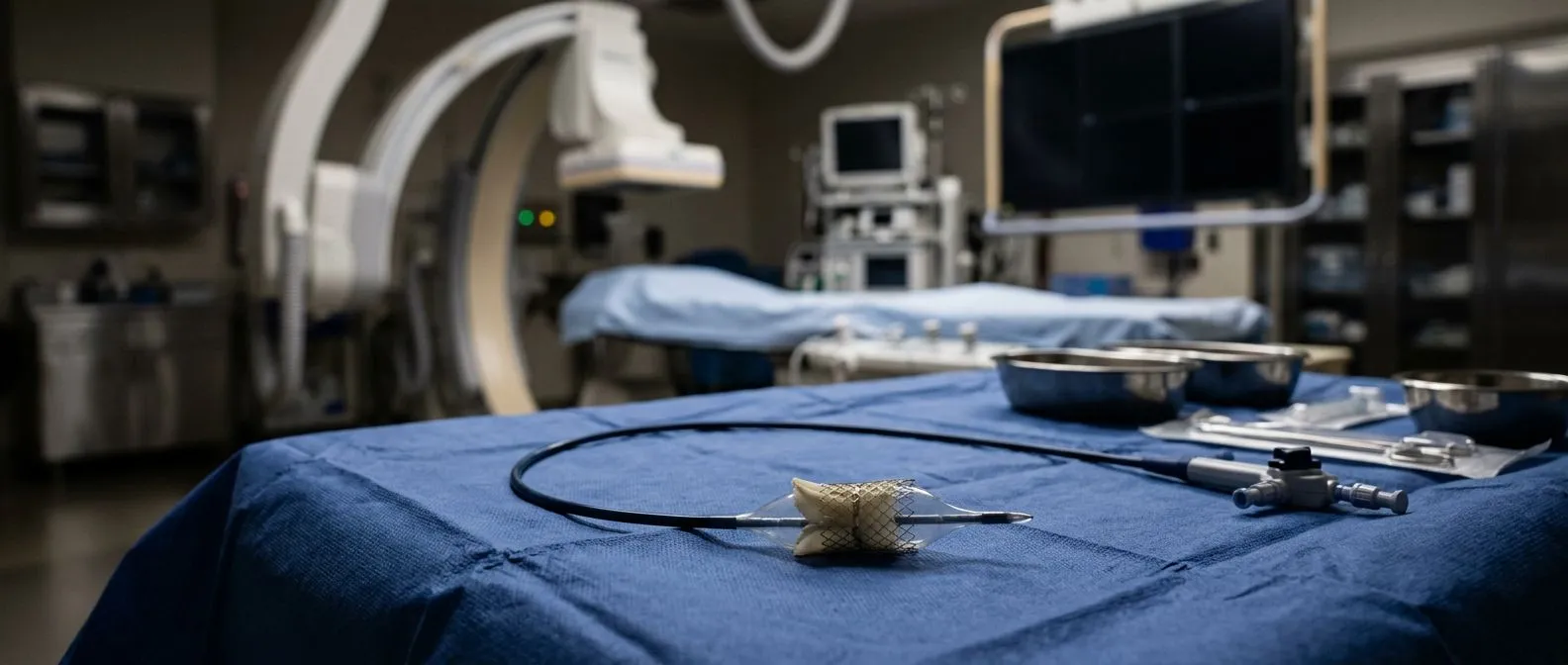
TAVR stands for transcatheter aortic valve replacement. Instead of opening the chest, a new valve made of tissue inside a metal frame is delivered through a thin tube called a catheter. The most common route is through the femoral artery in the groin, so the whole procedure happens through a small puncture rather than a large incision.
How does a catheter heart valve replacement work? The new valve is compressed onto the catheter, guided up the aorta to the position of the old valve, and then expanded. The new valve pushes the diseased leaflets aside and immediately begins working. The heart often keeps beating throughout, and in many cases general anaesthesia can be kept light.
The procedure has evolved enormously since it was first introduced for inoperable patients. A meta-analysis published in Scientific Reports documented how outcomes and complications improved steadily as the technique matured, supporting its expanded use (Scientific Reports). Today it is a standard option for people who cannot undergo conventional surgery.
Who Qualifies for TAVR Instead of Surgery?
The question of TAVR candidacy prohibitive risk status is answered by a heart team, not by one doctor. Eligibility depends on the valve problem itself, the patient's overall health, and the anatomy of the arteries that the catheter must travel through.
- Severe, symptomatic aortic stenosis: the valve must be narrow enough to justify replacement, usually with symptoms such as breathlessness, chest pain, fainting, or fatigue.
- High or prohibitive surgical risk: predicted operative mortality and complication rates must exceed what guidelines accept for open surgery.
- Suitable access: the arteries must allow the catheter to reach the heart, though alternative routes through the chest or arm exist.
TAVR eligibility criteria for elderly patients were the original foundation of the procedure. Age alone is not a disqualifier or an automatic qualifier — an active 82-year-old may tolerate surgery well, while a frail 70-year-old may not. Frailty, walking ability, muscle mass, and cognition all matter as much as the calendar. In our consultation we take the time to explain what the studies actually show, in plain words, and to answer every question before any decision.

Transcatheter Aortic Valve Replacement Risk Assessment: How Teams Decide
Transcatheter aortic valve replacement risk assessment combines several tools. The best known is EuroSCORE II, a calculator that estimates the risk of death from open-heart surgery using factors like age, lung function, kidney function, and prior operations. Other measures capture frailty, mobility, and the specific anatomy of the valve and vessels.
What does perioperative risk mean? It refers to the danger surrounding the operation itself — the days and weeks during and just after the procedure. This is different from long-term prognosis. A patient can have high perioperative risk but an excellent outlook once the valve is replaced, which is precisely the situation where TAVR shines.
Risk Stratification is the formal process of sorting patients into low, intermediate, high, and prohibitive categories. Our team reviews each patient's studies against these categories together, so the recommendation reflects the whole picture rather than one test result. The categories matter because they determine which treatment guidelines support for that person.
TAVR vs Open Heart Surgery in High-Risk Patients
For intermediate-risk patients, landmark research found that TAVR was at least comparable to surgery, reshaping how doctors think about The New England Journal of Medicine trial results in this field. For high- and prohibitive-risk patients, TAVR has long been the guideline-supported option because surgery itself poses the dominant danger.
TAVR vs open heart surgery high risk differences come down to invasion. Open surgery requires sternotomy — dividing the breastbone — a heart-lung machine, and days of intensive recovery. TAVR usually requires only a groin puncture. The trade-offs exist: surgery allows direct inspection of the valve and removal of the diseased one, while TAVR places the new valve inside it. Both approaches have a role, which is why the decision belongs to a team.
Best heart valve option high risk patients should expect is a recommendation tailored to anatomy and health, not a one-size-fits-all answer. We perform conventional, minimally invasive, robotic and transcatheter procedures, and we recommend the less invasive route only where the evidence supports it for that patient. That breadth matters, because a team offering only one technique has only one answer.
TAVR for Elderly and Frail Patients
TAVR for elderly patients has become one of the most common cardiac interventions worldwide, and for good reason. Age increases the danger of open surgery disproportionately, because older hearts and bodies recover less easily from sternotomy and cardiopulmonary bypass.
TAVR procedure for frail patients deserves special mention. Frailty is not the same as age — it describes reduced physiological reserve: weak grip, slow walking, unintentional weight loss. A frail patient may not survive the stress of major surgery but often tolerates a catheter-based procedure well. Studies of TAVR in high-risk groups show meaningful improvement in symptoms and functional status after the procedure, which is the outcome that matters most to patients and families.
Families often ask whether an elderly parent is "too old" for treatment. The honest answer is that frailty and overall condition matter more than birth year. A careful assessment — including walking tests, nutrition, and cognition — tells the team far more than age alone.
TAVR Benefits for High-Risk Patients
The benefits of TAVR for patients at prohibitive risk flow directly from what the procedure avoids. No chest is opened, the heart is not deliberately stopped in most cases, and the heart-lung machine is usually unnecessary. For someone whose lungs, kidneys, or previous surgeries make those steps dangerous, avoidance is the whole benefit.
Symptom relief is the benefit patients feel first. Severe aortic stenosis causes breathlessness, chest tightness, dizziness, and profound fatigue. Once the valve is replaced, blood flows properly again, and most patients notice improvement in daily activities within weeks. For patients once labelled inoperable aortic stenosis TAVR candidates, this change can be transformative.
Shorter hospital stay follows naturally. Because the body has not undergone major trauma, patients typically go home in a matter of days rather than weeks of rehabilitation. This also reduces exposure to hospital-acquired infections, a real concern for elderly patients.
What Are the Risks of TAVR?
An honest discussion requires naming the risks. TAVR is safer for high-risk patients than open surgery, but it is not risk-free, and "TAVR success rate high risk patients" searches deserve a straight answer rather than reassurance without evidence.
Bleeding Risk at the groin puncture site is the most common complication, though usually manageable with local repair. Thrombotic Risk — clot formation on the new valve — is uncommon but real, which is why blood thinners are prescribed after the procedure. Other recognised risks include the need for a pacemaker if the heart's electrical conduction is disturbed during valve placement, stroke, and valve leakage around the new device.
What are the potential risks associated with heart valve replacement surgery generally? Both surgical and transcatheter replacement carry risks of infection, arrhythmia, and valve dysfunction over time. We discuss these possibilities candidly with every patient, because an informed decision is the only decision we consider a real one. The final decision is always the patient's.
TAVR Recovery vs Surgery Recovery
TAVR recovery vs surgery recovery differs in almost every measurable way. After open-heart surgery, the breastbone needs six to eight weeks to heal, driving restrictions on lifting, driving, and returning to normal life. After TAVR, most patients walk within a day and resume light activities within a week or two.
The first days involve monitoring the puncture site, heart rhythm, and kidney function. A pacemaker check is standard, because some patients develop conduction changes that need temporary or permanent support. Most people are surprised by how quickly they are on their feet.
The first months involve follow-up echocardiograms — ultrasound scans of the heart — to confirm the new valve is working well, plus medication adjustments. Follow-up through these checkpoints usually involves reviewing each scan and adjusting medications as the recovery settles. Cardiac rehabilitation, where available, accelerates the return of strength and confidence.
Choosing a Heart Surgeon TAVR Consultation in Mexico
For patients in Guadalajara, Querétaro, Hermosillo, or travelling from abroad, a heart surgeon TAVR consultation should begin with questions, not paperwork. Ask whether the team performs both surgical and transcatheter procedures. Ask how risk was assessed and what the alternatives are. A team confident in its reasoning welcomes these questions.
What a first consultation should include:
- A plain-language explanation of what your echocardiogram and other studies actually show, not just their names.
- A clear recommendation with alternatives, including whether TAVR, surgery, or medical treatment fits your anatomy and health.
- Practical guidance on which additional studies are genuinely needed, so you are not ordered tests you already have.
TAVR cost Guadalajara and logistics are legitimate concerns for international patients. Costs vary with the valve device chosen, hospital stay length, and pre-procedure studies, so ask for a written estimate covering the full episode of care, including follow-up. The first contact is a free video consultation: we get to know the patient, talk through the condition, and say which studies are still needed so no unnecessary ones are ordered. A face-to-face visit at one of our consulting rooms follows when you decide to go ahead.
Aortic stenosis at prohibitive surgical risk is no longer a dead end. Aortic valve replacement without open surgery is an established, guideline-supported option, and the heart team that treats both surgically and transcatheter can recommend the route that truly fits you. If you or a loved one has been told surgery is too dangerous, do not stop there — seek a second opinion from a qualified cardiac team and book a consultation to discuss your specific situation.






