TAVR vs aortic valve surgery: how to choose
TAVR vs aortic valve surgery — learn what tips the balance, mistakes to avoid, and key questions to ask your surgeon.
The honest version of the conversation — what tips the balance, the common mistakes, and the hard questions you should ask. Weighing TAVR vs aortic valve surgery starts here.
TAVR or aortic valve surgery: how to choose. The honest version of the conversation, including the mistakes patients make and the hard questions you should ask your surgeon.
When I see a patient with aortic stenosis in clinic, almost always the same question comes up: "Doctor, which is better — the catheter procedure or the surgery?"
And my answer always begins the same way: "It depends — let us look at your heart together."
Choosing between TAVR and surgery is not a prescription. It is a personalised decision, based on anatomy, age, expectations and what we want to achieve in the long term.
First: understanding the aortic valve
The aortic valve is like a door that opens every time the heart beats to let blood out to the body.
Over the years — or because of congenital conditions — that door can harden and fill with calcium. Then the following happens:
- The valve opens less
- The heart has to push harder
- The muscle thickens
- Symptoms appear
When this progresses, we speak of severe aortic stenosis, a serious condition needing treatment.

What do patients feel?
Many tell me things like: "I get tired climbing stairs." "I'm short of breath." "I feel weak." "I had a fainting episode."
These symptoms are important signals — because once they appear, the disease can advance rapidly if we do not intervene.
TAVR vs aortic valve surgery: the two ways of treating it today
1. TAVR — replacement by catheter
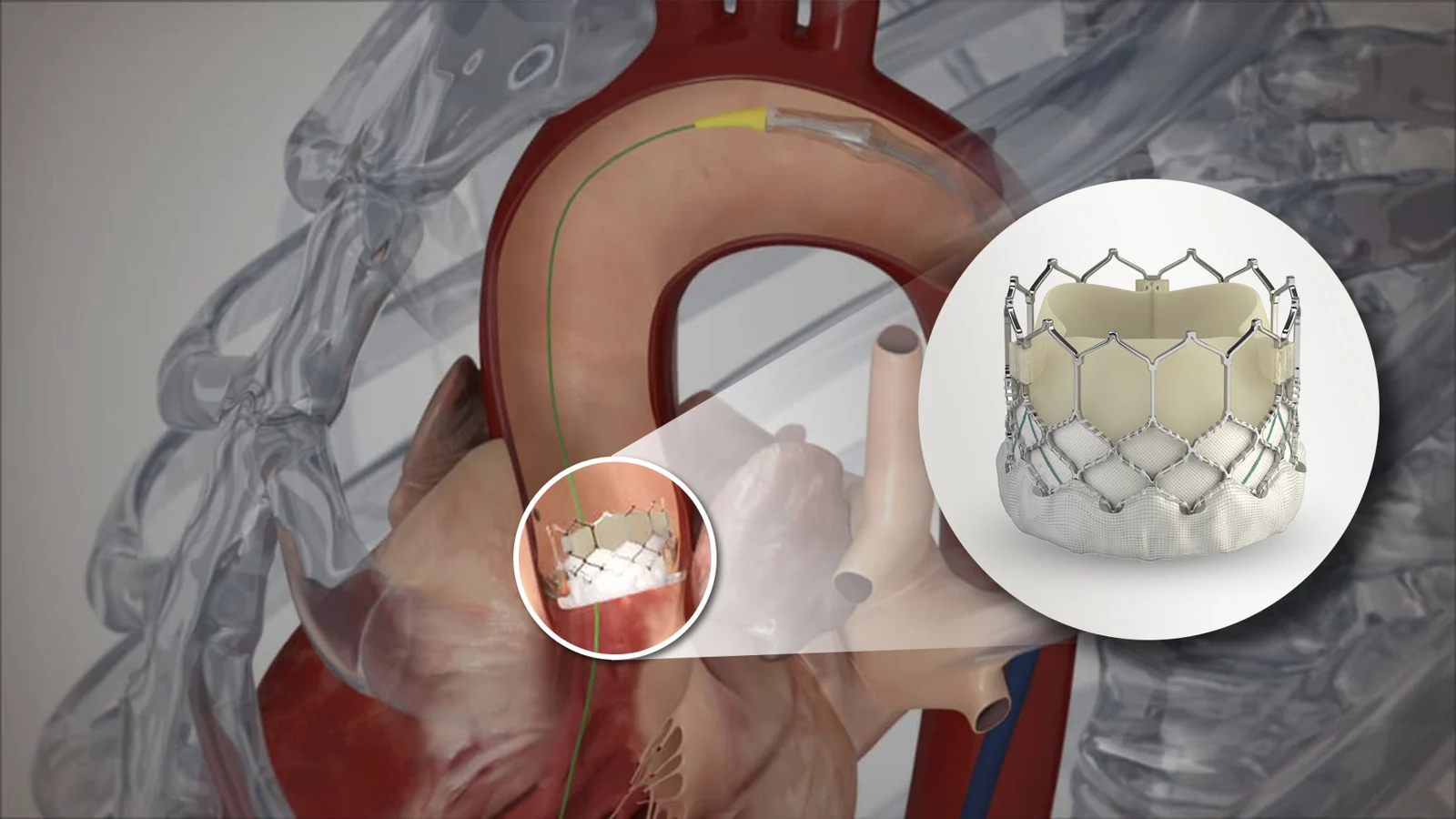
A new valve is placed through a catheter, generally from the groin in 90% of cases. The heart keeps beating — it is not stopped. The procedure usually takes about an hour. Many patients walk the following day. We cover it fully in our TAVR guide.
2. Surgery (SAVR)
The valve is replaced directly through cardiac surgery. The conventional approach is open-heart surgery, but more modern techniques let us operate through a minimally invasive approach, with a small incision of approximately 5 cm at the side of the chest, which brings several advantages over conventional surgery.
Surgery allows us to:
- Remove the calcium completely
- Repair the aorta
- Carry out other interventions in the same procedure, such as a coronary bypass if needed
- Choose the valve with a long-term strategy in mind
What the international guidelines say, in plain language
- Older patients (over 70–75) → TAVR is usually an excellent option
- Younger patients (under 65) → surgery is usually preferred
- Between 65 and 80 → a personalised decision
But most important of all: the decision should be taken by a Heart Team together with the patient. Always.
Thinking about a whole life, not just a procedure
This is probably the most important part of the conversation. We do not only ask "what do we do now?" We ask:
- What will happen in 10 years?
- Will there be another intervention? What kind?
- Will a valve-in-valve be possible?
- How does this valve age?
- What is new, or coming?
This changes the strategy completely.
The real advantages and disadvantages
TAVR — the good
- Less invasive
- Rapid recovery
- Ideal in older or frail patients
- Less initial pain
TAVR — what we must consider
- Greater likelihood of needing a pacemaker — this is not a small matter
- Durability in younger patients still under study
- Possible leak around the valve, which has a real impact on durability and life expectancy
Surgery — the good
- Proven durability, with years and years of hard data behind it
- The better option in complex anatomy
- Allows several problems to be treated at once
- A more solid strategy in younger patients
- The diseased valve — your own valve — is removed completely, along with all the calcium
Surgery — what it involves
- A longer recovery, although minimally invasive techniques reduce that considerably
- A major procedure compared with TAVR
Types of valve
In surgery: biological (no permanent anticoagulation) or mechanical (very durable, requiring oral anticoagulation).
In TAVR, the main platforms are Sapien, Evolut, Navitor, Acurate and MyVal. Each is chosen according to the patient's anatomy, age, specific characteristics, and the experience of the centre and the surgeon.
The factors that really tip the balance
- Age
- Frailty
- Anatomy on CT — from the neck to the groin
- Bicuspid valve (a malformation present from birth)
- Coronary disease
- Size of the aorta
- Personal preferences
There are no automatic decisions here.
The most important concept: shared decision
I always tell my patients: "My job is not to decide for you — it is to help you decide."
We talk about risks, benefits, expectations and quality of life. And we take the decision together.
Warning signs — do not wait
Seek advice if you have progressive breathlessness, fainting, chest pain or marked tiredness.
My personal reflection as a surgeon
In recent years we have seen an extraordinary transformation in the treatment of the aortic valve. Today we can offer personalised solutions that did not exist 20 years ago.
But something has not changed: every patient is unique, and every decision deserves time and conversation.
Choosing between TAVR and surgery is not choosing the easiest thing — it is choosing the right thing for your life.
Common mistakes when choosing between TAVR and surgery
An important part of my work in clinic is correcting ideas that circulate on the internet or are heard from acquaintances. Not because anyone is wrong — but because every case is different.
Mistake 1 — "Least invasive is always best"
Many patients arrive thinking TAVR is automatically the best option because it does not require open surgery.
The reality: least invasive is not always the most appropriate in the long term. In younger patients or those with complex anatomy, surgery can offer better durable results and fewer reinterventions.
Mistake 2 — Not thinking about the lifetime strategy
A key question I always ask is: "What do we want to happen over the next 15 to 20 years?"
Choosing a valve today affects future options: valve-in-valve, reoperations, durability, accumulated risk. Deciding without considering this is a common error.
Mistake 3 — Not assessing the anatomy properly
Critical factors that change the decision: bicuspid valve, severe calcification, a small annulus, a dilated aorta. Sometimes the anatomy decides for us.
Mistake 4 — Choosing on chronological age alone
Age matters — but it is not everything. Lung function, functional status and real life expectancy also matter. I have seen patients of 75 who were excellent candidates for surgery, and younger patients for whom TAVR was better.
Mistake 5 — Underestimating the centre's experience
Results depend heavily on volume, the Heart Team and experience in both techniques. Choosing a centre that offers only one option can bias the recommendation.
Mistake 6 — Not involving the patient in the decision
Modern medicine is shared. Personal preferences matter: avoiding anticoagulation, recovery time, life plans, tolerance of risk.
The hard questions you should ask your surgeon or cardiologist
There is something I always tell my patients: "You have every right — and the responsibility — to ask difficult questions."
Choosing between TAVR and surgery is not only choosing a procedure. It is choosing a team, an experience and a strategy that will affect your health for years. And yes — not every centre and not every operator has the same experience.
Where did you train in TAVR or in valve surgery?
Training matters — a great deal. Centres with high volume and structured training usually have refined protocols, better patient selection, expert management of complications and more consistent results.
Ask: did you train in a formal programme? Do you have experience at international or high-volume centres? How long have you been performing these procedures?
This is not an awkward question — it is a responsible one.
What experience does your centre have?
The evidence is very clear: results improve at centres with greater volume and solid multidisciplinary teams.
A mature programme usually offers a real Heart Team — not just on paper — advanced imaging, complex surgery available if needed, and experience with complications.
Useful questions: how many cases do you perform a year? What are your results? What happens if a complication arises?
Do you perform both TAVR and surgery?
This is a fundamental question. Why? Because when a team masters both options, the recommendation tends to be more balanced and centred on the patient — not on the technique available.
Ideally the team should be able to offer TAVR, conventional surgery, minimally invasive surgery and hybrid strategies. This reduces bias and allows a genuinely personalised decision.
Do you perform minimally invasive or advanced techniques?
Surgery is not one single thing. Today there are options such as mini-sternotomy, less invasive approaches, advanced preservation techniques, and strategies that make future reinterventions easier.
Where did you train for minimally invasive or advanced techniques?
The learning curve is real. Complex procedures require specific training, mentorship and sustained volume. A surgeon who has dedicated time to training in recognised programmes usually offers a lower complication rate, a more predictable recovery and better long-term planning.
What is your lifetime strategy for my case?
This is probably the most important question. Because the aim is not only to resolve the problem today — but to plan the future: what happens if the valve fails? Will a valve-in-valve be possible? Will reoperation be needed? How does my age affect this?
Why these questions matter
In structural cardiology and valve surgery, small details make large differences: the choice of valve size, the management of calcium, the planning on CT, the reintervention strategy, clinical judgement in complex situations.
This is not learned from books alone — it is acquired with experience. And that experience influences safety, results, recovery, quality of life and future options directly.
Trust is not based on avoiding questions. It is based on answering them transparently. A good team does not merely accept these questions — it welcomes them, because they mean the patient is involved in their own care.
Heart valve replacement options at a glance: TAVR procedure vs surgery
Patients often ask for a simple summary. Here is how we sketch TAVR vs aortic valve surgery on paper in clinic. It is a starting point, not a verdict.
- How the valve gets in: TAVR through a catheter, usually from the groin. Surgery through the chest, either a full sternotomy or a small incision.
- The heart during the procedure: with TAVR it keeps beating. With surgery we use the heart-lung machine and stop the heart while we work on the valve.
- The old valve: TAVR pushes it aside. Surgery removes it, with the calcium.
- Hospital stay: usually shorter with TAVR.
- Long-term data: much longer follow-up exists for surgical valves.
In the TAVR vs aortic valve surgery debate, none of these points decides on its own. They are weighed together with your anatomy and your plans.
SAVR surgery recovery compared with TAVR
Recovery is one of the things patients worry about most when weighing TAVR vs aortic valve surgery. It is worth knowing what to expect.
After TAVR, most patients stay in hospital for one to a few days. Many return to light daily activities within a week or two.
SAVR surgery recovery takes longer. The hospital stay is usually around a week, sometimes more. After a full sternotomy the breastbone needs about six to eight weeks to heal, so heavy lifting and driving wait. With a minimally invasive approach, many patients recover faster. Most people feel close to normal within two to three months. Cardiac rehabilitation helps in both cases.
Your surgeon will set your individual plan. A slower start is not a reason to rule surgery out. When we compare TAVR vs aortic valve surgery, a few extra weeks of recovery can be worth a more durable result in a younger patient.
If you or a relative has been diagnosed with aortic stenosis
Remember that you are not alone. You should lean on the group of doctors who have earned your trust. A cardiac intervention has the potential to change your life and your family's. It is fundamental that decisions are well informed, based on mutual respect and trust.
There are no universal or magic solutions — only solutions fitted to your particular case.

About the author
Dr Alejandro Molina is a cardiovascular surgeon practising in Guadalajara, Querétaro and Hermosillo. He trained in cardiothoracic surgery at the Universidad de Guadalajara, completed advanced training in cardiac surgery, minimally invasive surgery, robotic surgery and structural interventions at the University of Montreal, and a fellowship in structural cardiology and TAVR at CHU Bordeaux, France. He performed the first robotic mitral valve repair in the Ángeles Health System and the first robotic heart surgery in Guadalajara.
Medical degree: Universidad Autónoma de Guadalajara, Cédula Profesional 5757260 · Cardiothoracic surgery: Universidad de Guadalajara, Cédula de Especialidad 10768871 · Current certification, Consejo Nacional de Cirugía del Tórax, no. 447
Talk to a specialist
Request a free video consultation to clear up your questions and make a better-informed decision.