
Staying in the Therapeutic Range on Warfarin
Therapeutic range warfarin guidance from Guadalajara heart specialists.
If you or a family member has been prescribed warfarin after a heart valve procedure or for atrial fibrillation, you have probably heard the phrase "staying in the therapeutic range on warfarin" and wondered what it really means. In plain terms, it means keeping the blood-thinning effect of the medication inside a window where clots are prevented but bleeding is not provoked. This guide walks through what the therapeutic range is, how your INR (international normalized ratio) is measured, what affects it day to day, and how patients in our consulting rooms in Guadalajara, Querétaro and Hermosillo manage it with confidence.
What Does Therapeutic Range Mean in Pharmacology?
What "therapeutic" actually means in medicine. When doctors say a treatment is "therapeutic," they mean the dose produces the intended benefit without causing harm. Every drug has a concentration range in the blood where it works best. Below that range, the drug may be too weak to do its job. Above it, side effects and toxicity become likely. That band in between is the therapeutic range.
Why some drugs have a narrow window. Medications vary enormously in how forgiving they are. An antibiotic like amoxicillin has a wide margin: small variations in dose rarely matter. Other drugs have what pharmacologists call a narrow therapeutic index, meaning the distance between "works" and "harms" is small. Warfarin is one of the classic examples, and the Centers for Disease Control and Prevention identifies anticoagulants among the medication classes most often involved in adverse drug events, which is precisely why structured monitoring exists.
The clinical term behind your lab slip. The formal practice of measuring drug levels and adjusting doses to stay inside this window is called therapeutic drug monitoring. For warfarin, the measurement used is not the drug itself but its effect on clotting, expressed as the INR. In our practice, every case involving long-term anticoagulation is reviewed against international practice guidelines before we recommend a target, so the patient receives a clear proposal rather than a guess.
What Is the Warfarin Therapeutic Window?
The biology in one paragraph. Warfarin does not thin the blood directly. It blocks vitamin K–dependent clotting factors (proteins the liver makes with vitamin K) that your body needs to form clots. This action is delayed: the effect of a dose taken today mostly appears two to four days later. That delay is one reason the drug demands patience and steady habits rather than reactive dose changes.
Why the window is narrow. On one side sits the risk you are treating: stroke from atrial fibrillation or valve thrombosis after a mechanical valve replacement. On the other side sits bleeding, which is the main complication of any anticoagulant. The warfarin therapeutic window exists because both risks rise as the dose climbs. The goal of management is not "as thin as possible" but precisely enough thinning for your specific condition.
Individual variation is the rule. Two patients of the same age and weight can need very different doses to reach the same INR. Genetics, liver function, other medications, and diet all play a role. This is why no one can tell you your warfarin dose over the phone without seeing your INR history, and why a second opinion is always welcome when a plan feels unclear.
What Is Your INR Target Range on Warfarin?
The INR explained simply. INR stands for international normalized ratio. It is a standardized way to report how long your blood takes to clot compared with someone not on warfarin. An INR of 1.0 is normal. An INR of 2.0 means your blood takes roughly twice as long to clot.
The common targets. For most indications, the safe INR range on warfarin sits between 2.0 and 3.0. Some situations call for a higher target of 2.5 to 3.5, most notably older-generation mechanical heart valves, particularly in the mitral position. Your cardiac team sets the target based on what is being treated, the device or valve you have, and your bleeding risk.
Why you should know your own number. Patients who can state "my target INR is 2.0 to 3.0" and track their own results consistently do better over the years of therapy. We take time in consultation to explain exactly what each patient's studies show, in plain words, so the target is never a mystery handed down on a lab printout.
How Warfarin Blood Level Monitoring Works
The testing rhythm. Warfarin blood level monitoring follows a predictable rhythm. When therapy begins, INR is checked every few days until two or three consecutive results are stable in range. After that, checks stretch to every two weeks, then every four weeks for stable patients. Some long-term stable patients test as infrequently as every six to eight weeks under a structured anticoagulation program.
Who does the adjusting. In many countries, dedicated anticoagulation clinics run this process: you call in a result, a nurse or pharmacist applies a protocol, and your dose is adjusted. Research on structured pharmacist-led programs, including a published study on pharmacist involvement in medication adherence and clinical outcomes, shows that close professional follow-up measurably improves how well patients stay on therapy. The lesson applies to warfarin as much as to any other medication: consistency of follow-up, not heroic effort, is what keeps you in range.
What a dose adjustment looks like. Adjustments are small, often 5 to 10 percent of the weekly dose. Because of the drug's delay, a change today is judged by an INR drawn several days later, not tomorrow. Patients who log their doses and INR results in a simple notebook or phone note often find that patterns become visible to both patient and physician, which can help them reach stable dosing.
How to Maintain Therapeutic INR After Heart Surgery
The early weeks are the busiest. Right after cardiac surgery, staying in the therapeutic range on warfarin is a daily project. The body is healing, other medications come and go, and appetite shifts, all of which move the INR. Expect frequent testing during this bridge period before the dose settles.
Set up a routine. The habits that make warfarin anticoagulation manageable are unglamorous but effective:
- Same time every day: take your dose at an identical hour, and never double up if you miss one; note it and inform your team.
- Keep a log: record each dose, each INR, and any new medication or supplement so trends are visible.
- Report new medicines immediately: even short courses of antibiotics can swing the INR sharply.
- Know your target range: carry it with you, and ask for it in writing at every appointment.
Recovery and medication go hand in hand. For patients recovering from valve surgery, the anticoagulation plan is as important to the outcome as the operation itself. Our team reviews every postoperative case against international guidelines and explains the monitoring plan before discharge, because a patient who understands the plan is a patient who can follow it.
Which Drugs Have a Narrow Therapeutic Index?
Warfarin's famous company. Patients often ask whether warfarin is unusual in requiring monitoring. It is not alone. Common drugs with a narrow therapeutic index include warfarin, digoxin (a heart-rhythm and heart-failure drug), lithium (used in psychiatry), phenytoin and other anti-seizure medications, and certain immunosuppressants like tacrolimus and cyclosporine. All of these share the same logic: the helpful dose and the harmful dose sit close together, so blood levels or effects must be watched.
Why this matters for your other medicines. Many of these drugs interact with one another, and warfarin interacts with an unusually long list of medications. A new prescription, an over-the-counter painkiller such as aspirin or ibuprofen, or an herbal product can shift the warfarin therapeutic window you are actually experiencing, even if the label dose never changes.
The practical takeaway. Treat every new medication, supplement, or herbal tea as a question for your anticoagulation team, not a private experiment. If you are ever unsure, a quick call before starting the new product prevents weeks of INR instability later.
Warfarin Diet and Therapeutic Range
Vitamin K is the key variable. Because warfarin works by blocking vitamin K's role in clotting, the amount of vitamin K you eat affects the drug. Leafy greens such as spinach, kale, and Swiss chard are the richest sources. The goal is not to eliminate them; greens are healthy, and patients who eat them regularly while keeping the amount steady tend to be the most stable.
Consistency beats restriction. The warfarin diet and therapeutic range question comes down to one word: consistency. A large spinach salad once a month will move your INR far more than a modest serving of greens every day. If you love salad, eat it regularly and tell your monitoring team, so your dose is tuned around your real life rather than against it.
Other dietary influences. Alcohol is the other big dietary factor. Moderate, consistent intake is generally tolerated, but heavy or binge drinking destabilizes the INR and raises bleeding risk. Cranberry products, grapefruit, and some herbal supplements (notably St. John's wort and ginkgo) also interact. When in doubt, check before you drink or eat something new.
Home INR Monitoring on Warfarin
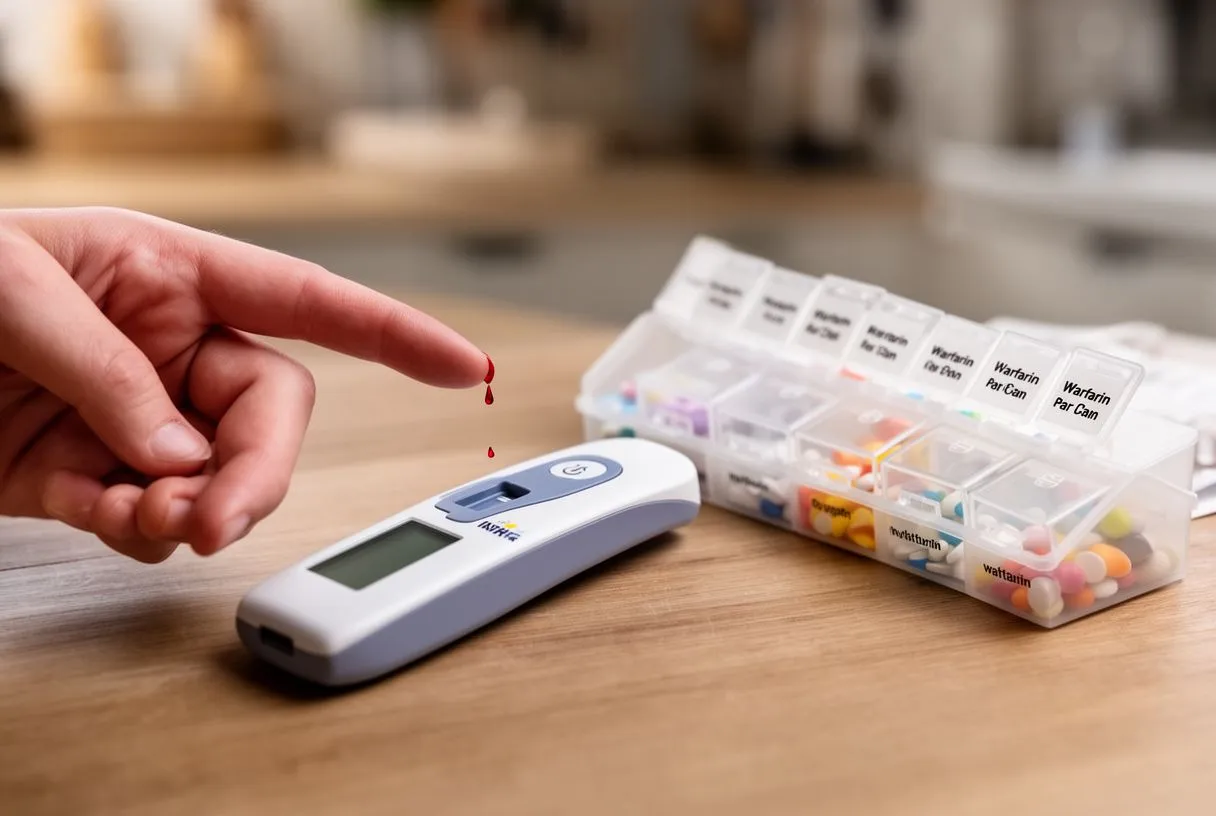
How self-testing works. Home INR monitoring on warfarin uses a small handheld device, similar in feel to a glucose meter for diabetes. A drop of blood from a fingertip gives a result in about a minute. Your care team teaches you how to test, calibrates your expectations, and sets rules for when to call in a result.
Who it suits best. Self-testing works well for motivated patients, those who live far from a laboratory, and frequent travelers. It usually involves a short training period and a confirmation phase where home results are compared with lab results. Not every patient is a candidate, and your team should assess that honestly rather than assume it.
The benefits are real. Testing more often means catching out-of-range values sooner, and studies of structured home monitoring show more time in range compared with infrequent clinic-only testing. In our practice, patients who live outside the main cities, for example in smaller towns across Jalisco or Sonora, often find home testing the difference between manageable and burdensome monitoring. We discuss it as an option whenever the patient's circumstances make it the lowest-friction route.

Therapeutic INR for AFib and Valve Patients
Atrial fibrillation. Therapeutic INR for AFib, the irregular rhythm that raises stroke risk, is generally a target of 2.0 to 3.0. The anticoagulant prevents the small clots that can form in the heart's left atrial appendage and travel to the brain. Many AFib patients today are candidates for newer direct oral anticoagulants instead of warfarin, but mechanical valves and certain other situations still require warfarin specifically.
Mechanical valves. Patients with mechanical valve replacements take warfarin for life, because clots forming on the valve itself can be catastrophic. The target depends on the valve's position and type, and the threshold conversations here matter: a modern bileaflet aortic valve may sit comfortably at the 2.0 to 3.0 range, while an older mitral prosthesis justifies the higher 2.5 to 3.5 range.
Bioprosthetic valves and other situations. Tissue valves, including those placed through TAVR (transcatheter aortic valve replacement, a catheter-based procedure that avoids open surgery), usually need only a limited course of anticoagulation followed by antiplatelet therapy, depending on the patient's rhythm. The decision is individual. In our multidisciplinary review of every case, we weigh valve type, rhythm, bleeding risk, and the patient's ability to monitor before recommending any specific plan, and the final decision always rests with the patient.
When to Call Your Cardiac Team
Warning signs that need same-day attention. Warfarin complications are uncommon when monitoring is consistent, but they require fast action. Contact your team or seek urgent care if you notice:
- Unusual bleeding: bleeding that will not stop from a small cut, blood in urine or stool, nosebleeds that recur, or large unexplained bruises.
- Stroke symptoms: sudden face drooping, arm weakness, or speech difficulty. Call emergency services immediately, do not wait.
- Signs of clot: sudden swelling, pain, or discoloration in a limb, which can signal a deep vein clot despite anticoagulation.
Situations that are urgent but not emergencies. An INR well above your target range with no symptoms, a missed dose, a new medication started by another doctor, or an upcoming procedure all warrant a call within a day or two rather than an emergency room visit. Keeping your team's contact handy makes these calls routine instead of frightening.
Planning procedures and travel. Before any surgery, dental extraction, or colonoscopy, tell the provider you are on warfarin well in advance, since some procedures require temporary dose changes and sometimes a short-acting bridge injection while the warfarin is paused. For travel, take your meter or book your lab appointments ahead, keep doses in original packaging, and know how to reach your anticoagulation service from wherever you are.

Bringing it all together. Staying in the therapeutic range on warfarin is not about perfect discipline; it is about steady habits, honest communication with your care team, and knowing your own target range. Keep your testing schedule, eat consistently, report every new medication, and learn the warning signs that need a call. Over the years, the patients who do these four things well spend most of their time in range and avoid most complications. Above all, never adjust your dose on your own, and bring every question to a qualified cardiac team. If you are facing heart surgery or starting anticoagulation and want a clear, unhurried explanation of your options, our team led by Dr Alejandro Molina offers a free first video consultation to talk through your situation, identify which studies are truly needed, and answer every question before any decision is made. Your situation deserves a plan built around you, not around an average patient.