Thrombotic Risk After Heart Surgery: Clot Prevention
Thrombotic risk after surgery is serious but manageable.
If you or a loved one is preparing for heart surgery, one of the most important things to understand is thrombotic risk after surgery — the chance that a blood clot forms inside a vein or artery during recovery. Clots are among the most studied and most preventable complications in cardiac care. This guide walks you through why the risk exists, when it peaks, which warning signs matter, and how modern clot prevention keeps it manageable. Our goal is to replace anxiety with a clear picture of what your care team is doing, and why.
What Is Thrombotic Risk After Surgery?
A thrombus is a blood clot that forms inside a blood vessel. Normally, clotting is a protective process: when you cut yourself, platelets and clotting proteins seal the wound. After any operation, however, this same system can become overactive. Surgery itself — the anesthesia, the tissue trauma, the inflammatory response — shifts your blood toward a more clot-prone state for days or even weeks.
Arterial versus venous clots: the distinction matters because the dangers differ. Arterial clots can block vessels feeding the heart or brain, causing a heart attack or stroke. Venous clots — the focus of post-surgical prevention — typically form in the deep veins of the legs, a condition called deep vein thrombosis, or DVT. A piece of a leg clot can travel to the lungs and cause a pulmonary embolism, which is a medical emergency.
Prohibitive risk versus manageable risk: heart teams use formal scales for risk stratification to sort patients into categories, from low to prohibitive risk, before recommending a procedure. That same logic applies to clot prevention. Very few patients face a prohibitive risk that cannot be managed; for most, a combination of medication, movement and mechanical measures brings the surgical risk down to a level where surgery is safely worthwhile. In our practice, every case is reviewed by the multidisciplinary team against international practice guidelines before a recommendation is given, precisely so that these risks are weighed rather than guessed at.
Why Is Blood Clot Risk After Cardiac Surgery Higher?
The three factors that drive clotting: doctors call this Virchow's triad, and it explains why operations raise the danger. First, blood flow slows when you are sedated and lying still. Second, the vessel lining can be injured by cannulation — the tubes placed in vessels during surgery. Third, blood itself becomes more prone to clot because of inflammation and stress hormones released by the body in response to the operation.
Cardiac surgery adds specific factors: the heart-lung machine used in conventional open-heart procedures exposes blood to artificial surfaces, which activates clotting proteins. Leg veins — especially the saphenous vein, often used as a bypass graft — are irritated or removed, further disturbing circulation in the legs. Some patients also need to pause their usual blood thinners around surgery, which briefly removes a layer of protection they normally rely on.
Patient-specific factors matter just as much: age over 60, obesity, varicose veins, prior clots, cancer, atrial fibrillation, and long travel before or after surgery all raise baseline risk. Atrial fibrillation — an irregular rhythm common after heart operations — deserves particular attention, because it independently increases the chance of clot forming inside the heart. The interaction between atrial fibrillation and high thrombotic risk is a genuinely difficult clinical question, and specialist literature examines exactly which antithrombotic strategy fits these patients best (Atrial fibrillation in patient with high thrombotic risk: which therapy?).
When Does Clot Risk Peak After Surgery?
The first days carry the highest danger: clotting activity rises within hours of surgery and stays elevated during the first week. This is when patients move least, blood flows slowest, and inflammatory markers peak. Most hospital clot-prevention protocols are therefore most intensive during this early window, with preventive anticoagulation — blood-thinning medication — started within the first 24 hours in most cases.
Risk does not vanish at discharge: the clot-prone state can persist for several weeks, and it can be prolonged by limited mobility at home, long car rides home from the hospital, or complications such as infection. A flight home for international patients is worth planning carefully with your team, since long-haul travel is itself a recognized trigger for venous clots.
Knowing the timeline helps you act: understanding that the peak occurs early means you can be an active participant in prevention from day one rather than waiting for symptoms. In our consultations, we take the time to explain what each study shows in plain words — including what your individual clotting profile means for the days right after your operation — and to answer every question before any decision is made.
What Are the Signs of a Blood Clot After Surgery?
Trust the symptom checklist over fear: most post-operative aches are normal healing, but a few specific patterns should prompt an immediate call to your care team. Warning signs include:
- One-sided leg swelling: one calf or thigh visibly larger than the other, or feeling tight, heavy, or warm.
- Unusual bruising or bleeding: while on blood thinners, oozing from incisions, blood in urine, or black stools need urgent review.
- Sudden breathlessness: shortness of breath that comes on quickly, especially with chest pain or a racing heart, may signal a pulmonary embolism — treat it as an emergency.
Why rapid reporting matters: a clot caught early is far easier to treat safely than one discovered late. Hospitals that identify DVT within the first days can typically manage it with medication alone, avoiding more invasive measures. Never dismiss a new, one-sided leg symptom as "just recovery" — a quick phone call costs nothing.
What Are Deep Vein Thrombosis Symptoms to Watch For?
DVT has a recognizable pattern: the classic presentation is pain, tenderness, and swelling in one leg, most often the calf. The skin may look redder or slightly bluish, and the area may feel warmer than the other leg. Some patients describe a cramping sensation or a deep ache that worsens when the foot is flexed upward. Because swelling after surgery can have many causes — including normal post-operative fluid retention — doctors often confirm DVT with an ultrasound scan of the leg veins, which is painless and takes minutes.
Prevention is the real answer: the most effective strategy against DVT is starting prevention before a clot ever forms. The core measures your team will use are simple and well-proven:
- Preventive anticoagulation: usually low-dose heparin injections given under the skin, started early and continued until you are fully mobile.
- Compression stockings or sleeves: graduated pressure garments that keep blood moving in the leg veins while you are less active.
- Early, frequent walking: getting out of bed the day after surgery and walking short distances several times a day remains one of the most powerful clot-prevention tools available.
Home vigilance continues after discharge: keep doing ankle exercises, stay hydrated, avoid sitting with legs dependent for long stretches, and break up any car journey longer than an hour with a short walk. If you notice one leg swelling in the weeks after surgery, contact your team rather than waiting to see if it resolves on its own.

What Is Pulmonary Embolism After Heart Surgery?
What actually happens: a pulmonary embolism occurs when a fragment of a venous clot — usually from the legs or pelvis — travels through the bloodstream and lodges in the arteries of the lungs. This blocks blood flow to part of the lung and forces the right side of the heart to work against sudden resistance. Symptoms include sudden breathlessness, sharp chest pain that worsens with breathing, a fast heartbeat, lightheadedness, or coughing up blood. It is one of the most serious forms of post surgical thrombosis, and it is why prevention is taken so seriously.
Why prevention beats treatment: the entire rationale behind heparin after cardiac surgery, compression devices, and early mobilization is to stop leg clots from ever reaching the lungs. This is also where the recent experience of the pandemic changed practice: COVID-19 was shown to dramatically raise clotting risk, prompting major reviews of how such patients are identified and protected, including antithrombotic therapy approaches for COVID-19 and thrombotic or thromboembolic disease in a State-of-the-Art review in the Journal of the American College of Cardiology. That experience reinforced a broader lesson now embedded in routine care — patients with elevated clotting tendency benefit most when prevention starts before symptoms appear.
Recovery after an embolism: when one does occur, treatment usually involves several months of anticoagulant therapy, and most patients recover fully. A question patients often ask is whether exercise is safe afterwards. The general answer, once your team has confirmed the clot is stable and treatment is working, is that gradual, supervised activity is not only safe but beneficial — cardiac rehabilitation programs are designed precisely for this, and your doctor will tell you when it is safe to increase your activity.
How Does Anticoagulant Therapy After Surgery Work?
Heparin comes first: in the immediate days after cardiac surgery, most patients receive heparin — a fast-acting injectable blood thinner — either in low preventive doses or, for some valve procedures, in higher monitored doses. Low-molecular-weight heparin, given as a once-daily under-skin injection, is common for prevention. Its effects are predictable and it can be paused quickly if bleeding becomes a concern, which is why it is the standard starting point.
Warfarin and other longer-term options: patients who need longer protection — for example, those with a mechanical heart valve, atrial fibrillation, or an actual clot — transition to oral anticoagulants. Warfarin therapy post surgery requires regular blood tests to keep the dose in a safe window, though newer direct oral anticoagulants are used in many situations without routine monitoring. The choice depends on what was repaired, why protection is needed, and your bleeding risk.
The balance with bleeding: every blood thinner is a trade-off — enough to prevent clots, not so much that bleeding becomes dangerous. Your team calibrates this using your kidney function, weight, other medications, and how well your incisions are healing. In our team, anticoagulation decisions are reviewed collectively against international guidelines rather than decided by one person alone, and the reasoning is explained to you in plain words so you know exactly why you are on what you are on, and for how long.

How Do Early Mobilization and Compression Therapy Help Recovery?
Movement is medicine for your veins: the calf muscles act as a pump, pushing blood upward through the leg veins with every step. When you lie still, that pump stops, and blood pools. This is why getting out of bed the day after surgery — even for a slow walk to the doorway — is one of the single most effective steps in clot prevention medication after surgery's supporting cast: it is free, it has no side effects, and it also speeds overall recovery of breathing and strength.
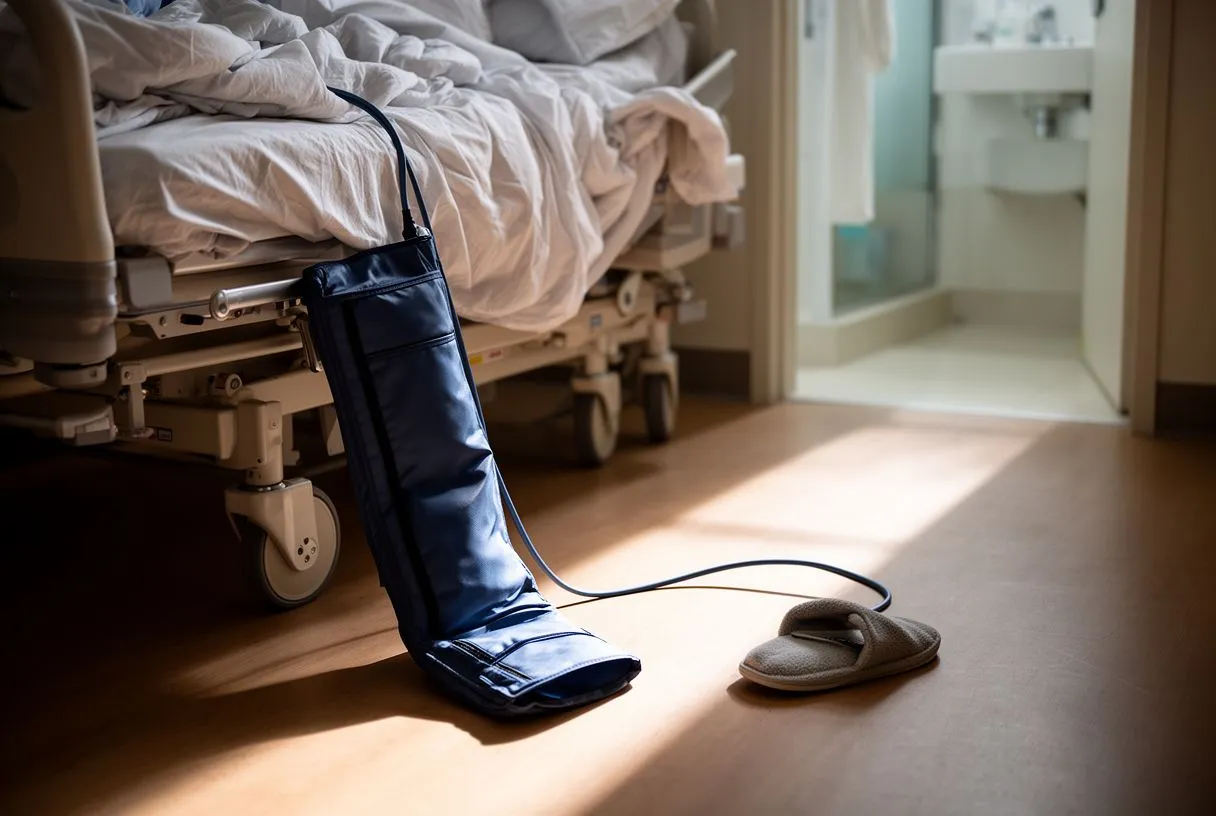
Compression therapy surgery recovery programs rely on: graduated compression stockings apply the most pressure at the ankle and less toward the knee or thigh, gently encouraging blood to flow upward. Intermittent pneumatic compression devices — sleeves that inflate and deflate rhythmically around the legs — are used in the hospital while you are in bed. Both reduce the pooling of blood that lets clots start. Wear stockings exactly as prescribed, and ask your team how long to continue them at home.
Cardiac rehabilitation ties it together: structured rehabilitation after heart surgery combines progressive exercise, education, and monitoring. Beyond rebuilding strength, the regular movement it enforces is itself part of clot prevention, and it gives professionals a chance to spot leg symptoms early. If a rehabilitation program is offered near you, treat enrollment as part of your treatment plan, not an optional extra.
How Long Is Thrombotic Risk After Surgery?
The honest answer is "weeks, with a steep early peak": the clotting activation triggered by surgery is strongest in the first days and gradually normalizes over roughly the following four to six weeks for most patients. How long is thrombotic risk after surgery for any individual, though, depends on what was done — a coronary bypass alone carries a different profile than a valve replacement plus atrial fibrillation — and on personal factors such as mobility, weight, and history of prior clots.
Protection continues after you feel better: it is common for patients to feel strong and energetic well before the clotting system has fully settled. Do not stop preventive measures early on your own. Blood thinners prescribed for a defined period should be completed unless your team tells you otherwise, and compression stockings should be worn for as long as advised. If you were on a blood thinner before surgery for another condition, your team will tell you clearly when and how it resumes.
Your follow-up visits are the checkpoint: scheduled reviews in the weeks after discharge are where your team confirms that wounds are healing, medication doses are right, and no leg symptoms have appeared. Keep every appointment even when you feel well — that is exactly the point at which prevention matters most.
How Do We Reduce Stroke Risk and Prevent Blood Clots After Surgery?
Individual risk stratification guides everything: before we recommend any operation, we assess thrombotic risk alongside bleeding risk, surgical risk, and overall condition. The goal is not to avoid the least invasive option automatically, but to choose the lowest-risk route for your specific situation — whether that is a conventional operation, a minimally invasive approach, a robotic repair, or a transcatheter procedure such as TAVR. We recommend the less invasive route only where the evidence supports it for that patient.
Stroke prevention after cardiac surgery has its own logic: strokes after heart operations usually come from clots or debris reaching the brain, so teams work on several fronts at once — meticulous technique during cannulation, managing atrial fibrillation aggressively, precise anticoagulation during and after the procedure, and tight blood pressure control in recovery. Reducing stroke risk after heart surgery is a continuous process that begins before the operation and continues through every recovery visit.
What working with us looks like: the first contact is a free video consultation in which we get to know you, talk through your condition, and identify exactly which studies are still needed — so no unnecessary tests are ordered. If you decide to proceed, a face-to-face visit follows at our consulting rooms in Guadalajara, Querétaro or Hermosillo. Our team includes cardiac surgeons led by Dr Alejandro Molina, who trained in cardiac, minimally invasive, robotic and structural surgery at the University of Montreal and in structural cardiology and TAVR at CHU Bordeaux, and who performed the first robotic mitral valve repair in the Ángeles Health System and the first robotic heart surgery in Guadalajara. We encourage second opinions — asking for one before high-risk surgery is a normal, sensible step, and we treat it as such.
Bringing it all together: thrombotic risk after heart surgery is real, but it is also one of the most thoroughly understood and preventable complications in modern cardiac care. The formula is consistent across every good program: individual risk assessment, early preventive medication, compression therapy, early and frequent movement, and attentive follow-up. If you are weighing a heart procedure and want to understand how these protections would apply in your own case, the most useful next step is a conversation with a qualified cardiac team — not self-diagnosis. You can book a consultation with our team to talk through your situation in plain words and get a clear proposal, with the alternatives, before any decision is made.