


Aortic Cross-Clamp in Heart and Aortic Surgery
Aortic cross-clamp surgery safely pauses blood flow for heart repair.
If you or someone you love has been told they need heart surgery or an aortic operation, you will likely hear the term aortic cross-clamp surgery during the conversation. It sounds alarming, and the image of a clamp on the body's largest artery can be frightening. In reality, the aortic cross-clamp is one of the most routine and carefully controlled steps in modern cardiac surgery. This guide explains what the clamp is, why surgeons use it, how long it stays on, what the risks really are, and what recovery looks like — so you can walk into your consultation knowing what to ask.
What Is an Aortic Cross-Clamp?
The basic idea. The aortic cross-clamp is a surgical instrument that briefly closes the aorta — the main artery that carries oxygen-rich blood from the heart to the rest of the body. The surgeon places it on the ascending aorta, the segment just above the heart, during open-heart procedures. Closing the artery creates a still, blood-free surgical field around the heart, which makes precise repair possible.
Where the clamp sits. The placement matters. Surgeons usually clamp between the origin of the innominate artery and the aortic valve, a short stretch of vessel with no branches in between. This supra-coronary position lets blood continue to flow to the head and arms through the heart-lung machine while the segment below the clamp is isolated for repair.
It is temporary by design. The cross-clamp is not left in place. It stays on for a defined period — often under an hour for simpler valve operations, longer for complex aortic work — and is removed once the repair is complete and the heart is ready to be restarted. Patients are fully asleep and connected to a cardiopulmonary bypass machine, which takes over the work of the heart and lungs while the clamp is on.
How Aortic Cross-Clamp Surgery Works
Step by step. After the chest is opened and the patient is placed on bypass, the surgeon applies the aortic cross-clamp. With the aorta occluded, the heart below the clamp is isolated from circulating blood. The team then delivers a special preservation solution into the heart and can open the aorta itself to work on the valve, the aortic root, or the ascending segment.
Why the heart must be stopped. A beating heart moves constantly, and it bleeds heavily when opened. Stopping it converts a moving, dangerous field into a quiet, dry one. That stillness is what allows a surgeon to sew a valve in place with millimetre precision, or to replace a segment of diseased aorta with a synthetic graft.
Then the heart is restarted. Once the repair is finished, the clamp is removed, blood flows back into the heart's coronary arteries, and the heart usually resumes beating on its own or with a controlled electric shock. The bypass machine is gradually weaned off, and the chest is closed. This sequence is planned before the first incision, so the clamp time is kept as short as the repair allows.

Why Do Surgeons Clamp the Aorta During Heart Surgery?
Protection, not aggression. Patients sometimes worry that clamping the aorta cuts off blood to the body. It does not — the heart-lung machine circulates blood to the organs while the clamp is on. The clamp protects the heart itself, giving the surgical team a still field and a heart that is resting rather than working.
The procedures that need it. Aortic clamping is standard in many operations: aortic valve replacement, repair of an Aortic Root Aneurysm, coronary artery bypass grafting, and surgery for Type A Aortic Dissection, where the inner lining of the aorta has torn and blood is forcing its way into the vessel wall. Each of these requires an open, still aortic segment to be treated safely.
Alternatives exist for selected patients. Not every heart procedure needs a cross-clamp. Transcatheter Aortic Valve Implantation — usually called TAVR — and beating-heart coronary bypass avoid it entirely, and minimally invasive techniques can sometimes use a smaller clamp placed through the chest. Our multidisciplinary team reviews every case against international guidelines and recommends the less invasive route only where the evidence genuinely supports it for that patient.
What Is Cardioplegia and How Does It Work With the Cross-Clamp?
Two tools that work together. Cardioplegia is a potassium-rich preservation solution delivered into the coronary arteries once the cross-clamp is on. It stops the heart in a relaxed, resting state and protects the heart muscle from damage during the period without its own blood supply. The clamp isolates the field; the cardioplegia protects the muscle. One does not work well without the other.
How it is delivered. Surgeons can give cardioplegia antegrade — into the aortic root above the coronary arteries — or retrograde, through a small catheter in the coronary sinus, the vein that drains the heart. Many teams use both. Repeat doses are given during long operations to keep the heart protected throughout the repair.
What this means for you. Because cardioplegia keeps the heart muscle alive while it is stopped, the length of the operation matters less than it once did. Still, minimizing the interval between clamping and unclamping remains one of the strongest predictors of a smooth recovery, which is why experienced centres track it for every case.
What Is a Safe Cross-Clamp Time in Heart Surgery?
What the numbers describe. Cross-clamp Time is the minutes between applying and removing the clamp. It is one of the most closely watched metrics in any cardiac operation. Aortic Cross-clamp times vary enormously by procedure: a routine valve replacement might fall between 30 and 60 minutes, while complex aortic root reconstruction can run considerably longer.
Shorter is better, but context matters. Research consistently links longer clamp times to higher rates of complications, because the heart muscle spends more time without its own circulation. Yet a longer time spent doing a more complete, precise repair can serve the patient better than a rushed, incomplete one. The goal is always the shortest time that a careful repair allows — not the shortest time possible for its own sake. The technique of clamping also influences outcomes: one study of elective open aortic aneurysm repair compared supra-renal with infra-renal clamping and found results that support tailoring the clamp position to the patient's anatomy rather than using a single approach for everyone (Outcomes of supra-versus infra-renal clamping in elective open aortic aneurysm repair in a tertiary vascular center).
Questions worth asking. When you meet your surgeon, it is completely reasonable to ask how long they expect the clamp to be on for your operation, and what factors could lengthen it. We take the time in consultation to explain what the studies actually show, in plain words, and to answer every question before any decision is made.
Aortic Cross-Clamp vs Partial Clamp: What Is the Difference?
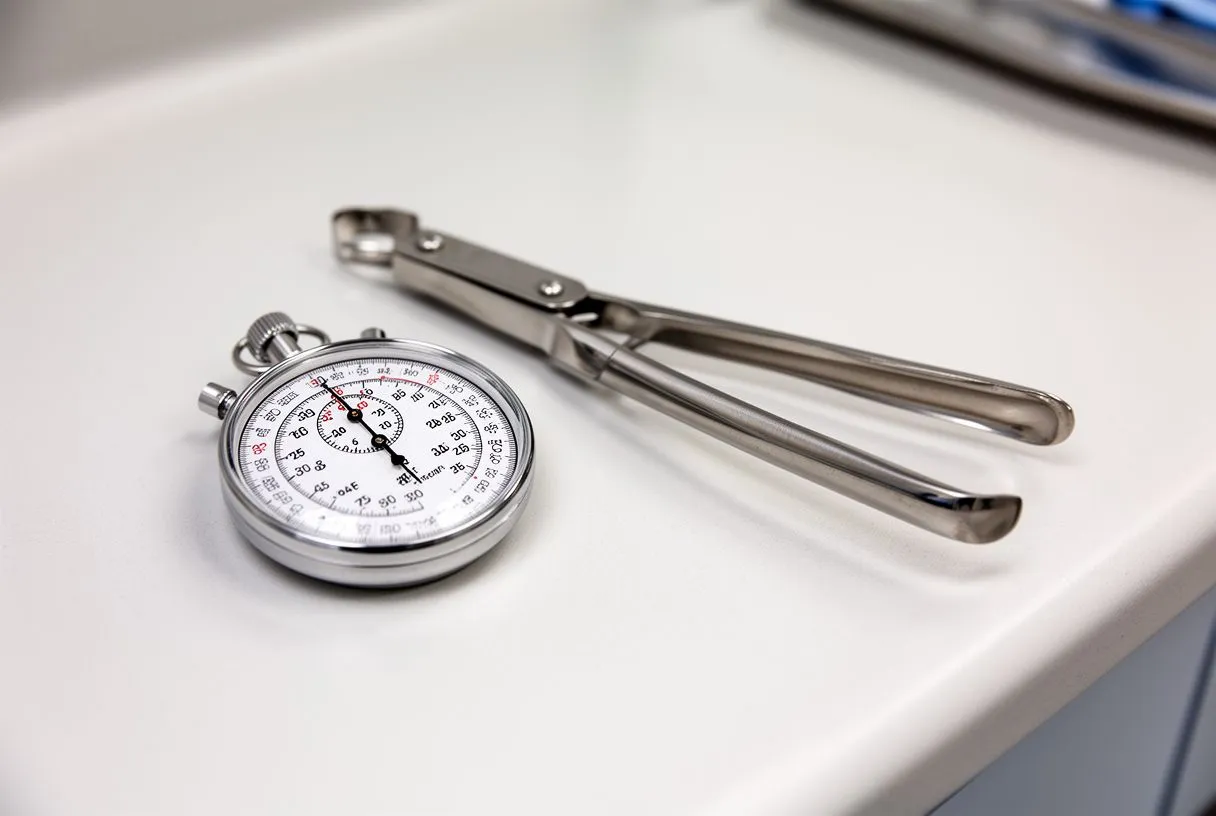
The full cross-clamp. A complete cross-clamp occludes the entire aorta. Nothing passes the clamp, the heart below is isolated, and cardioplegia can be delivered cleanly. This is the technique of choice whenever the surgeon needs to open the aorta or operate on the aortic valve, because a blood-free field is essential.
The partial (side-biting) clamp. A partial clamp — sometimes called a side-biting or tangential clamp — closes only part of the aorta's circumference. Blood keeps flowing through the unclamped portion, so the heart keeps beating and the patient may not need full support. Surgeons use it for smaller jobs, such as attaching a bypass graft to the side of the aorta during coronary surgery, or for the proximal anastomosis in some Thoracic Aortic Aneurysm operations.
- Full cross-clamp: complete occlusion, still and blood-free field, heart stopped with cardioplegia; used for valve work, aortic root surgery, and ascending aorta replacement.
- Partial clamp: partial occlusion, heart usually still beating, no cardioplegia needed; used for side grafts and selected less invasive procedures.
- Trade-off: the partial clamp avoids a stopped heart but works on a blood-filled aorta, so it demands precise technique and suits only specific repairs.
How Is Clamping Done in Aortic Aneurysm Surgery?
Why aneurysms change the plan. An Aortic Aneurysm is a permanent widening of the artery, usually defined as a diameter above 5.5 cm for repair decisions in most guideline frameworks. The thinned, stretched wall is fragile, and clamping a diseased segment risks tearing it. So the surgeon must place clamps on healthier tissue above and below the aneurysm — which sometimes means clamping at different levels than in a standard heart operation.
Ascending versus descending disease. For an Ascending Aorta aneurysm or aortic root surgery, the standard ascending aorta cross-clamp procedure applies, with the clamp placed above the diseased segment when possible. For Abdominal Aortic Aneurysm repair, the clamp is placed on the abdominal aorta, and the position — above or below the renal arteries — is chosen based on the aneurysm's shape and the patient's kidney risk, exactly the choice examined in the supra- versus infra-renal clamping study cited earlier.
Emergency dissection is different. In Aortic Dissection — a true cardiovascular emergency where the artery's layers split apart — the clamp may need to go wherever healthy tissue can be found, sometimes under greater time pressure. An Aortic Rupture or a contained Penetrating Aortic Ulcer can force similar improvisation. These operations demand a team that has rehearsed the difficult versions, not only the elective ones.
What Are the Risks of Aortic Cross-Clamp Surgery?
An honest picture. Every open-heart operation carries risk, and the clamp contributes to specific ones. The most studied is related to Cross-clamp Time: the longer the heart sits without its own blood flow, the higher the chance of temporary kidney stress, neurocognitive effects such as difficulty concentrating after surgery, and, in a minority of cases, more serious complications including Aortic Insufficiency from valve injury or clamp-related damage to the vessel itself.
What reduces the risk. Several factors are within the team's control:
- Cardioplegia technique: delivering and repeating the protective solution on schedule keeps the muscle rested throughout the repair.
- Clamp placement: choosing healthy aortic tissue for the clamp avoids tears in diseased segments.
- Efficiency: experienced teams complete complex repairs in less clamp time because every step is rehearsed and coordinated.
- Organ protection: cooling the body and, in some aortic operations, using circulatory support to protect the brain during deep hypothermia.
Your individual risk. Factors like age, kidney function, lung disease and diabetes influence how well any patient tolerates the clamp. Every case we review is scored against international practice guidelines before a recommendation is given, and the patient receives a clear proposal with the alternatives — the final decision is always theirs.
What Is Recovery Like After Cross-Clamp Heart Surgery?
The first days. Most patients spend one to two nights in intensive care, then move to a cardiac ward. The clamp itself leaves no trace — recovery is driven by the operation it enabled, not by the clamping step. Expect a chest incision that heals over six to eight weeks, gradual return of energy over the first two to three months, and cardiac rehabilitation, a supervised exercise programme that speeds safe recovery.
Realistic milestones. Walking the ward within a day or two is typical. Driving usually resumes around four to six weeks, and return to office work follows soon after for many patients. Heavy lifting waits until the breastbone has knitted, usually around the eight-week mark. These are broad patterns, not promises — your own timeline depends on your operation and your starting health.
Watch for the warning signs. Contact your team if you develop fever, increasing chest pain, leg swelling, sudden breathlessness, or any sign of a wound problem. Our team in Guadalajara, Querétaro and Hermosillo encourages a second opinion at any point when a recommendation does not feel fully clear.

What Does Aortic Cross-Clamp Surgery Cost in Mexico?
Why patients look here. Mexico has become a destination for cardiac care, and Guadalajara in particular hosts established heart surgery programmes with internationally trained surgeons. For international patients, experienced teams and modern private hospitals make the option worth exploring — always with careful verification of the surgeon's credentials and the hospital's capabilities.
What shapes the price. The cost of aortic surgery depends on the procedure's complexity, the hospital and its intensive care facilities, the length of stay, and whether the operation is elective or emergency. An aortic valve replacement with a straightforward clamp differs greatly in cost from a root aneurysm repair or emergency dissection surgery. Our first contact is a free video consultation: we get to know the patient, talk through the condition, and say which studies are still needed so no unnecessary ones are ordered — a face-to-face visit at the consulting rooms follows when the patient decides to go ahead.
Choosing your team. Look for a multidisciplinary team rather than a single surgeon, transparent discussion of alternatives including transcatheter options where they apply, and a willingness to encourage second opinions. Dr Molina performed the first robotic mitral valve repair in the Ángeles Health System and the first robotic heart surgery in Guadalajara, and patients seeking a video consultation with a heart surgeon about aortic cross-clamp surgery can start exactly there — with a conversation, not a commitment.
In summary, the aortic cross-clamp is a controlled, temporary step that makes precise heart and aortic repair possible. Its duration and placement are among the strongest markers of how well an operation goes, so they are worth discussing openly with your surgical team. Every patient's anatomy and circumstances are different, and the right answer for one person may be open surgery with a cross-clamp, while for another it may be a transcatheter or minimally invasive route. If you have been diagnosed with a valve problem, an aneurysm, or an aortic condition, the most useful next step is a consultation with a qualified cardiac team that can review your specific images and explain your options in plain language — rather than deciding anything on your own. Book that conversation; it costs nothing but your time, and it is the clearest path to a confident decision.






