

Balloon-Expandable Valve or Self-Expanding: TAVR Choices
Balloon-expandable valve TAVR compared to self-expanding valves: differences in procedure, recovery, and outcomes.
If you have been told you need a new aortic valve, you will quickly hear about two very different devices: a balloon-expandable valve TAVR and a self-expanding valve. Both are delivered through a thin tube, usually from an artery in the groin, and both replace a narrowed aortic valve without opening the chest. The difference between them matters, because each design behaves differently inside your heart and each suits a different anatomy and set of priorities. This guide walks you through what each valve is, how the procedure works, who qualifies, what recovery really looks like, and how to weigh the choice with your cardiac team.
What Is a Balloon-Expandable Valve TAVR?
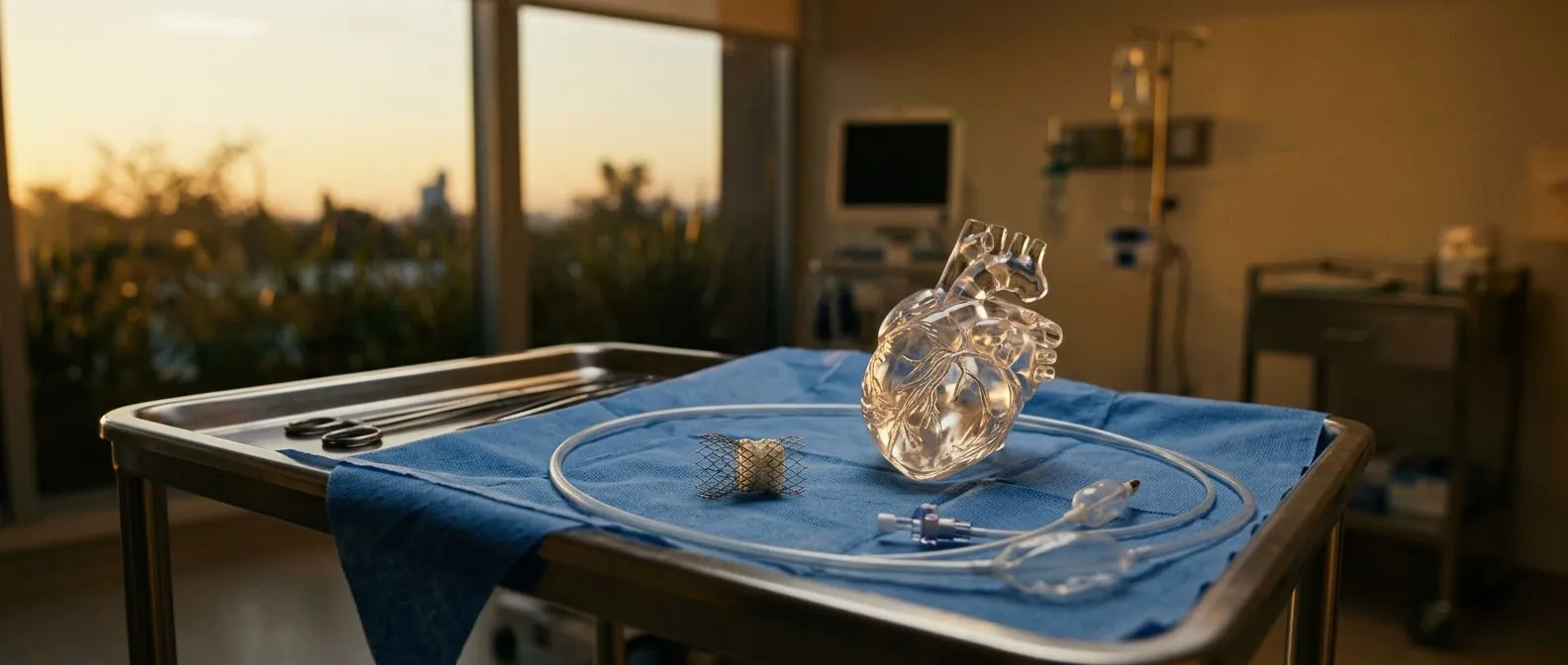
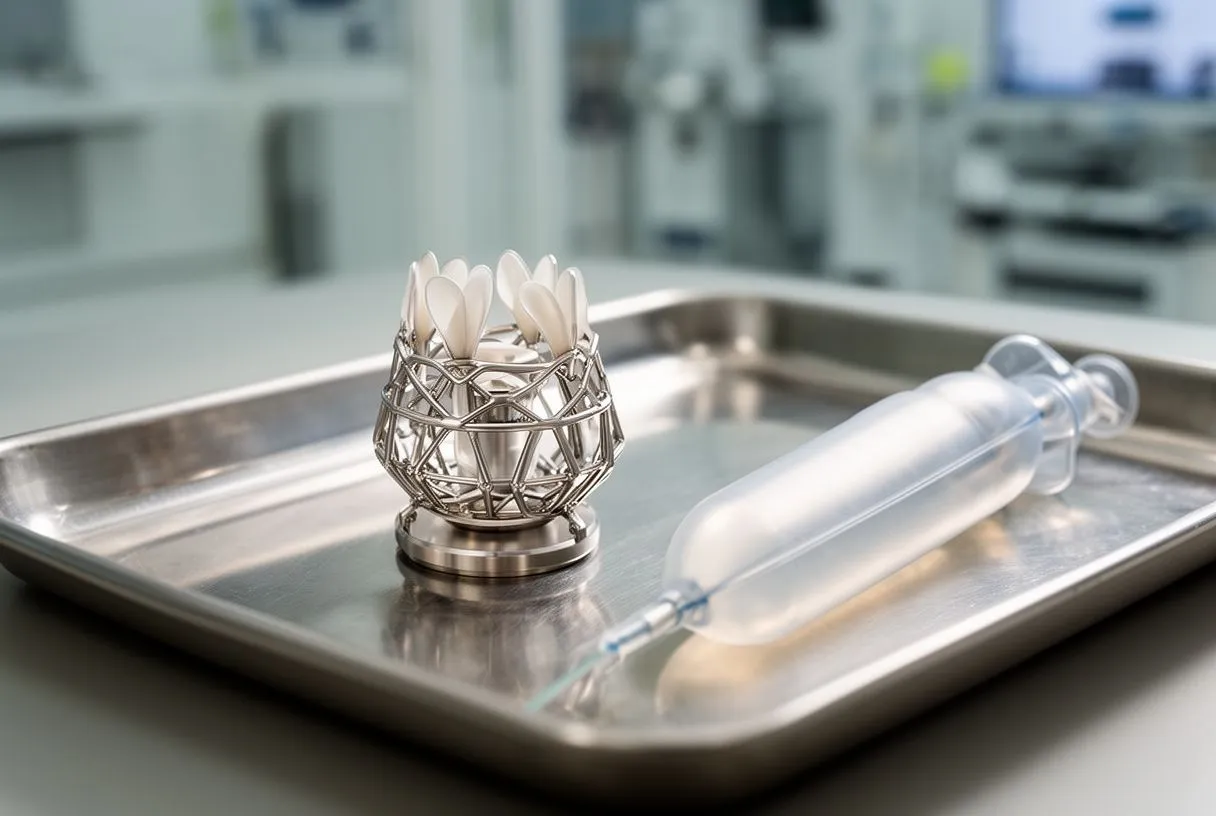
The basic idea. TAVR stands for transcatheter aortic valve replacement. Instead of open-heart surgery, a new valve is compressed onto a delivery catheter, guided up the aorta, and placed inside your diseased valve. In a balloon-expandable valve TAVR, the replacement valve is mounted on a balloon. When the balloon inflates inside the old valve, it pushes the new valve open and presses it firmly against the surrounding tissue. The balloon is then deflated and removed, and the valve stays where it was placed.
What the valve is made of. A balloon-expandable valve is a type of stented valve: a metal frame, usually cobalt-chromium, holds a set of tissue leaflets made from cow or pig pericardium. Because the frame is rigid, it expands to its final size in a single controlled moment and does not continue to change shape afterwards. In Europe the same family of procedures is sometimes called Transcatheter Aortic Valve Implantation, or TAVI; the devices and technique are the same, only the name differs.
Why this matters to you. The word "balloon-expandable" is not marketing jargon. It describes exactly how the valve behaves in your heart, which in turn affects how well it seals, how much it may press on the electrical system of the heart, and how predictable the final position is. Understanding this helps you ask better questions when your team presents options.
Balloon-Expandable Valve vs Self-Expanding TAVR: Key Differences
How each valve opens. The central distinction in a balloon expandable valve vs self expanding TAVR comparison is the deployment mechanism. A balloon-expandable valve opens all at once when the balloon inflates, so the implanting team sees the final result immediately and can decide within the procedure whether the position and sealing are right. A self-expanding valve, by contrast, is made of nitinol, a super-elastic metal that unfolds on its own once released from the catheter, and continues to exert outward force on the surrounding tissue over time.
Rewrappable versus committed. Many self-expanding systems can be partially or fully pulled back and repositioned before final release. Balloon-expandable valves are more committed: once the balloon inflates, the valve is where it is. That sounds like a disadvantage, but the trade-off is precision — the balloon-centering design typically gives very consistent, predictable placement.
- Balloon-expandable: opens in one controlled inflation, rigid frame, immediate final result, very little ongoing outward force.
- Self-expanding: unfolds gradually, often repositionable, taller frame, continuous outward pressure on the annulus and left ventricular outflow tract.
Which is "better"? Neither, universally. The right answer depends on your annulus — the ring of tissue where the valve sits — the amount of calcium in your valve, the dimensions measured on your CT scan, and whether you already have a pacemaker. Most valve choice debates are resolved not by preference but by anatomy.
Balloon-Expandable TAVR Valve Types
The family of devices. When surgeons talk about balloon expandable tavr valve types, they are usually referring to a small group of balloon-expandable platforms that share a common principle: a rigid frame expanded by an inflatable balloon. Different generations have refined the frame, the leaflet design, and the sealing skirt around the valve. Later-generation balloon-expandable valves use a shorter frame and an outer skirt designed to reduce leakage around the valve.
Where the valve sits. Balloon-expandable valves are generally positioned so the frame sits within the native annulus, whereas some self-expanding designs are supra-annular valves, meaning the functioning leaflets sit above the annulus level. Neither position is inherently superior; each changes how the valve interacts with the coronary arteries and the conduction system. Your team measures these distances on a CT scan before recommending a specific device.
Tissue leaflets. Nearly all balloon-expandable TAVR valves use bovine pericardium — tissue from cow hearts — treated to resist calcification. These are porcine or bovine tissue valves in the same biological family as surgical tissue valves. They open and close with your heartbeat exactly like your own valve did, and they do not require blood thinners beyond the standard post-procedure regimen, unlike some mechanical surgical valves.
How the Balloon-Expandable Valve TAVR Procedure Works
Before the day. A balloon expandable valve tavr procedure always begins with detailed imaging. A CT scan of the chest, abdomen, and pelvis maps your arteries, measures your aortic annulus and valve area, and shows the calcium distribution. An echocardiogram measures how blood flows through the valve. Together these studies determine access route, valve size, and whether a balloon-expandable or self-expanding device is the better fit.
On the day itself. You are typically given either light sedation or general anesthesia, depending on your team's approach. The team enters through the femoral artery in the groin in the large majority of cases. A guidewire crosses your narrowed valve, a temporary pacing lead may be placed to slow your heart briefly, and the catheter carrying the crimped valve is advanced up the aorta and positioned across your own valve.
The critical minute. When the balloon inflates, your heart is briefly paused by rapid pacing so the valve can be placed with total stability. The inflation lasts seconds. Once it deflates, the team performs an immediate echocardiogram to check that the new valve opens well, seals well, and does not block the coronary arteries. Most patients walk the same day or the next morning and go home within a few days.
In our practice, the multidisciplinary team reviews every TAVR case together against international practice guidelines before a recommendation is made, and the patient receives a clear proposal with the alternatives — the final decision is always theirs.
Balloon-Expandable Valve TAVR Candidacy: Who Qualifies?
The starting point. Balloon expandable valve tavr candidacy rests on two questions. First, is your aortic stenosis severe enough to justify intervention? Guidelines from the European Society of Cardiology define severe stenosis by valve area, pressure gradients, and symptoms — a mean gradient above 40 mmHg or a valve area below 1.0 cm², always interpreted together with your symptoms. Second, is TAVR the right route for you versus surgical valve replacement? Age, frailty, artery anatomy, and other medical conditions drive that decision.
Anatomy decides the valve. This is where the balloon-versus-self-expanding question becomes concrete. Patients with a small aortic annulus are one of the groups where the choice matters most, because the fit between valve and annulus affects both sealing and the risk of pressure on the heart's conduction system. A published review of self-expanding versus balloon-expandable TAVR in patients with a small aortic annulus examines exactly this question and how each platform performs in tighter anatomy (Journal of Cardiovascular and Thoracic Research).
Other candidacy factors. Heavy, bulky calcium concentrated on one side of the valve, the size and health of your leg arteries, previous chest surgery, and existing conduction disease on your ECG all shape the recommendation. None of these automatically rule you out — they simply move the balance of the decision. If you have a bicuspid aortic valve, meaning a valve with two leaflets instead of three, your team will assess it particularly carefully, since valve performance in bicuspid anatomy has its own considerations.
From our consulting rooms in Guadalajara, Querétaro and Hermosillo, we see many patients who were told elsewhere that they were not candidates; in the consultation we take the time to explain what the studies actually show, in plain words, before any decision.
Balloon-Expandable Valve TAVR Recovery Timeline
The first 48 hours. Balloon expandable valve tavr recovery is usually faster than open-heart surgery recovery, because the chest is never opened. Most patients spend one night in an intensive care or monitored unit, where the team watches heart rhythm, the groin puncture site, and how the new valve is functioning. You will typically be encouraged to sit up and walk within hours of the procedure.
The first few weeks. Expect fatigue — your body has been working against a narrowed valve for years, and it takes time to adjust to easier blood flow. Most people return to light daily activities within a week and more normal activity within two to four weeks. Groin soreness and bruising are common and fade on their own. Your team will arrange a follow-up echocardiogram to confirm the valve is working as intended.
The longer arc. Many patients report a noticeably different quality of life within weeks — less breathlessness on stairs, better sleep, more energy. That said, recovery is individual. Age, lung health, kidney function, and how long you were symptomatic before treatment all influence the pace. Keep every follow-up appointment even when you feel well; some issues are silent and easiest to address early.
Self-Expanding vs Balloon-Expandable TAVR Outcomes
What the registries show. In a self expanding vs balloon expandable tavr outcomes comparison, the important differences cluster around a few measurable endpoints: how well the valve seals, how often patients need a pacemaker afterwards, and how the valves behave in different annulus sizes. A clinical registry comparing a balloon-expandable valve directly against a self-expanding transcatheter heart valve for severe aortic stenosis provides real-world data on exactly these endpoints (Journal of Clinical Medicine).
Pacemaker rates. The most consistent finding across studies is that self-expanding valves, with their taller frames and continuous outward force, are associated with higher rates of new pacemaker implantation than balloon-expandable valves in comparable patients. A pacemaker is a manageable outcome — but it is a lifelong device, so it weighs meaningfully in the decision, especially for younger or more active patients.
Sealing and leakage. The rigid, balloon-centered frame of a balloon-expandable valve tends to give predictable sealing against paravalvular leak — blood escaping around the edge of the new valve. Newer self-expanding generations have narrowed this gap with improved sealing skirts. What matters for you is not the device category in the abstract, but how the specific measured anatomy on your CT scan matches the specific device being proposed.
The honest summary. Both platforms deliver excellent survival and symptom relief in appropriately selected patients. The registries show differences at the margins — pacemaker rates, sealing behavior, ease of repositioning — and those margins are exactly where a good heart team earns its role.
Balloon-Expandable Valve TAVR Complications and Risks
Common and usually manageable risks. The main balloon expandable valve tavr complications fall into a familiar group: bleeding or bruising at the artery access site, new rhythm disturbances, and paravalvular leak. In balloon-expandable procedures, the forces during valve expansion are high, so the team watches particularly for annular injury — stress on the ring of tissue where the valve seats — and for vascular complications in the artery used for access.
Conduction problems. The aortic valve sits right next to the bundle of His, the electrical cable that carries the heartbeat to the ventricles. Any valve placed in this region can compress the conduction system. Balloon-expandable valves exert less ongoing force after deployment, which is one reason their pacemaker rates are generally lower, but transient conduction changes can occur with any device and are monitored continuously in the days after the procedure.
Serious but rare events. Stroke, coronary artery obstruction, valve migration, and prosthetic valve endocarditis — infection of the new valve — are rare but recognized complications of any TAVR. The overall risks are low and continue to fall as devices and techniques improve, but honest counseling means hearing them, not just the benefits. Every serious risk has a monitoring plan and a response plan that your team should be able to explain clearly.
Balloon-Expandable Valve TAVR Longevity and Durability
What durability means for tissue valves. Questions about balloon expandable valve tavr longevity come down to how long the tissue leaflets keep opening and closing cleanly. All biological tissue valves — transcatheter or surgical — eventually show structural changes as calcium builds up on the leaflets. This is a gradual process, not a sudden failure, and it is tracked on routine echocardiograms over the years.
Age and expected lifespan. TAVR was originally developed for older, higher-risk patients, for whom the realistic durability of a tissue valve comfortably exceeds the competing risks of age. In younger patients, durability becomes a bigger part of the conversation, and your team should discuss it openly, including the possibility of a future procedure. Because the valve sits inside your own anatomy, a degenerated TAVR can often be treated with a valve-in-valve procedure — placing a second transcatheter valve inside the first — rather than open surgery.
Protecting your investment. The biggest factors in valve longevity are partly in your hands: controlling blood pressure, managing cholesterol, not smoking, and attending follow-up imaging. It helps to think of the valve as part of a lifelong heart-health plan rather than a one-time event, with echocardiographic follow-up to catch any change early.
What drives the cost. When patients research balloon expandable valve tavr cost mexico, they usually find that the total depends far more on the hospital, imaging, and device selection than on any single line item. Costs include the valve itself, the catheter lab time, CT and echocardiographic planning, hospital stay, anesthesia, and follow-up care. For international patients, add travel, accommodation during recovery, and any pre-arrival studies your team can review remotely to avoid repeating work.
Choosing the team, not just the city. Searching for a balloon expandable valve tavr hospital guadalajara or a "balloon expandable valve tavr cardiologist near me" will return many names. What matters more than geography is whether the team performs both TAVR and surgical valve replacement regularly, reviews each case multidisciplinarily, and can honestly tell you when the less invasive route is — and is not — the right one. A team that only offers one technology has only one answer.
Questions to ask any team. Bring this list to your first consultation, wherever you go:
- Anatomy fit: Based on my CT scan, is a balloon-expandable or self-expanding valve the better fit for my annulus and calcium pattern — and why?
- Pacemaker risk: What is the expected pacemaker rate for the specific device you are proposing, given my ECG?
- Alternatives: Would you also consider surgical valve replacement for me, and what would change your recommendation?
- Follow-up: What monitoring schedule do you use after TAVR, and who performs it?
How we work with international patients. The first contact with our team is a free video consultation: we get to know you, talk through your condition and your existing studies, and identify only the tests still needed, so no unnecessary ones are ordered. When you decide to go ahead, a face-to-face visit at one of our consulting rooms follows. We encourage second opinions and treat seeking one as a normal part of deciding about heart surgery — it is a sign of good judgment, not doubt.
A balloon-expandable valve TAVR and a self-expanding valve TAVR are both mature, well-studied ways to replace a severely narrowed aortic valve without open surgery. The devices differ in how they open, how they seal, and how they affect the heart's electrical system, and the best choice is the one that fits your anatomy, your age, and your goals — not the one with the strongest advertisement. If you have been diagnosed with severe aortic stenosis, the most valuable next step is a conversation with a qualified multidisciplinary cardiac team that can review your own imaging and lay out every option in plain language. Book a consultation rather than self-diagnosing; your heart, and your peace of mind, deserve that level of care.
Balloon-Expandable Valve TAVR Cost in Mexico and Choosing Your Team
What drives the cost. When patients research balloon expandable valve tavr cost mexico, they usually find that the total depends far more on the hospital, imaging, and device selection than on any single line item. Costs include the valve itself, the catheter lab time, CT and echocardiographic planning, hospital stay, anesthesia, and follow-up care. For international patients, add travel, accommodation during recovery, and any pre-arrival studies your team can review remotely to avoid repeating work.
Choosing the team, not just the city. Searching for a balloon expandable valve tavr hospital guadalajara or a "balloon expandable valve tavr cardiologist near me" will return many names. What matters more than geography is whether the team performs both TAVR and surgical valve replacement regularly, reviews each case multidisciplinarily, and can honestly tell you when the less invasive route is — and is not — the right one. A team that only offers one technology has only one answer.
Questions to ask any team. Bring this list to your first consultation, wherever you go:
- Anatomy fit: Based on my CT scan, is a balloon-expandable or self-expanding valve the better fit for my annulus and calcium pattern — and why?
- Pacemaker risk: What is the expected pacemaker rate for the specific device you are proposing, given my ECG?
- Alternatives: Would you also consider surgical valve replacement for me, and what would change your recommendation?
- Follow-up: What monitoring schedule do you use after TAVR, and who performs it?
How we work with international patients. The first contact with our team is a free video consultation: we get to know you, talk through your condition and your existing studies, and identify only the tests still needed, so no unnecessary ones are ordered. When you decide to go ahead, a face-to-face visit at one of our consulting rooms follows. We encourage second opinions and treat seeking one as a normal part of deciding about heart surgery — it is a sign of good judgment, not doubt.
A balloon-expandable valve TAVR and a self-expanding valve TAVR are both mature, well-studied ways to replace a severely narrowed aortic valve without open surgery. The devices differ in how they open, how they seal, and how they affect the heart's electrical system, and the best choice is the one that fits your anatomy, your age, and your goals — not the one with the strongest advertisement. If you have been diagnosed with severe aortic stenosis, the most valuable next step is a conversation with a qualified multidisciplinary cardiac team that can review your own imaging and lay out every option in plain language. Book a consultation rather than self-diagnosing; your heart, and your peace of mind, deserve that level of care.






