Exercise Intolerance and Heart Disease: Causes and Tests
Exercise intolerance heart disease signals hidden cardiac problems.
What Is Exercise Intolerance Heart Disease?
Exercise intolerance heart disease describes the situation where a heart condition makes ordinary physical activity feel far harder than it should. Climbing a flight of stairs, walking to the market, or carrying groceries leaves you unusually tired, breathless, or with a heavy chest. It is not laziness or poor fitness — it is a signal that something is limiting how well your body can deliver oxygen when you move.
Doctors also call this reduced exercise capacity or dyspnea on exertion — the medical phrase for shortness of breath that appears during activity. The key word is "unexplained." If you have always been sedentary, some fatigue is normal. But if you could previously do something and now struggle with it, your heart deserves a closer look.
At our practice in Guadalajara, Querétaro and Hermosillo, this is one of the most common reasons patients first reach out to us. Many people tolerated their symptoms for months, assuming it was age or weight, before a proper evaluation revealed a treatable heart condition. That is why we start every conversation with a simple question: what can you no longer do that you used to do?
Why Does Heart Disease Cause Exercise Intolerance?
Exercise demands a rapid increase in blood flow. Muscles need more oxygen, so your heart must pump harder and faster. A healthy cardiac output — the amount of blood the heart pumps each minute — can rise several-fold during activity. When disease limits that rise, the body runs out of oxygen quickly, and fatigue and breathlessness follow.
Several mechanisms can interrupt this chain. Narrowed coronary arteries can reduce blood supply to the heart muscle itself, a problem called myocardial ischemia. A stiff or leaking valve can stop the heart from filling or emptying properly. Heart muscle weakened by heart failure simply cannot generate enough force. Research on the mechanisms of exercise intolerance, including work using tissue Doppler imaging, shows that subtle changes in how the heart relaxes and fills can limit activity long before other symptoms appear, according to studies published in Frontiers and related cardiovascular journals.
What matters for you as a patient is that each of these mechanisms has a different treatment, and the tests we describe below are designed to tell them apart. The anatomy drives the plan: a blocked coronary artery may need a coronary stent, a failing valve may need repair or replacement, and a weakened heart may respond best to medication.
What Are the Common Causes of Exercise Intolerance?
Coronary artery disease is the most frequent culprit in adults. Cholesterol plaques narrow the arteries that feed the heart, so during exertion the muscle becomes starved of oxygen. This can produce chest pressure, breathlessness, or simply fatigue. Many patients never feel classic chest pain — especially women and people with diabetes — so unexplained fatigue can be the first warning of ischemic heart disease.
Valvular heart disease is another major cause. A narrowed aortic valve forces the heart to push blood through a tight opening, and a leaking mitral valve lets blood flow backward. Both limit how much blood reaches the body during activity. Rheumatic heart disease, still seen in parts of Mexico, can damage valves years after a childhood throat infection.
- Coronary artery disease: narrowed arteries limit blood supply to the heart muscle during effort
- Heart valve disease: stiff or leaking valves restrict normal blood flow and pressure
- Heart failure: weakened pump function reduces oxygen delivery to muscles
- Arrhythmias: irregular rhythms, such as atrial fibrillation, can cause heart palpitations during exercise
- Non-cardiac causes: anemia, thyroid problems, lung disease, and deconditioning can mimic heart symptoms
This is why a careful evaluation matters before anyone assumes the heart is to blame. The same complaint of fatigue can come from several very different conditions, and each needs its own plan.
Is Shortness of Breath During Exercise Always a Heart Problem?
Shortness of breath during exercise has many possible explanations, and not all of them involve the heart. Lung conditions such as asthma or chronic obstructive pulmonary disease cause breathlessness too, which is why pulmonary function tests are often part of the workup. Anemia reduces the blood's oxygen-carrying capacity, and thyroid disorders change your metabolic rate. Simple deconditioning after months of inactivity also produces exertional fatigue.
There are warning patterns that point toward the heart. Breathlessness that comes with chest pressure, that wakes you at night, that appears with swelling in the ankles, or that has clearly worsened over weeks is more concerning. Breathlessness paired with palpitations, dizziness, or fainting also deserves urgent attention.
In our consultations, we take the time to explain what each finding actually means in plain words. We ask patients to describe a specific activity — climbing the stairs at home, for example — and exactly how their breathing and body feel during it. That detail often tells us more than a generic complaint of "fatigue," and it guides which studies are genuinely needed rather than ordered by habit.
Which Tests Diagnose Exercise Intolerance?
Cardiovascular stress testing is the cornerstone of this workup, because the heart often looks normal at rest and only reveals its limits under effort. Your evaluation may include an electrocardiogram, an echocardiogram (an ultrasound of the heart), blood work, and one or more exercise-based tests.
A stress test can take several forms. Some involve walking on a treadmill; others use medication to simulate exercise when walking is not possible. Imaging-based stress tests combine exercise or medication with ultrasound or nuclear scanning to see how the heart behaves under load. A coronary calcium score — a simple CT scan that measures calcium in the artery walls — can help assess risk in patients without clear symptoms. For more detailed anatomy, coronary CT angiography offers a non-invasive picture of the arteries themselves.
Choosing among these tests is a matter of matching the right study to the right question, not doing everything at once. A thoughtful team will start with the least invasive option that can answer the question at hand, and move to more detailed testing only when the first results justify it.
How Does a Cardiac Exercise Stress Test Work?
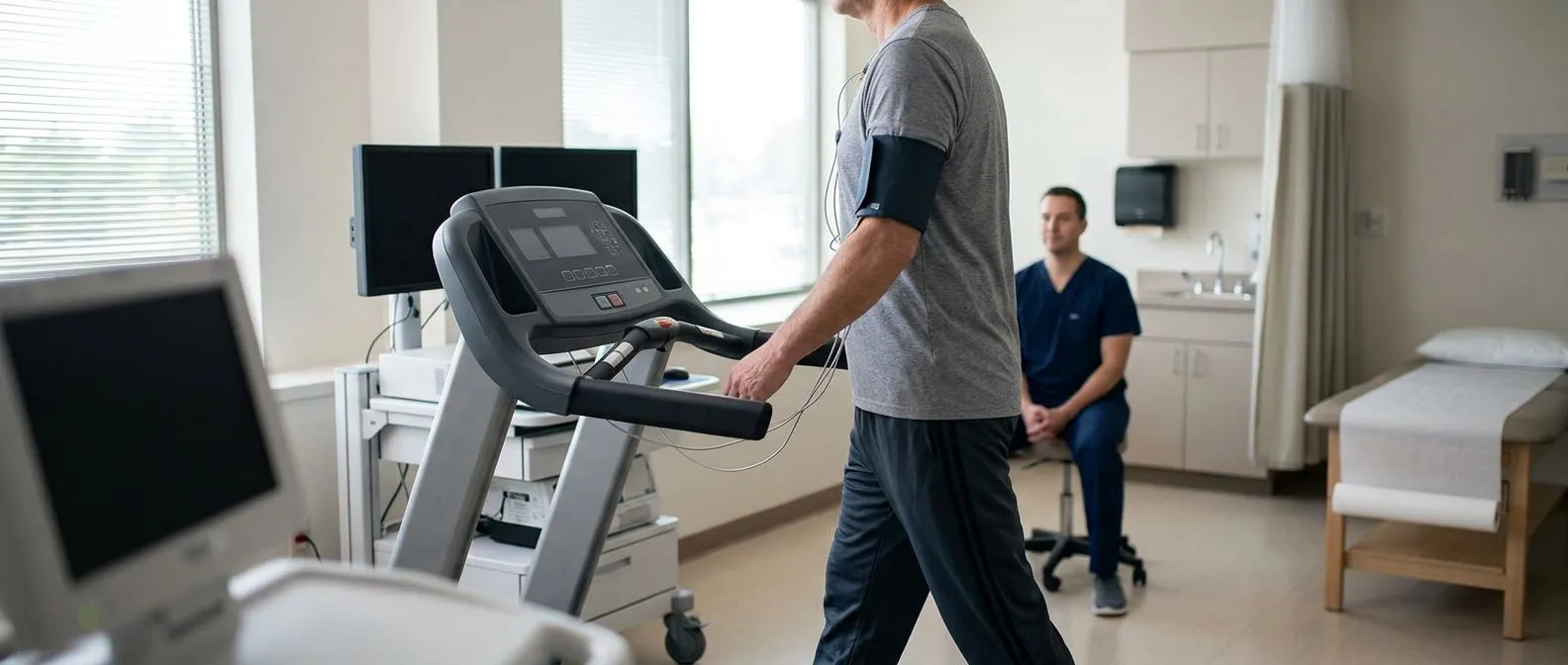
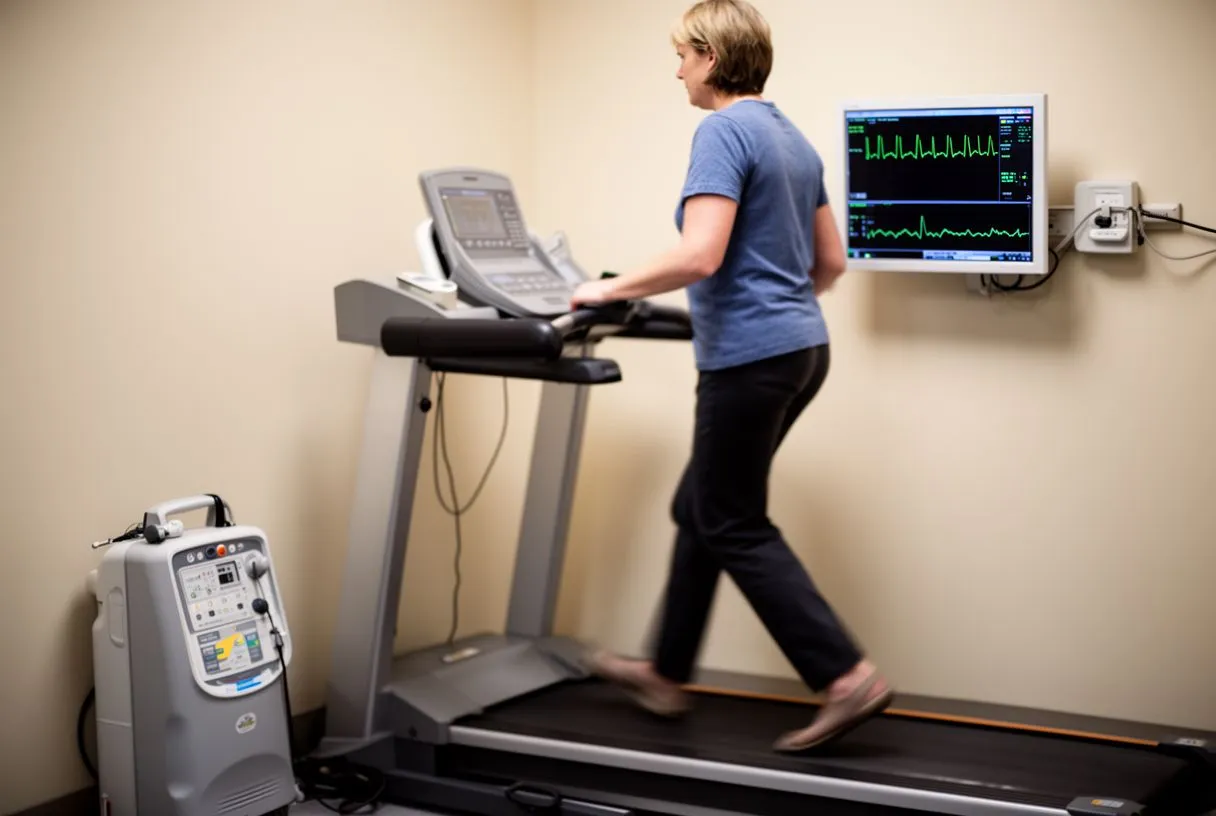
The treadmill test is the most familiar form of stress testing. Electrodes are placed on your chest, and you walk on a treadmill that gradually speeds up and steepens every few minutes. Meanwhile, your heart rhythm, blood pressure, and symptoms are monitored continuously. The goal is to reach a target level of effort based on your age, or to stop when symptoms appear.
What the test reveals is more than just fitness. Changes in the electrocardiogram during exercise can suggest myocardial ischemia. Blood pressure that fails to rise, or drops, can signal pumping problems. Chest pain or breathlessness at a low workload tells us how limited you already are. In patients with known chronic kidney disease, medication-based stress imaging is often preferred because it avoids the demands of treadmill exercise.
In our practice, every case is reviewed by the multidisciplinary team against international practice guidelines before we recommend any study. We explain what the test can and cannot show, and we only order the studies that will genuinely change the plan for your specific situation.
What Is a Cardiopulmonary Exercise Test and Who Needs One?
The cardiopulmonary exercise test, or CPET, is the most detailed exercise evaluation available. You exercise on a treadmill or bicycle while breathing through a mouthpiece connected to a gas analyzer. The test measures how much oxygen you consume, how much carbon dioxide you produce, and how your breathing and heart respond at every level of effort.
CPET is especially valuable when the cause of exercise intolerance is unclear. It distinguishes cardiac limitation from pulmonary limitation, and it identifies deconditioning. It also plays an important role before surgery, helping teams assess whether a patient can safely tolerate a major operation. When patients report persistent exercise intolerance after viral illness, careful exercise testing combined with cardiac imaging has helped document real physiological changes, as described in a study of exercise intolerance following COVID-19 using augmented cardiopulmonary exercise testing.
For most patients with straightforward symptoms, a standard stress test or echocardiogram is enough. CPET is reserved for cases where the answer remains elusive, or where precise measurement of exercise capacity will guide a major decision such as valve surgery or heart transplantation evaluation.
When Should You See a Cardiologist About Exercise Symptoms?
Knowing when to act is one of the most useful things you can take from this article. Some symptoms should never wait for a scheduled appointment, because they can signal a serious problem such as unstable angina or a dangerous arrhythmia.
- Seek urgent care: chest pressure at rest, chest pain with sweating or nausea, fainting, or breathlessness that comes on suddenly and severely
- See a cardiologist promptly: new breathlessness during routine activity, palpitations with dizziness, or exercise-induced chest pain that eases with rest
- Plan a consultation: a gradual decline in exercise capacity over weeks or months, fatigue that no longer improves with rest, or a family history of early heart disease
We encourage patients not to self-diagnose. The same symptom can range from harmless to urgent, and only proper testing can place yours on that spectrum. The first contact at our practice is a free video consultation: we get to know the patient, talk through the condition, and say which studies are still needed so that no unnecessary ones are ordered.
Can Exercise Intolerance Improve With Heart Treatment?
The encouraging news is that exercise intolerance usually improves when the underlying condition is treated. A patient with a severely narrowed aortic valve often reports being able to climb stairs again within weeks after transcatheter aortic valve replacement (TAVR), a procedure where a new valve is delivered through a catheter in the groin without opening the chest. Someone with a critical coronary blockage who receives a coronary stent, or percutaneous coronary intervention, frequently notices the difference on their first walk home.
Recovery takes patience even after successful treatment. The heart improves quickly, but the muscles and overall fitness take weeks to months to rebuild, and a structured cardiac rehabilitation program — supervised, gradually increasing exercise — is the safest way to do it. Medications for heart failure also work over weeks rather than days, and doses are adjusted as your body adapts.
In our experience, patients who set small, measurable goals — one more flight of stairs each week, a longer walk around the block — recover their confidence faster than those chasing a single big milestone. We also see patients who delayed treatment for years, and the difference in their recovery is real: treating the cause early almost always means an easier path back to normal activity.
Whether the answer is medication, a stent, a minimally invasive procedure, or conventional surgery, the choice depends on your anatomy and your overall health. We perform conventional, minimally invasive, robotic and transcatheter procedures, and we recommend the less invasive route only where the evidence supports it for that patient.
How Do You Choose the Right Cardiac Care Team?
Choosing a team for heart surgery or a major cardiac procedure is one of the most consequential health decisions you and your family will make. Look for a multidisciplinary team rather than a single opinion — a group that includes cardiac surgeons, cardiologists, and imaging specialists who review your case together before recommending anything.
Questions worth asking include how many procedures of your type the team performs each year, what the alternatives are, and what recovery realistically looks like for someone your age and with your health profile. A good team will present the alternatives openly, including the option of doing nothing immediately, and will make clear that the final decision is always yours.
Dr Molina trained in cardiothoracic surgery at the Universidad de Guadalajara, in cardiac, minimally invasive, robotic and structural surgery at the University of Montreal, and in structural cardiology and TAVR at CHU Bordeaux, and he performed the first robotic mitral valve repair in the Ángeles Health System and the first robotic heart surgery in Guadalajara. Our team also trained at Jena, Bad Berka and Buffalo. We encourage second opinions and treat seeking one as a normal part of deciding about heart surgery — a confident team will welcome it.
Exercise intolerance heart disease is a signal, not a sentence. It tells you that your body is asking for help, and in most cases the cause can be found and treated. If you have noticed that activity has become harder than it used to be, start with a conversation with a qualified cardiac team — and rather than diagnosing yourself, book a consultation so the right studies can be ordered and the right plan built for you.