Drug-Eluting Stent: Daily Life, MRI and Travel
Drug-eluting stent daily life made simple: MRI safety, travel rules, exercise, and work return timelines.
Life after a drug-eluting stent daily life question comes up in almost every consultation we hold. A stent is a small metal mesh tube that holds a coronary artery open after a blockage has been treated, and a drug-eluting stent is a type of coronary stent coated with medication that slowly releases to keep the artery from narrowing again. The procedure itself is usually over in an hour or two, but patients leave with real questions: can I fly, can I have an MRI, when can I go back to work? This guide walks through each of those answers in plain language, so you know what to expect and what to ask your own cardiac team.
What Is a Drug-Eluting Stent?
The basic idea. When a coronary artery — one of the vessels that feeds the heart muscle — becomes narrowed by plaque, blood flow drops and chest pain or a heart attack can follow. During angioplasty, a cardiologist inflates a small balloon at the narrowing, then usually leaves a stent behind to prop the vessel open. A drug-eluting stent adds a polymer coating that releases an antiproliferative drug over weeks or months, preventing scar tissue from re-narrowing the artery.
How it differs from a bare-metal stent. A bare-metal stent does the same mechanical job but has no medication coating, so scar tissue growth is more common and can lead to in-stent restenosis, the re-narrowing of the treated segment. Drug-eluting stents became the standard in most modern practice precisely because that medication layer lowers the rate of repeat procedures. Both types carry a need for blood-thinning medication, but the duration differs, which we will cover below.
Which type you receive. The choice depends on your artery anatomy, bleeding risk, and whether you need urgent non-cardiac surgery soon after. Manufacturers such as Meril Life Sciences and others produce several generations of drug-eluting stents with different coatings and drug-release profiles. Every case is reviewed by our multidisciplinary team against international practice guidelines before a recommendation is given, and the patient receives a clear proposal with the alternatives — the final decision is always theirs.
What Does Drug-Eluting Stent Daily Life Look Like in the First Days?
The first 48 hours. Most patients go home the same day or the next morning. The puncture site — usually the wrist (radial artery) or the groin (femoral artery) — needs to stay clean and dry. Expect mild bruising and a small, tender lump that fades over a couple of weeks. Avoid lifting anything heavier than about five kilograms for the first few days so the access site does not bleed.
What you can do at home. Walking is encouraged almost immediately; short, gentle walks several times a day help circulation and confidence. Showering is fine, baths and swimming should wait until the puncture site is fully healed, usually around a week. Keep an eye on the site: spreading swelling, active bleeding, or increasing pain at the puncture are reasons to contact your doctor the same day.
What feels normal versus not. Mild fatigue is very common for the first one or two weeks — the heart has just been through a procedure, and your body needs time to adjust. Chest discomfort that is new, severe, or comes with sweating, nausea, or breathlessness is never something to wait on; go to an emergency department. Ask your treating team for this kind of day-by-day roadmap before the procedure, so you do not go home guessing.
Can You Have an MRI With a Drug-Eluting Stent?
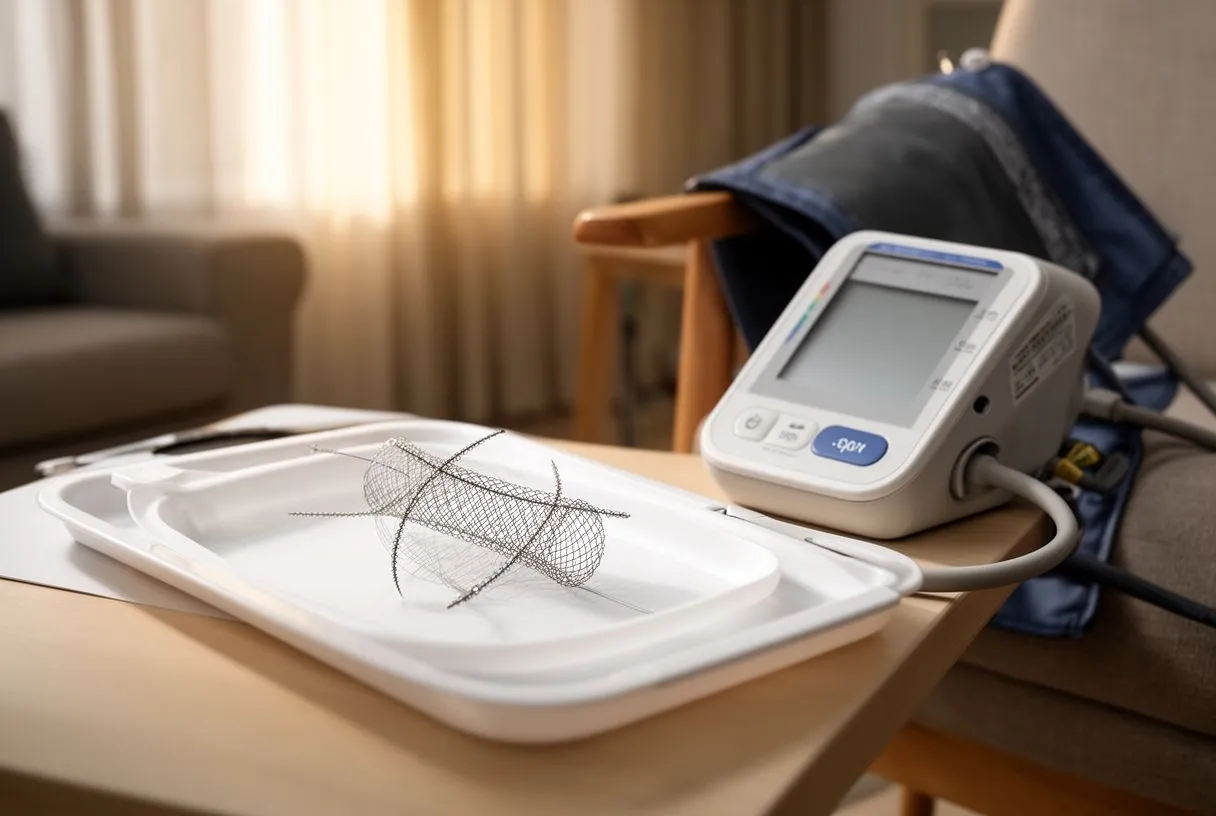
The short answer. In the great majority of cases, yes. Modern coronary stents — including virtually all drug-eluting stents — are made of non-ferromagnetic or only weakly magnetic materials such as stainless steel alloys, cobalt-chromium, or platinum-chromium. Studies and device labeling consistently show that these stents do not move, heat, or deform under clinical MRI conditions, which is why the MedlinePlus guidance on implants treats most coronary stents as MRI-compatible. Manufacturers typically mark a stent "MR-conditional," meaning it is safe in an MRI scanner under specific field strengths, usually up to 1.5 or 3 Tesla.
What the radiologist needs to know. Before an MRI — and this includes a cardiac MRI scan, which is often the best test to assess heart muscle scarring and function after a stent — you should tell the imaging center that you have a stent, and ideally bring the card from your procedure stating its brand, model, and implant date. With that information, the radiologist can verify the device's MR-conditional status before scanning. Most stents implanted in the last decade pose no barrier to a cardiac MRI.
A practical caveat. Older stents, implanted roughly before 2000 or so, occasionally lack clear MR-conditionality documentation. If that is your situation, the imaging team may need to contact the manufacturer or weigh the clinical need against the small uncertainty. In practice the stent rarely turns out to be the obstacle — the scheduling paperwork usually is.
What Are the Drug-Eluting Stent Travel Restrictions?
Early travel. In the first days after the procedure, the main concern is not the stent itself but the access site and the possibility of complications needing urgent care. Most cardiologists advise staying within reasonable reach of your treating hospital for roughly the first week. If you live abroad and traveled to Mexico for the procedure, plan your return journey with your treating team, who will confirm the artery has stayed open and that you are stable on your medications.
Travel after heart surgery versus after a stent. Recovery from open heart surgery, which involves a sternotomy and weeks of healing, follows much stricter travel timelines than a stent procedure. Travel after heart surgery is typically deferred for four to six weeks or more, while most patients who have had only a stent can travel within days to a couple of weeks, depending on stability. Knowing which category your treatment falls into changes the whole conversation, so ask explicitly.
Practical checklist before any trip. Wherever you go, preparation matters more than distance. Keep these points in mind:
- Carry all medications in original labeled packaging in your hand luggage, with at least a few extra days' supply.
- Travel with a summary letter listing your stent model, implant date, and blood-thinner doses.
- Know where the nearest hospital with a cardiac catheterization laboratory is at your destination.
- Keep taking antiplatelet medication exactly on schedule, even across time zones — set phone alarms.

How Soon Can You Fly After a Drug-Eluting Stent Procedure?
Commercial flying timelines. For an uncomplicated stent procedure done through the wrist, many patients can fly short-haul within a few days; for longer flights, most teams suggest waiting about a week so that any access-site issue or early complication would already have declared itself. If the procedure was done emergently during a heart attack, or through the groin, the waiting period is usually longer — your cardiologist will give you a specific clearance rather than a general rule.
Why the delay matters. Cabin pressure, prolonged sitting, and dehydration all mildly increase circulatory strain, and a puncture site in the femoral artery is vulnerable to pressure changes and straining. The real reason for the wait, though, is simply that the highest-risk window for stent problems is the first days; being far from your treating hospital during that window is the avoidable risk. Metal detectors and airport scanners are a non-issue — a stent is small and almost never sets off alarms, and a device card resolves questions on the rare occasion it does.
On the flight itself. Book an aisle seat so you can stand and walk the cabin every hour or so, drink water regularly, and avoid alcohol on longer flights since it promotes dehydration. Compression stockings are reasonable advice for flights over four hours in the first weeks. International patients should ask for written instructions sized to the journey length before the flight home.
What Exercise Is Safe With a Drug-Eluting Stent?
The general progression. Walking starts within days. Most patients can resume moderate activity — brisk walking, cycling on flat ground, swimming — within one to two weeks, and return to more vigorous exercise such as running or gym training after about two to four weeks, depending on how the procedure went and whether there was a heart attack. Your own cardiologist's clearance always overrides generic timelines.
Cardiac rehabilitation. For patients who had a heart attack before the stent, structured cardiac rehabilitation is one of the most valuable steps in the whole recovery. A drug-eluting stent cardiac rehabilitation program combines supervised, gradually increasing exercise with education on diet, stress, and medication, and it is associated with better long-term outcomes and quality of life. If your team offers it, take it — the sessions build confidence in a way that going it alone rarely does.
Listen to the signals. Some practical recovery tips for exercising safely:
- Start with 10–15 minute walks and add a few minutes each day rather than jumping to long sessions.
- Stop and rest for chest pressure, unusual breathlessness, dizziness, or palpitations, and report them.
- Avoid exercising in extreme heat or cold in the first weeks; both make the heart work harder.
- Skip heavy straining (maximal weightlifting) until cleared, because it spikes blood pressure briefly.
In our consultations we take the time to explain what the studies actually show about exercise after a stent, in plain words, and to set a realistic plan for the patient's own fitness level before any decision.
Why Is Medication Adherence So Important?
The two-drug combination. After a drug-eluting stent, patients take dual antiplatelet therapy: aspirin plus a second medication such as clopidogrel, ticagrelor, or prasoprel. These drugs keep platelets — the tiny blood cells that form clots — from sticking to the stent's metal surface. Missing doses raises the risk of stent thrombosis, a clot forming inside the stent, which is uncommon but can cause a heart attack and is one of the most serious complications of the procedure.
How long the therapy lasts. The typical course of dual therapy runs from six to twelve months, after which the stronger second drug is often stopped and aspirin continues long-term. The exact duration depends on bleeding risk, the stent type, and whether other procedures are planned — which is precisely why stopping early "because you feel fine" is dangerous; the medication schedule is set for a reason, not a habit.
Practical ways to stay on track. Use a weekly pill organizer, anchor doses to a fixed daily event such as breakfast, and set phone reminders. Before any other doctor, dentist, or surgeon prescribes or stops a medication, tell them you have a stent and take antiplatelet drugs — a drug interaction between an antiplatelet agent and another medicine (for example, certain anti-inflammatories or anticoagulants) can tip the balance toward bleeding. Bring your full medication list to every appointment, and make sure any changes are coordinated between your treating doctors.
When Can You Return to Work After a Stent?
Desk jobs. Most patients with sedentary work go back within a few days to a week, once the puncture site is comfortable and they are driving again. Fatigue is the main limiter rather than physical capability; planning a lighter first week back makes the transition much smoother.
Physical jobs. Work involving heavy lifting, machinery operation, or sustained exertion usually needs two to four weeks, and sometimes longer if the stent was placed during a heart attack with reduced heart function. The guiding principle is a gradual return: reduced hours or lighter duties at first, building up over two or three weeks. An occupational health or cardiology sign-off is worth arranging for jobs with safety-critical demands, such as commercial driving.
Driving itself. After an elective stent through the wrist, most patients can drive within about a week. After a heart attack, guidelines commonly advise waiting longer — often one to four weeks depending on the country and the severity — so confirm with your own team rather than a friend's experience. Every patient's case is reviewed by our multidisciplinary team against international guidelines before we advise on returning to work, and we always put the alternatives and the reasoning in front of the patient.
Are There Dental Precautions After a Stent?
Routine dental care is safe. Cleanings, fillings, and everyday dental treatment do not require stopping or changing your antiplatelet medication. In fact, keeping your teeth and gums healthy matters more after a stent, not less — chronic gum inflammation is associated with systemic inflammation, and good oral health is part of good cardiovascular health. Tell your dentist about the stent and your medications so they have the full picture.
The timing question. If extensive dental work is planned, it is wise to wait until the dual antiplatelet therapy period has ended, if that is clinically possible, because bleeding during procedures is slightly heavier on two antiplatelet drugs. Never stop aspirin or the second antiplatelet for a dental procedure without written clearance from your cardiologist — the small risk of a gum-bleeding nuisance is far outweighed by the risk of stent thrombosis.
Practical tips. Schedule dental appointments in the morning, mention your medications at booking, and expect minor gum oozing that stops with simple pressure. If bleeding persists beyond what your dentist considers normal, call both your dentist and your cardiologist. This question is common and can usually be resolved by a short conversation between your treating team and your dentist.
What Does Long-Term Care Look Like After a Stent?
Monitoring schedule. After the procedure, most teams see patients at around two to four weeks, then at three to six months, and roughly annually thereafter, with periodic blood tests for cholesterol, kidney function, and blood counts. Imaging of the stent itself — a repeat angiogram — is not routine; it is done only if symptoms return or a stress test suggests a problem. Research on in-stent restenosis patterns, including long-term outcome studies published in JAHA: Journal of the American Heart Association, has clarified which types of re-narrowing carry which risks, and that evidence shapes how closely a patient needs follow-up.
Preventing complications over years. The stent treats one blockage, but the disease process that caused it continues throughout the arteries. Long-term care therefore means: taking statins and blood pressure medication as prescribed, not smoking, keeping diabetes tightly controlled, staying physically active, and maintaining a Mediterranean-style diet. These drug-eluting stent recovery tips sound unglamorous, but they are what separates a stent that lasts from a second procedure down the line.
Warning signs to act on. Return to medical care promptly for chest pain or pressure that is new or reproducible with exertion, breathlessness that limits ordinary activity, or symptoms like those that led to the original procedure. Early re-evaluation catches a problem while it is still straightforward to treat. Good follow-up looks at the whole picture — symptoms, medications, risk factors — not just the stent, because the goal is the patient's long-term quality of life, not the absence of a procedure.
Bringing it together: life with a drug-eluting stent is, for the great majority of patients, close to ordinary life. MRIs are almost always possible, flying is a matter of timing rather than prohibition, work and exercise return within weeks, and the medication schedule — taken faithfully — is what protects the stent. The two things that matter most are the antiplatelet regimen in the first year and the lifestyle and cholesterol care that protect the rest of your arteries for decades. If you are facing a stent procedure, or you have one and are unsure about any of these questions, discuss your specific situation with a qualified cardiac team rather than deciding alone. Our multidisciplinary team led by Dr Alejandro Molina offers a free first video consultation in which we review your studies, explain your options plainly, and only then recommend which additional tests — if any — are genuinely needed. Booking that conversation costs nothing and usually replaces anxiety with a clear plan.