

Reduced Functional Capacity in Heart Disease
Reduced functional capacity heart symptoms and causes explained by Guadalajara specialists.
If walking to the corner shop or climbing a short flight of stairs suddenly leaves you breathless, tired, or needing to stop and rest, your body may be telling you something important about your heart. Doctors call this reduced functional capacity heart — in plain words, your heart can no longer support the activity you used to manage with ease. It is one of the most common complaints among people with heart disease, and one of the most useful clues for measuring how well treatment is working. This guide explains what reduced functional capacity actually means, why it happens, how it is measured, and what can be done about it — in language you can share with your family and bring to your next appointment.
What Does Reduced Functional Capacity Mean?
The meaning of functional capacity. Functional capacity is simply the amount of physical work your body can sustain — walking, climbing stairs, carrying groceries, gardening — without undue fatigue or breathlessness. When heart disease limits the heart's ability to pump blood efficiently, less oxygen reaches your muscles, and everyday activities start to feel like hard labour. Doctors measure this on a scale called metabolic equivalents, or METs, where 1 MET is sitting quietly and everyday independence generally requires somewhere around 4 to 5 METs. Poorly preserved capacity is one of the strongest predictors of long-term outcomes in cardiovascular medicine, as studies indexed in SpringerLink have repeatedly shown.
What it feels like day to day. Patients usually describe it the same way: "I run out of steam." Tasks that were automatic — making the bed, walking the dog, keeping pace with family — now require a pause or a plan. Importantly, this is different from joint pain or general ageing; the hallmark of heart-related limitation is that rest relieves it, and effort reliably brings it back.
Why it matters for decisions. Functional capacity is not just a symptom — it helps your cardiac team choose treatment. A patient with poor capacity and severe valve disease may need surgery sooner than test numbers alone would suggest. In our consultations, we explain what the studies actually show in plain words, so the patient understands not just the diagnosis but what their heart can and cannot currently do.
What Are the Signs of Functional Decline?
The early warnings. Functional decline rarely arrives overnight. It usually creeps in: needing more frequent rests while shopping, avoiding stairs, sleeping in a chair instead of a bed, or asking family to carry things. These are examples of functional disabilities in the cardiovascular sense — real losses of independence that patients often dismiss as "just getting older." Distinguishing genuine decline from deconditioning requires proper evaluation, which is why these changes deserve a conversation with a doctor rather than quiet resignation.
Common signs include breathlessness on exertion, chest pressure during activity, swollen ankles, a fast or irregular heartbeat when walking, and unexplained fatigue. In practice, we also watch for subtler markers: a shrinking daily step count, a patient who arrives in a wheelchair "just for the parking lot," or a spouse who says, "he hasn't left the sofa in weeks."
- Breathlessness: stopping to catch your breath on activities you previously finished easily
- Leg fatigue: heavy, aching legs that force early stops, even without chest pain
- Sleep and posture changes: needing extra pillows or sleeping upright because lying flat triggers shortness of breath
If several of these are appearing together over weeks or months, that pattern — rather than any single symptom — is what suggests a cardiac cause and justifies a proper work-up.
What Causes Reduced Functional Capacity in Heart Disease?
The pump, the pipes, and the valves. Reduced exercise capacity in heart patients almost always traces back to one of three problems: the heart muscle itself (for example, heart failure functional capacity decline), the coronary arteries, or the valves. When the heart cannot increase its cardiac output — the amount of blood it moves with each beat — the muscles receive less oxygen and fatigue arrives early.
Coronary causes. Narrowed coronary arteries are a classic driver. In Coronary Artery Disease, plaques limit blood flow precisely when the heart needs it most, during exertion. This is why exercise can provoke chest pain or breathlessness that rest relieves. Some patients have no pain at all but simply lose capacity — a pattern we see especially in older patients and people with diabetes, and it always warrants investigation.
Valve and structural causes. Narrowed or leaking valves — as in Valvular Heart Disease or a history of Rheumatic Heart Disease — make the heart work harder for the same output, draining capacity over years. Other contributors include long-standing high blood pressure, Chronic Kidney Disease, anaemia, lung disease, and deconditioning from a sedentary life. Frequently, several of these stack together, which is why careful assessment matters more than any single test.
How Do Doctors Measure Heart Disease Reduced Exercise Capacity?
The six-minute walk test. The simplest and most widely used measure of reduced physical capacity in heart patients is the six-minute walk test: you walk at your own pace along a marked corridor for six minutes, and the distance covered is compared with expected values for your age and sex. It requires no expensive equipment, and research on tele-cardiac rehabilitation programs has used it precisely because it reliably captures real-world capacity — for example, work published at the International Journal of Physiotherapy and Research on coronary bypass patients used it to track recovery of functional independence and hand grip strength.
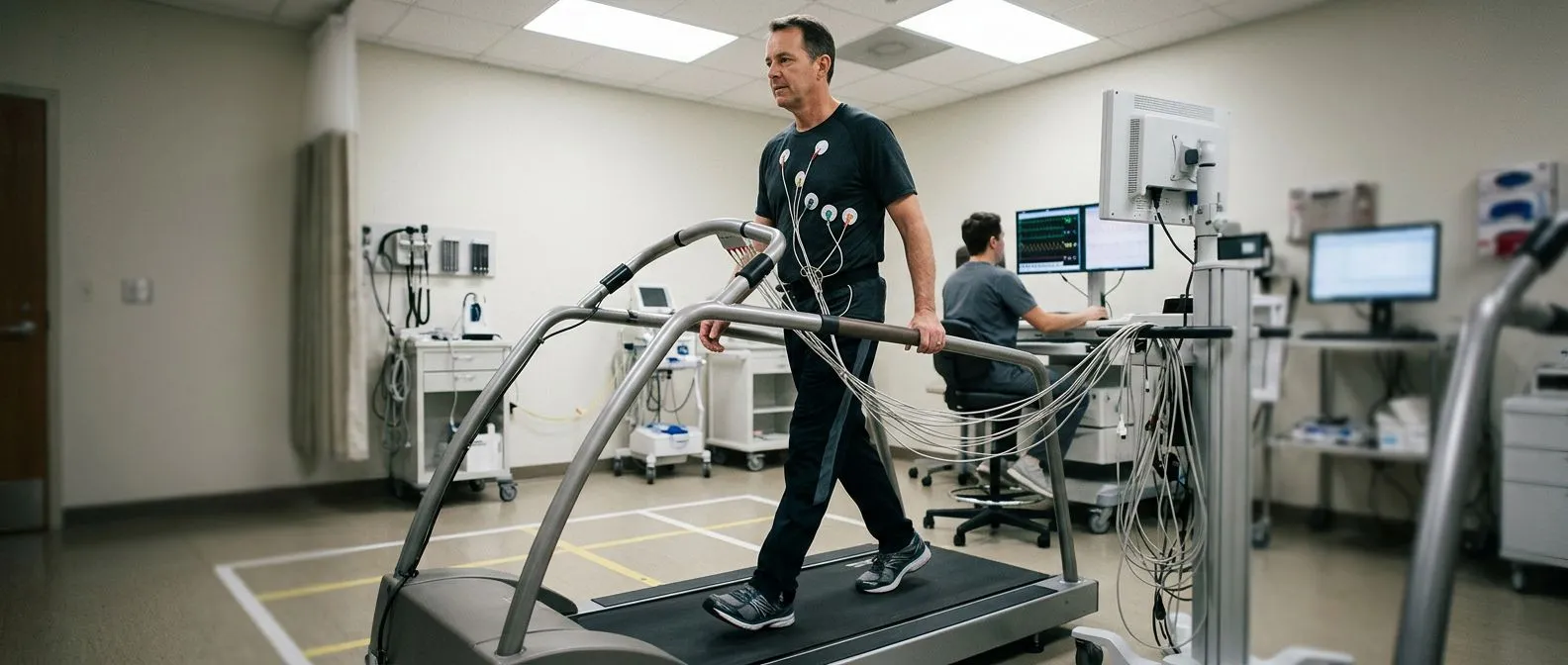
Exercise stress testing. For a more precise picture, cardiologists use treadmill or bicycle stress tests with an electrocardiogram, and sometimes echocardiography or stress imaging alongside. These tests show how the heart responds under graded demand and can reveal problems that a resting test misses entirely.
Cardiopulmonary exercise testing. The gold standard is CPET — breathing analysis during exercise — which measures peak oxygen uptake (VO2). It tells the team whether breathlessness comes from the heart, the lungs, or both, and it helps quantify surgical risk. In our team, every case is reviewed by the multidisciplinary group against international practice guidelines before any recommendation, and these exercise numbers are often what tips a decision from "watch and wait" to "treat."
What Is a Functional Capacity Test?
Beyond the treadmill. A functional capacity test is a structured assessment of what you can safely do in daily life — not just how long you can walk on a treadmill. Formal Functional Capacity Evaluations used in occupational settings measure lifting, carrying, standing tolerance and repetitive tasks; in cardiac care, the equivalent is a graded exercise test plus questions about your typical day. Together, these translate "your echo shows a leaky valve" into "you can safely walk three blocks but not carry the shopping upstairs."
What the numbers mean for you. A rough clinical shorthand is walking blocks: patients who can manage only one to two blocks before symptoms have significantly limited capacity, while four to five blocks or more suggests reserve. There is no pass or fail — the goal is an honest baseline from which recovery can be measured.
Does a functional capacity test determine a percentage of disability? In insurance and social security contexts, yes — formal evaluations produce percentile ratings used for claims. In cardiac care, we use the same underlying information differently: to guide treatment timing and to set safe, realistic goals for rehabilitation.
Reduced Functional Capacity Heart Symptoms by Condition
Heart failure. Reduced functional capacity is the defining symptom of heart failure. Patients typically notice breathlessness and fatigue that worsen over months, plus fluid retention — swollen ankles, abdominal fullness, and weight gain. Doctors traditionally grade this on the New York Heart Association (NYHA) scale, from Class I (no limitation) to Class IV (symptoms at rest). If your own capacity has slipped a full class, that is meaningful, reportable information for your cardiologist.
Coronary disease. Here the picture is chest-centred: pressure, tightness, or burning during exertion — Angina — that resolves with rest. Some patients experience atypical forms: jaw discomfort, arm ache, or pure breathlessness. Others develop reduced capacity without any pain, particularly after a silent heart attack; this is Ischaemic Heart Disease presenting quietly, and it deserves the same seriousness as a dramatic chest episode.

Valve disease and other structural problems. Severe aortic stenosis — a narrowed aortic valve — classically produces the triad of breathlessness, chest pain, and fainting on exertion; any of these means the valve needs prompt attention. Mitral valve problems cause fatigue and breathlessness, sometimes with palpitations. Structural conditions such as Congenital Heart Disease in adults, or consequences of procedures on the coronary ostia or the Left Main Coronary Artery, each carry their own capacity patterns. A prior Coronary Stent, Percutaneous Coronary Intervention, or Coronary Artery Bypass Grafting may restore flow, but capacity recovery then depends on the heart muscle itself and on rehabilitation.
How Treatment Improves Heart Function Capacity Decline
Fixing the underlying problem. The most reliable way to restore capacity is to treat the cause: opening or bypassing blocked arteries, repairing or replacing a failing valve, or optimising heart-failure medication. Modern medicine offers several routes — from medication adjustments to transcatheter procedures like TAVR (transcatheter aortic valve replacement, a new valve delivered through the arteries without open surgery) — and the right choice depends on the patient, not the technology. Our team performs conventional, minimally invasive, robotic and transcatheter procedures, and we recommend the less invasive route only where the evidence supports it for that particular patient.
Medication as a capacity tool. Guideline-directed medical therapy in heart failure — the combination of drug classes proven to improve survival and symptoms — genuinely restores functional capacity over months, not days. Patients often tell us they feel the difference within weeks of an optimised regimen, but the full benefit builds gradually and requires patience with side-effect adjustments.

Rehabilitation. No treatment beats structured, supervised exercise for rebuilding capacity safely. Cardiac rehabilitation is covered in detail below, but the headline is consistent across every major guideline: it improves symptoms, exercise tolerance, and quality of life with a strong safety record. Research on tele-rehabilitation after coronary bypass — including the study at ijphy.com — shows that even home-based supervised programs can improve functional independence, hand grip strength and six-minute walk distance in patients who cannot attend in person.
Cardiac Rehabilitation Reduced Capacity: Recovery Explained
What a program actually looks like. Cardiac rehabilitation is a supervised program of graded exercise, education, and lifestyle support, usually running two or three sessions a week for twelve weeks. You begin below your tested limit and increase gradually, always monitored. It is one of the most evidence-backed treatments in cardiology, yet one of the most under-used — patients assume it is optional, when in truth it is treatment, not a perk.
What realistic recovery looks like. Most patients regain a meaningful share of lost capacity within the first three months, and continued gains over the first year. Recovery after open surgery follows a rough arc: walking freely within two to three weeks, driving and light duties around six weeks, and progressive strengthening over three months. After minimally invasive or transcatheter procedures, the physical recovery is often faster, though the underlying heart still needs time and conditioning.
- Start low, progress slow: short daily walks build the habit and the aerobic base
- Stay supervised: monitored sessions catch rhythm or blood pressure changes you would not notice
- Bring the family: recovery outcomes improve when the household understands the plan and joins the walking
When capacity does not return. If months of good rehabilitation and optimised treatment leave you no better, that is a finding, not a failure. It prompts re-evaluation: repeat imaging, a check for residual blockages or valve problems, and a look for non-cardiac contributors such as lung disease or anaemia. Persistent decline in Functional Capacity deserves the same rigour as the initial diagnosis.
When to Seek a Heart Specialist for Reduced Capacity
Red flags that need urgent attention. Some situations are emergencies, whatever your baseline: chest pain at rest or lasting more than a few minutes, fainting on exertion, breathlessness that comes on suddenly or wakes you at night, or a racing heartbeat with dizziness. These need immediate medical care — call emergency services rather than waiting for a scheduled appointment.
When a planned consultation is enough. Gradual loss of exercise tolerance, new breathlessness on familiar activities, or ankle swelling that persists are all appropriate reasons to book a specialist review within days to weeks. Bring a simple record: what you could do six months ago, what you can do today, and anything that triggers symptoms. That single comparison often tells more than an hour of tests.

Getting an honest second view. Heart surgery decisions deserve certainty. Our first contact is a free video consultation: we get to know the patient, talk through the condition, and say which studies are still needed so no unnecessary ones are ordered — a face-to-face visit follows only when the patient decides to go ahead. We encourage second opinions and treat seeking one as a normal part of deciding about heart surgery; the patient receives a clear proposal with the alternatives, and the final decision is always theirs.
Living Well With Cardiovascular Functional Limitations
Quality of life is the real goal. For most patients, the question is not "what is my ejection fraction?" but "will I be able to dance at my granddaughter's wedding?" Heart disease quality of life research consistently shows that capacity, symptoms, and confidence predict life satisfaction far better than isolated test numbers. Set concrete goals — walking to the plaza, returning to the garden, travelling — and measure progress against those, not against a treadmill printout.
Daily habits that protect capacity. Beyond medical treatment for reduced functional capacity, the controllable basics matter enormously: staying active within safe limits, keeping salt intake low, taking medications exactly as prescribed, protecting sleep, and managing weight. Avoiding complete rest is important too — prolonged bed rest after illness is one of the fastest ways to lose muscle and capacity that the heart then has to re-supply.
Your next step. Reduced functional capacity in heart disease is common, measurable, and — in most cases — improvable. The pattern is nearly always the same: understand the cause, treat it properly, rebuild with rehabilitation, and stay active for life. If you or someone you love is losing ground on everyday activities, do not self-diagnose. Bring those changes to a qualified cardiac team — our consulting rooms in Guadalajara, Querétaro and Hermosillo exist precisely for that conversation — and book a consultation to find out what your heart is actually saying before the next test says it for you.






