The Surgical Safety Checklist in Heart Operations
Surgical safety checklist heart surgery steps explained: sign in, time out, sign out.
Anyone facing heart surgery naturally asks two questions: will the operation go well, and what protects me while I am asleep? A large part of the honest answer is something surprisingly simple — the surgical safety checklist in heart surgery. It is a short, structured list the whole team reads aloud together before, during and after the operation. It catches small problems before they become serious ones, and decades of evidence show it saves lives. This guide walks you through what the checklist contains, when each part happens, and what you as a patient can do to take part in it.
What Is a Surgical Safety Checklist?
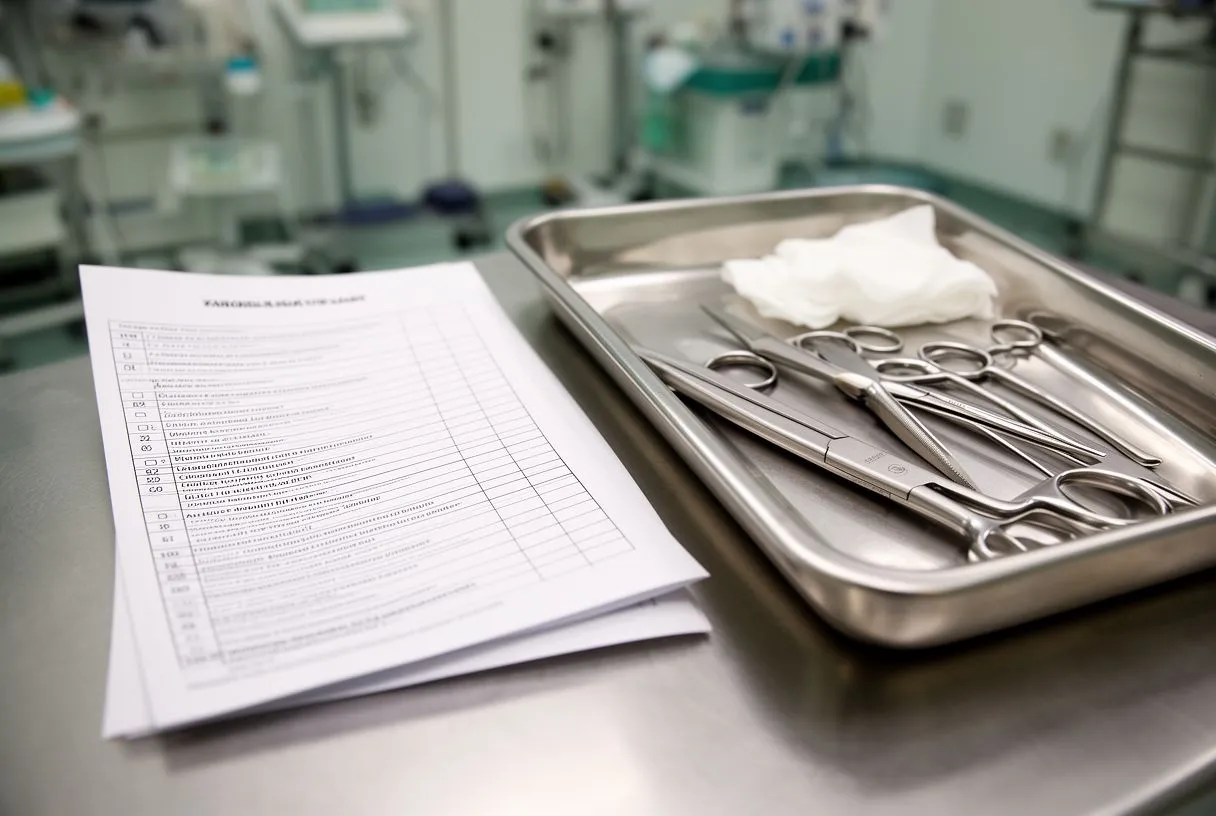
A surgical safety checklist is a printed or digital list of essential safety steps that the operating room team completes together at defined moments around an operation. It was popularised by the World Health Organization's Safe Surgery Saves Lives programme, which published a 19-item version designed to work in any hospital, anywhere in the world.
Where did it come from? The idea was borrowed from aviation, where pilots have run through pre-flight checklists for decades because memory alone fails under pressure. When the WHO pilot-tested its checklist in eight hospitals across six countries — from rich and poor settings alike — major complications after surgery fell and deaths dropped significantly. A Surgical Safety Checklist to Reduce Morbidity and Mortality in a Global Population published these landmark findings in the New England Journal of Medicine, and they changed practice worldwide.
What is actually on it? The WHO list covers three moments: before anaesthesia ("sign in"), before the skin incision ("time out") and before the patient leaves the operating room ("sign out"). Items include confirming the patient's identity, the planned procedure and side of the body, checking that blood and equipment are ready, and counting sponges and instruments at the end. In our practice, every case is reviewed by the multidisciplinary team against international practice guidelines before an operation is even recommended — the checklist inside the operating room is the final layer of that same safety culture.
Why Heart Surgery Teams Use a Checklist
Heart operations are among the most complex procedures in medicine. They involve stopping or supporting the heart, managing the heart-lung machine, choosing between many possible techniques, and coordinating a large team — surgeon, anaesthesiologist, perfusionist, scrub nurse and more. With so many moving parts, the risk of a preventable error is real, and checklists are the single best-studied way to reduce it.
The human reason. Even excellent surgeons and anaesthesiologists forget things when they are rushed or distracted. A checklist does not replace skill; it protects skill from fatigue, interruption and overconfidence. Nature has reported extensively on how structured team communication improves outcomes in complex medicine, and the operating room is where that structure matters most.
What it means for you as a patient. When the team pauses to confirm your name, your operation and your allergies out loud, that pause is your protection. It is completely normal — and should feel reassuring. We encourage our patients to see the time out as something done for them, and we welcome questions about how our safety routine works, because an informed patient is part of the safety net too.
What Are the Five Stages of Surgical Care?
Surgeons often describe surgical care as five linked stages, and the checklist threads through all of them. Understanding the stages helps you know what to expect and when each safety conversation happens.
- Preoperative evaluation: your history, physical exam, blood tests, echocardiogram and any catheterisation are reviewed so the operation and anaesthesia plan match your specific condition.
- Informed consent and planning: you and your surgeon agree on the exact procedure and its alternatives — in our consultations we take the time to explain what the studies actually show, in plain words, before any decision.
- Immediate preoperative preparation: fasting instructions, skin preparation, medication adjustments and the sign-in verification in the holding area.
- The operation itself: the time out before incision, the procedure, and the sign out before you leave the operating room.
- Postoperative care and handoff: recovery in the ICU, a structured handoff to the ward team, and clear instructions for discharge and follow-up.
Each stage has its own small checklist — from the anesthesia checklist used while you are being put to sleep, to the postoperative handoff checklist the ICU team receives. The value comes from the chain: a weakness at any stage puts the whole journey at risk, so each link is verified.
What Happens at Sign In Before Heart Surgery?
Sign in happens in the holding area or operating room before anaesthesia begins. The anaesthesia team leads it, and it is the moment designed to confirm the right patient is about to receive the right operation safely.
Identity and consent confirmed. The team checks your full name, your date of birth, and matches them to your wristband and consent form. They confirm you understand and agree to the planned procedure — for example, a coronary bypass or an aortic valve replacement.
Site marking. If any part of the operation depends on side or location, the surgeon marks the site with your involvement. In cardiac surgery this matters for procedures such as minimally invasive access or vein harvesting from a specific leg, so the surgical site marking checklist step is never skipped.
Medical readiness. The team reviews your allergies, your airway, whether you have any loose teeth or implants, your risk of bleeding, and whether any last bloodwork is pending. Your fasting status is confirmed, and any intravenous access is checked. In our practice, the first contact is a free video consultation where we identify exactly which studies are needed so no unnecessary ones are ordered — and by the time you reach sign in, that file is complete and verified.
What Is the Surgical Time Out in a Heart Procedure?
The time out is a deliberate pause taken by the entire team just before the first incision. Everyone stops what they are doing, and the checklist is read aloud. It usually takes under two minutes.
What gets confirmed. The surgeon states the patient's name and the planned procedure. The anaesthesiologist confirms the patient is properly positioned, monitored and asleep. The scrub nurse confirms that instruments and implants — for example, a specific valve prosthesis — are present and sterile. Any anticipated critical events, such as expected blood loss or the need for a particular heart-lung machine setup, are announced.
Why "everyone" matters. The power of the time out comes from participation, not paperwork. Studies on surgical safety checklist compliance in cardiac surgery show that outcomes improve most when the whole team speaks and listens — not when one person signs a form silently.
What you might notice. If you are still awake during part of it, you may hear your own name being spoken by several people. That is the system working exactly as intended.
What Is the Sign Out After Heart Surgery?
Sign out happens as the operation ends, before you leave the operating room. It is the step patients know least — yet it prevents some of the most common surgical errors.
Counts and completeness. The scrub and circulating nurses confirm that sponges, needles and instruments are all accounted for. The surgeon reviews what was actually done, whether anything unexpected was found, and what the recovery team should watch for.
Equipment and specimens. The team confirms any implants used are recorded correctly, that equipment is functioning for the next steps, and that any tissue specimens are properly labelled. In valve surgery, for instance, the exact valve type and size entered is documented and cross-checked.
Concerns for recovery. The anaesthesiologist and surgeon voice anything the ICU team needs to know — a difficult airway, a brief drop in blood pressure, expected drainage. This verbal handoff is the start of the postoperative handoff for heart surgery patients, and it is where continuity of care really begins.

How Do You Prepare a Patient for a Heart Operation?
Preparation begins days or weeks before the checklist is ever printed, and your own actions play a direct role in how smoothly the safety checks go.
Follow fasting and medication instructions. You will be told when to stop eating and drinking, and which medications to take or hold — blood thinners and diabetes drugs especially. Skipping these steps can force the team to postpone surgery, so if anything is unclear, call ahead. That is exactly why we use a free video consultation as the first contact: it is where these instructions get personalised and confirmed.
Bring an accurate medication and history list. The sign-in step depends on honest, complete information about allergies, supplements and prior reactions to anaesthesia. Write it down before the day of surgery.
Ask questions early. In our experience, patients who understand their operation ask better questions and recover with more confidence. We take the time to explain what the studies actually show and to answer every question before any decision — and we encourage second opinions, treating them as a normal part of deciding about heart surgery. A common practical question is why you cannot wear a bra during surgery: metal clasps interfere with monitoring equipment and electrocautery, and clothing must allow full access for the surgical preparation, so jewellery and undergarments with metal come off before you enter the operating room.
What Are the Top 3 Riskiest Surgeries — and How Checklists Help?
Patients often read lists of the "riskiest surgeries" and worry. Cardiac operations regularly appear on such lists, alongside complex emergency procedures. It is worth understanding why — and why risk ranking says less about your individual case than you might think.
Why cardiac procedures rank high. Open-heart surgery involves the body's central pump and often the heart-lung machine, which carries risks of bleeding, stroke, kidney strain and infection. Emergency aortic surgery and complex repeat operations add further challenges. But modern risk scoring tools such as EuroSCORE II estimate each patient's individual risk before surgery, and the whole plan — including whether a conventional, minimally invasive, robotic or transcatheter approach is appropriate — is chosen against that estimate. In our team, every case is reviewed by the multidisciplinary group against international guidelines before a recommendation is made, and the final decision is always the patient's.
How checklists change the picture. The landmark WHO study showed that even in these high-stakes operations, structured verification reduces death and major complications. Checklist items directly target the known failure points of big operations: correct patient, correct procedure, blood available, critical equipment present, and a shared plan for foreseeable problems.
Context matters more than rankings. A "risky surgery" performed by a well-coordinated team in a hospital with a strong safety culture is often safer than a "minor surgery" done carelessly. When you compare hospitals or surgeons, asking about their safety routine is one of the most revealing questions you can ask.
Why Checklist Compliance Matters More Than the Paper
Having a checklist and actually following it are two different things, and the difference shows up in patient outcomes.
The compliance gap. Research published on PMC — the National Institutes of Health's open-access archive — has documented that checklist use can be uneven within the same hospital: teams tick boxes without pausing, or skip steps when they feel rushed. Clinical audits of surgical safety checklist compliance in cardiac surgery consistently find that engagement, not the document itself, predicts benefit.
How good teams stay compliant. Strong programs audit their own checklists regularly, train new staff to speak up, and treat any skipped step as a system problem to fix rather than a person to blame. Some hospitals give the checklist a fixed place in the workflow — no incision until the time out is complete and spoken.
The patient's role. You can quietly support compliance by knowing your own details: your full name, your operation, the side or site involved, and your allergies. Answering confidently and asking "can you confirm which procedure I'm having?" is entirely appropriate — good teams welcome it.
What to Ask Your Heart Surgery Team About Safety
If you are choosing where to have heart surgery, a short list of questions will tell you a great deal about the safety culture of any team you are considering.
Questions worth asking directly.
- Do you use a surgical safety checklist in every operation, and does the whole team participate in the time out?
- How is my case reviewed before surgery is recommended — is there a multidisciplinary discussion against published guidelines?
- Will I have a structured handoff from the operating room to the ICU team after surgery?
- What is my individual estimated risk, and which approach — conventional, minimally invasive, robotic or transcatheter — do you recommend for me, and why?
How we answer these. Our team, led by Dr Alejandro Molina, is a multidisciplinary group of cardiac surgeons with consulting rooms in Guadalajara, Querétaro and Hermosillo. We review every case together against international practice guidelines, present you with the recommendation and the alternatives, and leave the final decision in your hands. Dr Molina trained in cardiothoracic surgery at the Universidad de Guadalajara, and in cardiac, minimally invasive, robotic and structural surgery at the University of Montreal, with further training in structural cardiology and TAVR at CHU Bordeaux — and he performed the first robotic mitral valve repair in the Ángeles Health System and the first robotic heart surgery in Guadalajara. We recommend the less invasive route only where the evidence supports it for that specific patient.
Take the next step. The surgical safety checklist in heart surgery is one part of a much larger safety system — and the part you can influence most is choosing a team that takes every stage seriously. If you or a family member is facing a heart operation, start with a conversation rather than a search engine. We offer a free first video consultation where we get to know you, talk through the condition, and identify exactly which studies are needed. Bring your questions, including the ones on this page, and ask every team you meet the same ones. Your decision deserves that level of care.