
When to Call an Ambulance for Chest Pain
Ambulance for chest pain: learn the warning signs that demand immediate action, what paramedics do on arrival, and how fast response protects your heart.
When to Call an Ambulance for Chest Pain
Deciding when to call an ambulance for chest pain is one of the hardest calls a family ever has to make. The fear of overreacting is real. The cost of an emergency visit is real. But the heart muscle cannot wait, and hesitation is the one decision that can turn a treatable event into permanent damage. This guide walks you through the warning signs, what happens inside the ambulance, and what to expect afterward, so you can act with confidence instead of guesswork.
Here is the simple truth: no one expects you to diagnose yourself in the middle of an emergency. Emergency dispatchers and paramedics assess chest pain every day. Their job is to decide, not yours. If you are wrong and the pain turns out to be indigestion, the worst outcome is a few hours of tests and a sense of relief. If you are right and you waited, the outcome can be far worse.
In our consultations in Guadalajara, Querétaro and Hermosillo, we meet patients who acted within minutes and recovered well, and patients who waited hours at home hoping the pain would pass. The difference in their outcomes is often just those first few minutes.
Warning signs that demand immediate action: A heavy pressure or squeezing sensation in the center of the chest that lasts more than a few minutes, especially when it comes with cold sweat, nausea, or lightheadedness. Pain that spreads to the arm, jaw, or back. Sudden shortness of breath alongside chest discomfort. Any of these is a reason to call emergency services, not to wait.
Why speed matters so much: When a coronary artery becomes blocked, the heart muscle downstream starts to die within minutes. Treatments that open the artery work best early, and their benefit shrinks with every hour of delay. That is why emergency guidelines worldwide emphasize calling for help rather than driving yourself.
When the pain is not obviously heart-related: Pain that changes with breathing, shifts with posture, or feels like a burning behind the breastbone may be muscular, reflux, or anxiety. But you cannot be certain from the outside. If you are unsure, the safe choice is always to get evaluated. Even if it is not a heart attack, ruling one out is worth the visit.
What Causes Sudden Chest Pain in the First Place?
Understanding where chest pain comes from helps you judge how serious it is. The heart is a muscular pump fed by its own arteries, called the coronary arteries. These vessels sit on the surface of the heart and deliver oxygen-rich blood to the muscle itself. When they narrow or become blocked, the muscle below suffers, and the body signals that distress as pain.
Cholesterol buildup and blocked arteries: Over years, fatty deposits called plaque can build up inside the coronary artery walls. High cholesterol, smoking, high blood pressure, and diabetes all speed this process. A plaque can suddenly rupture, and when it does, a blood clot forms on top of it and blocks the artery completely. That is a heart attack, and it is the most common cause of serious chest pain in adults.
The aorta as another source of danger: The aorta is the main artery that carries blood upward from the heart. If its wall weakens and stretches, or if a tear develops in its lining, the pain is typically sudden and severe, often described as ripping or tearing and felt between the shoulder blades. This is a different emergency from a heart attack, and it needs a different response, but it is just as urgent.
Causes that are not cardiac: Not every chest pain comes from the heart. Reflux of stomach acid, strained chest muscles, pinched nerves, and anxiety attacks can all produce genuine, frightening pain. The problem is that these conditions can feel very similar to cardiac pain in the first minutes. Only tests can tell the difference reliably.
Some chest pain is also referred from other organs. Gallbladder problems can cause epigastric pain, which is discomfort in the upper abdomen just below the ribs. Stomach irritation can produce burning that mimics heart pain. This overlap is exactly why self-diagnosis is unreliable and why emergency teams run tests rather than guess.
Our multidisciplinary team reviews every case together before any recommendation is made, precisely because chest pain has so many possible origins. A clear diagnosis always comes before a treatment proposal, and the alternatives are laid out for the patient to decide.
How Do Heart Attack Warning Signs Differ From Other Chest Pain?
Recognizing heart attack warning signs is the single most useful skill in this whole topic. Cardiac pain has a recognizable character. It is usually described as pressure, squeezing, heaviness, or a weight sitting on the chest, rather than a sharp or stabbing sensation. It typically does not change when you breathe deeply, move, or press on the spot.
Cardiac pain also tends to spread. Many patients feel it radiate from the chest toward the left arm, the jaw, the neck, or the upper back. This radiating pain happens because the heart and these areas share the same nerve pathways, so the brain sometimes interprets heart signals as coming from the arm or jaw instead. Jaw pain in particular is a classic sign that many people dismiss.
Heart attack warning signs also come with company. The pain rarely arrives alone. Watch for this cluster of symptoms together:
- Chest pressure or squeezing: A heavy, tight sensation in the center of the chest lasting more than a few minutes.
- Cold sweat and nausea: Clammy, pale skin with a feeling of sickness or vomiting.
- Shortness of breath: Difficulty breathing that comes with or without the pain.
- Lightheadedness: Dizziness or a feeling that you might faint.
Atypical presentations matter enormously, and they are easy to miss. Women, older adults, and people with diabetes often have heart attacks without the dramatic movie chest-clutch. Instead, they may feel only extreme fatigue, a vague unease, mild stomach upset, or a dull ache that will not go away. These quiet presentations are frequently mistaken for the flu or indigestion, and the delay is dangerous.
One important rule to hold onto: if new chest discomfort lasts more than ten or fifteen minutes, or if it comes in waves that keep returning, treat it as a possible cardiac emergency until proven otherwise. Uncertainty is not a reason to wait. It is a reason to call.

Can I Just Call an Ambulance or Should I Drive Myself?
This is one of the most common questions patients and families ask, and the answer is almost always: yes, you can and should just call an ambulance. You do not need permission, insurance approval, or a doctor's referral to call emergency services. Dispatchers are trained to triage the situation over the phone, and they can send help even if you are unsure how serious it is.
The reason driving yourself is risky is straightforward. If your heart is under stress, the physical effort of driving, the anxiety of traffic, and the delay in receiving care all work against you. Worse, if your rhythm deteriorates or you faint at the wheel, you endanger yourself and others. In the ambulance, treatment begins the moment the crew arrives, which can save minutes that matter.
There is also a practical, less discussed reason: the ambulance crew can send your electrocardiogram ahead to the hospital. An electrocardiogram, or ECG, is a recording of the heart's electrical activity. If it shows a major heart attack in progress, the hospital activates its cardiac team before you even arrive, which means the catheterization lab is ready. That is time no private car can buy.
People sometimes hesitate because they worry the situation is not serious enough. In our experience, patients rarely regret calling. The far more common regret we hear in consultations is from families who waited, hoping the pain would settle on its own. If you are weighing the choice, err on the side of calling.
One more practical note: if you are with someone having chest pain and they insist on driving, do not let them. Call instead. If the situation is clearly life-threatening and no ambulance can reach you, having someone else drive while you call ahead to the hospital is a last resort, never the first choice.
What Happens When the Ambulance Arrives?
Knowing what the ambulance crew actually does can ease a lot of the fear of that moment. The first thing they do is assess. They check your heart rhythm, blood pressure, oxygen levels, and breathing. They ask a few short questions about your symptoms and medical history. Nothing you say will be judged; they have heard it all.
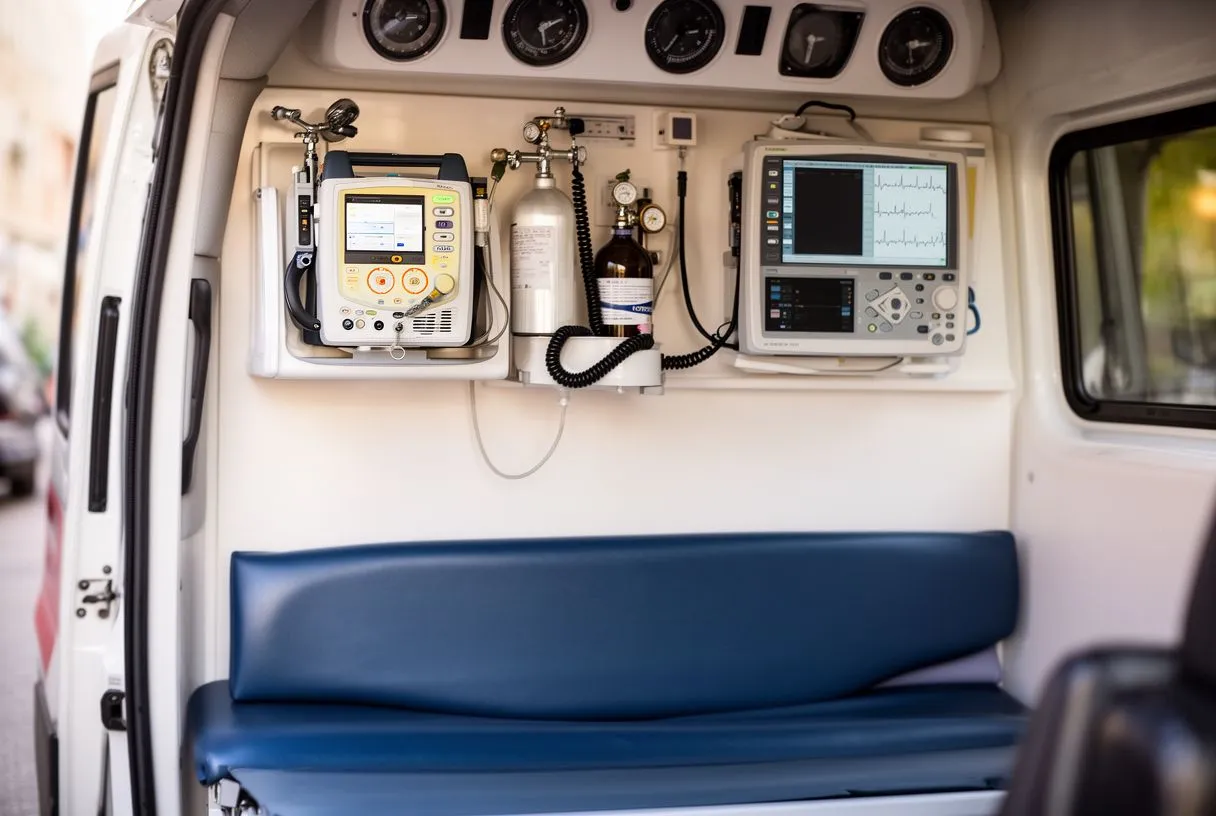
Monitoring and treatment on the spot: The crew attaches continuous ECG monitoring so they can watch your heart rhythm during the entire ride. They place an intravenous line so medications can be given quickly. If your oxygen levels are low, they give oxygen. If your pain is severe, they give medications to ease it, because pain control is not a luxury, it reduces the strain on the heart.
Medications that stop the clot from growing: If a heart attack is suspected, the crew may give aspirin to chew, which helps prevent the clot from getting bigger. This single step, taken early, has a measurable effect on outcomes. They may also give nitroglycerin under the tongue to ease chest pressure by widening the blood vessels, though only if your blood pressure allows it.
Preparing for the worst: Ambulance crews carry defibrillators, which are devices that can deliver an electric shock if the heart rhythm becomes dangerously chaotic. If the heart stops during transport, the crew can begin chest compressions and advanced life support immediately. This is the safety net you do not have at home.
Throughout the ride, the crew communicates with the receiving hospital. They send the ECG ahead, describe the situation, and help the hospital decide whether to activate the cardiac catheterization lab. This coordination is a major reason ambulance transport improves outcomes for heart attacks. The hospital is ready when you arrive, not starting from zero.
Is EMS the Same as an Ambulance?
The terms confuse people, and the confusion is worth clearing up. EMS stands for emergency medical services, which is the whole system: the call centers, the dispatchers, the paramedics, and the vehicles. An ambulance is one part of that system, the vehicle and crew that reach you. When people say "call EMS," they mean the same thing as "call an ambulance."
Within EMS there are different levels of training. Emergency medical technicians, or EMTs, provide basic life support: assessment, oxygen, CPR, defibrillation. Paramedics have advanced training and can give intravenous medications, interpret ECGs, and perform more advanced procedures. The crew that arrives at your door will be matched to the severity your dispatcher assigns to the call.
Dispatch systems also prioritize calls. In many countries, emergency calls are triaged into categories, and a suspected cardiac emergency sits at the top tier, meaning the fastest available response. This is why the dispatcher will ask specific questions about your symptoms and location. Answering them calmly and clearly speeds up the right response.
Emergency systems differ by country, and for our international patients this matters. In Mexico, the emergency number is 911, and private ambulance services and hospital-based emergency teams also operate in major cities. If you are traveling in Mexico and have known heart disease, know your local emergency number before you need it. A few minutes of preparation before a trip can save critical time later.
What Happens at the Hospital After a Chest Pain Emergency?
Arriving at the emergency department is often when the anxiety peaks, so it helps to know the sequence. The team will already have your ECG if you came by ambulance. They repeat the ECG, take blood tests to look for cardiac enzymes, which are proteins released into the bloodstream when heart muscle is damaged, and assess your symptoms directly.
Opening the blocked artery: If the tests confirm a major heart attack, the standard treatment is an emergency coronary angioplasty. In this procedure, a thin tube is threaded from the wrist or groin up to the heart, a small balloon is inflated at the blockage to open it, and a stent, a small metal mesh scaffold, is placed to keep the artery open. This is done in a catheterization lab, and speed is everything.
When medications are the first step: Not every chest pain leads to the catheterization lab. Unstable angina, smaller events, or cases where the diagnosis is still unclear are managed with medication first: blood thinners, antiplatelet drugs, and medications that reduce the heart's workload. Further testing then decides whether a procedure or surgery is needed.
Other tests you may encounter: A chest X-ray may be taken to check the lungs and the size of the heart. An echocardiogram, an ultrasound of the heart, shows how well the muscle is pumping and whether the valves are working. Depending on findings, a CT scan or additional imaging may follow to rule out other causes.
Some patients who arrive with a chest emergency turn out to have valve disease rather than, or in addition to, blocked arteries. For a severely narrowed aortic valve, transcatheter aortic valve replacement, or TAVR, is a well-established option in which a replacement valve is delivered through a catheter without opening the chest. TAVR is usually a planned procedure rather than an emergency one, but knowing it exists matters for patients who learn during a hospital stay that their valve is the problem.
In our practice, we perform conventional, minimally invasive, robotic, and transcatheter procedures, and we recommend the less invasive route only where the evidence supports it for that specific patient. If you leave a hospital stay with a new diagnosis and a recommendation, that is exactly the moment to have the options explained plainly and to consider a second opinion.

When Is Chest Pain a Sign of an Aortic Problem?
Most chest pain discussions center on blocked coronary arteries, but the aorta deserves its own attention. The aorta is the largest artery in the body, and it exits the heart upward before arching and descending. When its wall weakens, it can stretch and enlarge, a condition called an aortic aneurysm, or it can develop a tear, called a dissection.
An aortic dissection produces a characteristic pain: sudden, severe, and often described as tearing or ripping, frequently felt in the back between the shoulder blades or moving as the tear extends. This pain is different from the crushing pressure of a heart attack, though patients may not know the difference. Both are emergencies that require an ambulance, not a wait-and-see approach.
The enlargement of the aorta is usually silent. It causes no symptoms until something goes wrong. That is why it is typically found on imaging done for other reasons, such as an echocardiogram or a CT scan. Once found, it is monitored with regular imaging, because size drives the decision.
Guideline thresholds for surgery: International practice guidelines generally recommend surgery for an enlarged ascending aorta, the section that rises from the heart, when its diameter exceeds 5.5 centimeters, and earlier in patients with certain genetic conditions or a family history of dissection. Before any operation, the surgical team calculates a risk score, such as the EuroSCORE II, to weigh the risks of surgery against the risks of watching and waiting, and to find the lowest-risk path for that individual.
When aortic surgery is needed, the surgeon replaces the weakened section with a graft and may repair or replace the aortic valve in the same operation. Recovery is longer than a stent procedure, but for patients with a threatened aorta, surgery is the difference between a managed condition and a catastrophe. Strict blood pressure control in the meantime is essential, because high blood pressure is the main driver of both enlargement and dissection.
As a team that works on the aorta alongside valve and coronary disease, we review every aortic case against international guidelines before making any recommendation. If you have been told you have an enlarged aorta, we encourage you to understand the exact measurement, the monitoring schedule, and the threshold that would trigger surgery in your case.
What Does Recovery Look Like After a Heart Emergency?
Surviving a heart event is the first milestone. Recovery is the second, and it deserves as much attention. The first few weeks are about healing: the heart muscle that was damaged needs time to form a stable scar, and any procedure or surgery you had needs time to settle. Heavy lifting, strenuous exertion, and driving are usually restricted for a defined period set by your team.
Cardiac rehabilitation: Structured cardiac rehabilitation is one of the best-supported parts of recovery. It is a supervised program of gradually increasing exercise, education, and support, designed to rebuild strength safely and reduce the risk of another event. Patients who complete it consistently do better in the long term than those who try to recover alone at home.
Medications that protect the future: After a heart event, most patients go home on a set of long-term medications: blood thinners or antiplatelet drugs, statins to lower cholesterol, beta blockers, and often ACE inhibitors. These are not optional extras. They are the main reason a second event is less likely. Taking them exactly as prescribed, and never stopping them without medical advice, is one of the most powerful things you can do.
Addressing fatigue and mental fog: Many patients notice persistent tiredness, low mood, and difficulty concentrating after a cardiac event, and this is not imagined. Research on post-COVID-19 syndrome has shown that fatigue and cognitive impairment are real, measurable phenomena after serious illness, and similar patterns appear in cardiac recovery as well. Fatigue and cognitive impairment in Post-COVID-19 Syndrome: A systematic review and meta-analysis documents how these symptoms persist and deserve recognition rather than dismissal. If you feel this way months after your event, tell your team; it is a legitimate part of recovery.
Recovery also involves the family. Loved ones who witnessed the emergency often carry their own anxiety, and they need to understand what happened and what to watch for. In our consultations, we take the time to explain the studies and the recovery plan in plain words, and to answer every question, including the ones from the family, before any decision is made.
Above all, recovery means follow-up. Appointments, imaging, blood tests, and honest conversations about symptoms are not bureaucracy. They are the mechanism by which problems are caught early, when they are still easy to fix.
When Should You Talk to a Cardiac Team About Chest Pain?
Emergency care is for emergencies. But a great deal of chest pain is not an emergency, and that is where a planned conversation with a cardiac team earns its place. If you have recurring chest discomfort, risk factors like diabetes, high blood pressure, smoking, or a family history of heart disease, or if you have already had a heart event, a scheduled evaluation is the right move.
What a consultation actually looks like: A proper evaluation starts with your history, a physical examination, and an ECG, and then builds from there with the least invasive tests that answer the question. The goal is not to order every possible study. It is to understand what your chest pain is and is not, and to give you a clear picture of your risk.
Our first contact is a free video consultation, where we get to know the patient, talk through the condition, and identify which studies are genuinely needed so no unnecessary ones are ordered. A face-to-face visit at our consulting rooms in Guadalajara, Querétaro or Hermosillo follows when the patient decides to go ahead. Every case is then reviewed by the full multidisciplinary team before a recommendation is made, and the patient always receives the alternatives along with the proposal.
We also encourage second opinions and treat seeking one as a completely normal part of deciding about heart surgery. No good cardiac team should be threatened by that. Your heart deserves more than one perspective before a major decision.
So, when should you talk to a cardiac team instead of calling an ambulance? When symptoms are recurring but not acute, when you have been diagnosed with a condition and want to understand your options, when you have been told you need a procedure and want to explore less invasive routes, or when you simply want a clear answer to the question "how worried should I be?" Those are all good reasons to book a consultation.
And when should you call an ambulance for chest pain instead of booking anything? When the pain is new, severe, crushing, or spreading, when it comes with breathlessness, cold sweat, nausea, or fainting, or when it simply feels different from anything you have felt before. In that moment, the ambulance is the right answer, every time.
Chest pain will always be frightening, but it does not have to be confusing. Learn the warning signs, know your own risk profile, keep emergency numbers at hand, and build a relationship with a qualified cardiac team before you ever need one urgently. If anything in this article describes your situation, do not wait for a crisis. Book a consultation, ask your questions, and let a specialist team help you decide what is lowest risk for you.