


Coronary Spasm: Chest Pain With Clear Arteries
Coronary spasm treatment brings relief even when arteries look clear.
What Is Coronary Spasm?
Coronary spasm is a sudden tightening of the muscle in the wall of a coronary artery, one of the small vessels that feeds the heart itself. When the artery wall squeezes, the passage inside narrows sharply, blood flow drops, and the heart muscle briefly goes short of oxygen. That shortage is felt as chest pain, even though the artery may be completely open again minutes later.
Why it matters: Many patients are told their angiogram looked normal and are left without an explanation for their pain. Coronary spasm is one of the most common reasons for chest pain with clear arteries, and the good news is that coronary spasm treatment is usually highly effective once the diagnosis is made. The condition has been described in the medical literature for decades, and its management is well established.
The two settings: Spasm can occur in people with entirely healthy arteries, and it can also occur in people who also have coronary artery disease, where fatty plaque partly narrows the vessels. The treatment plan differs between these two groups, which is why proper evaluation matters before any medication is started.
Patients who finally receive this diagnosis often describe months of uncertainty. Getting a clear name for the problem is itself a form of relief, because it opens the door to a specific plan rather than vague reassurance.
What Does a Coronary Spasm Feel Like?
Most people describe it as a crushing chest pain or a tight, squeezing pressure in the center of the chest. It can feel genuinely alarming, similar to what a heart attack is described as feeling like. Some patients feel burning or a heavy weight rather than a sharp stab.
Rest pain is the hallmark: Unlike the classic chest pain of blocked arteries, which usually appears with exercise and fades with rest, coronary spasm typically strikes at rest, often overnight or in the early morning hours. Patients frequently wake at three or four in the morning with pain. Episodes often come in clusters, several over a few nights, then quiet periods.
Where the pain travels: The discomfort may stay in the chest or show radiating pain into the left arm, jaw, neck, or back. Some people feel it as epigastric pain, an ache just below the rib cage that seems digestive rather than cardiac. A sense of breathlessness, cold sweat, or nausea can accompany an episode.
Each episode usually lasts a few minutes and settles on its own or quickly after nitroglycerin. If pain lasts longer than about fifteen minutes, does not ease, or comes with fainting, that is an emergency and warrants calling emergency services immediately.
What Causes Coronary Spasm?
The artery wall contains smooth muscle that normally adjusts vessel width. In coronary spasm, that muscle overreacts and clamps down. The exact reason varies from person to person, but several well-recognized factors raise the likelihood.
- Smoking: the single strongest association; it injures the artery lining and directly provokes spasm.
- Emotional stress: stress-induced chest pain can be real spasm, driven by the nervous system's influence on vessel tone.
- Cold exposure: sudden chilling of the body can trigger an episode in susceptible people.
- Certain drugs: stimulants, some migraine medicines, cocaine, and heavy alcohol use are known triggers.
- Underlying conditions: high blood pressure, high cholesterol, and Raynaud's phenomenon travel with spasm more often than chance would predict.
The role of the artery lining: The inner surface of the artery, called the endothelium, releases substances that keep the vessel relaxed. When that lining is damaged by smoking, diabetes, or inflammation, the balance tips toward constriction. This endothelial dysfunction is a central mechanism, and addressing it is part of long-term coronary spasm treatment.
When suspected spasm is evaluated, a careful history of smoking, medications, and stress patterns matters, because identifying the trigger often matters as much as prescribing the drug.
Why Chest Pain With Clear Arteries Happens
It is natural to feel confused when a catheterization shows no blockages yet the pain is real. The explanation is that a standard angiogram shows the artery's shape at one moment in time, but spasm is dynamic. The artery can look wide open during the test and clamp shut an hour later in your bedroom.
A MINOCA heart attack: When spasm is severe enough to cause actual heart muscle injury, doctors call it a MINOCA heart attack — "myocardial infarction with non-obstructive coronary arteries." The ECG changes and blood markers look like a heart attack, but the arteries are not blocked by plaque. Spasm is one of the leading causes of MINOCA, alongside small-vessel disease and other mechanisms.
What this means for you: Clear arteries do not mean nothing is wrong, and they do not mean everything is fine. They mean the cause is functional rather than a fixed blockage, and the diagnostic and treatment path is different. Chest pain with clear arteries deserves the same seriousness as any other cardiac symptom.
Our multidisciplinary team reviews these cases together, because distinguishing spasm from small-vessel disease and other causes of chest pain with clear arteries requires putting the angiogram, ECGs, and the symptom pattern side by side before drawing conclusions.
Is Coronary Spasm Life Threatening?
For most people, coronary spasm is manageable and does not shorten life, especially once smoking stops and medication is taken consistently. Most episodes resolve within minutes. That said, honesty matters: a severe, prolonged spasm can, in a small minority of patients, trigger a dangerous heart rhythm, a heart attack, or rarely sudden collapse.
The risk picture: The prognosis is worst in patients who continue smoking, those who have spasm plus significant fixed blockages, and those whose episodes caused heart muscle injury. Johns Hopkins Medicine notes that coronary artery spasm can lead to serious complications when untreated, which is why a diagnosis followed by a treatment plan is important rather than optional.
Warning signs to act on: Pain lasting more than fifteen minutes, pain that does not respond to nitroglycerin, fainting during an episode, or pain with breathlessness at rest all warrant emergency evaluation. These are the situations where spasm crosses from uncomfortable to potentially dangerous.
Every patient with this diagnosis should know exactly which symptoms mean "call emergency services now" and which ones mean "note it down and mention it at follow-up." That clarity removes a lot of the fear that comes with the diagnosis.
Coronary Spasm Diagnosis: How Doctors Confirm It
The story comes first: Chest pain at rest, at night, in clusters, in a smoker, strongly suggests spasm before any test is done. An ECG recorded during an episode often shows characteristic changes, which is why patients are sometimes asked to wear a portable monitor for a day or two.
Cardiac catheterization with normal arteries: When the initial workup points to the heart, doctors proceed to cardiac catheterization — a thin tube threaded from the wrist or groin into the coronary arteries with dye injected to outline them. If the arteries are normal, that does not end the workup; it redirects it. Provocation testing: In selected patients, spasm can be confirmed by giving a small dose of a provoking agent (such as acetylcholine) directly into a coronary artery during catheterization and watching the artery constrict. This is done in specialized centers and is the most definitive test, though it is not needed for everyone.
Supporting studies: An echocardiogram (ultrasound of the heart), blood tests for cholesterol and diabetes, and sometimes a coronary calcium score help map the overall cardiovascular picture and rule out other causes such as valve problems or pericarditis.
In our practice, the first contact is a free video consultation: we get to know the patient, talk through the pattern of symptoms, and say exactly which studies are still needed — so no unnecessary tests are ordered and no useful one is skipped.

Coronary Spasm Treatment Options
The foundation of coronary spasm treatment is medication that keeps the artery muscle relaxed, combined with removing whatever is provoking the spasms. Most patients become episode-free or nearly so within weeks of starting the right regimen.
Calcium channel blockers: These are the mainstay. Drugs such as diltiazem, amlodipine, and verapamil relax the smooth muscle in the artery wall and are the best-studied coronary spasm medication. Doctors often start at a moderate dose and increase until episodes stop, since under-dosing is a common reason treatment appears to fail.
Nitroglycerin for coronary spasm: Fast-acting nitroglycerin, as a tablet under the tongue or a spray, aborts an episode within a minute or two by directly relaxing the artery. Every diagnosed patient should carry it and know how to use it. Long-acting nitrates (patches or oral preparations) can be added for patients with frequent attacks.
Additional considerations: If spasm occurs alongside significant plaque disease, statins and low-dose aspirin are added. Beta-blockers — staple drugs for many heart conditions — can worsen spasm and are generally avoided unless there is another strong reason to use them. Stent placement is not a routine answer for pure spasm, because spasm is a diffuse behavior of the artery wall, not a single blocked spot.
We recommend the least invasive route only where the evidence supports it for that patient, and every case is reviewed by our multidisciplinary team against international practice guidelines before any recommendation is made — including decisions about which drug regimen fits best.
Variant Angina and Prinzmetal Angina Management
Variant angina — also called Prinzmetal angina, after the physician who described it — is the formal name for chest pain caused purely by coronary spasm. Variant angina treatment follows the same principles as general spasm care: high-dose calcium channel blockers, rescue nitroglycerin, and ruthless trigger removal. Prinzmetal angina management succeeds in the large majority of patients who stop smoking and take their medication consistently.
What recovery looks like: Most patients notice fewer episodes within the first two to four weeks of therapy. Keeping a simple diary — time of pain, what you were doing, what you had used — helps the cardiologist fine-tune doses quickly.
When spasm and blockages coexist: Some patients have both spasm and fixed coronary artery disease. In that situation the plan has two layers: medication for the spasm component and, where a critical blockage exists, revascularization — either percutaneous coronary intervention (a stent placed through a catheter) or coronary artery bypass grafting, a surgical bypass using the patient's own vessels. The choice between these depends on the anatomy, and there is no one-size answer.
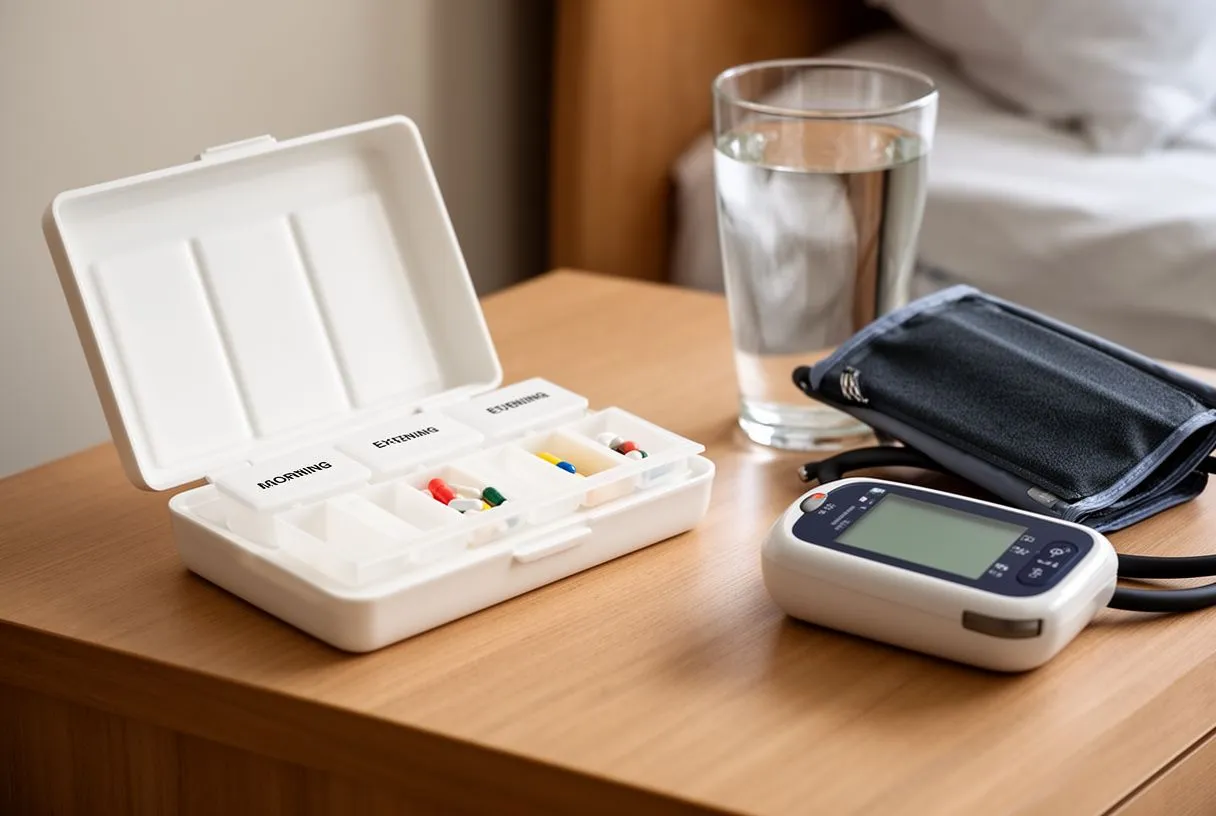
Medication adherence is not optional in coronary disease, and this applies directly to spasm, where a single missed dose can allow an attack through.
Coronary Spasm Triggers to Avoid
Medication does much of the work, but lifestyle does the rest. The most important single step in coronary spasm treatment is quitting smoking completely — not cutting down. Recreational stimulants, particularly cocaine, are absolutely off the table for anyone with spasm, as they can trigger a fatal episode.
- Quit tobacco entirely: this one change transforms the outlook more than any drug.
- Limit cold exposure: dress warmly, breathe through a scarf in cold air, avoid sudden temperature shocks.
- Watch stimulants: very high caffeine intake and decongestant cold medicines can provoke episodes in some patients.
- Manage stress deliberately: breathing exercises, regular sleep, and addressing anxiety reduce stress-induced chest pain frequency.
- Protect sleep: since attacks cluster overnight, treating sleep apnea and keeping a regular schedule helps.
Patients sometimes ask whether stress alone can truly cause chest wall or cardiac spasm. It can: the autonomic nervous system directly influences coronary tone, and acute emotional stress is a recognized trigger for stress-induced chest pain in susceptible individuals. Treating the trigger is as legitimate as treating the vessel.
Coronary Spasm Prognosis and Long-Term Care
The coronary spasm prognosis is genuinely good for most patients who stop smoking and stay on therapy. Episodes typically become less frequent over years, and many patients eventually taper medication under supervision. Patients whose attacks caused a MINOCA event, or who have coexisting plaque disease, need closer follow-up and should never assume the condition has vanished on its own.
Rehabilitation and recovery: Cardiac rehabilitation is not only for surgical patients. Structured, supervised exercise helps rebuild confidence after frightening attacks, and there is evidence that even remote programs work: one study of a tele-cardiac rehabilitation program in coronary artery bypass patients found improvements in functional capacity, hand grip strength, and functional independence (International Journal of Physiotherapy). A similar supervised approach benefits patients recovering from any cardiac event.
Follow-up rhythm: Expect a review a few weeks after starting treatment, then periodic check-ins to reassess symptoms, adjust doses, and monitor cholesterol and blood pressure. Keep nitroglycerin accessible at all times, check its expiry date, and tell your cardiologist if attacks return after a quiet period — that usually means a dose or a trigger needs revisiting, not that treatment has failed.
We encourage a second opinion at any point — deciding about heart care is a major decision, and hearing more than one perspective is a normal, sensible part of it, not a betrayal of your doctor.

Finding the Right Team for Coronary Spasm Care
Because spasm is a functional problem, the quality of the evaluation matters more than the equipment. You want a team that takes rest pain seriously, does not dismiss clear arteries as "nothing found," and knows when provocation testing is appropriate.
Questions worth asking: Ask whether your symptom pattern fits spasm, what medication and dose they would start with, what trigger you should remove first, and what the plan is if the first regimen does not work. A confident team answers these plainly and involves you in the decision. When you consult the best cardiologist for coronary spasm, the conversation should feel like a joint plan, not a prescription handed down.
Every patient who comes to us receives a clear proposal with the alternatives, and the final decision is always theirs. We take the time in consultation to explain what the studies actually show, in plain words, and to answer every question before anything is decided.
Coronary spasm is frightening because it mimics a heart attack, but it is also one of the most treatable cardiac conditions once named. Stop smoking, take your calcium channel blocker, carry your nitroglycerin, and keep your follow-up appointments — and if you are still having unexplained chest pain with clear arteries, book a consultation with a qualified cardiac team rather than self-diagnosing. Dr Molina and our multidisciplinary team are available for a first free video consultation, where we will listen to your story and map out exactly what comes next.






