Deep Vein Thrombosis After Surgery: Prevention and Signs
Deep vein thrombosis after surgery prevention and warning signs explained by Guadalajara cardiac specialists.
Deep vein thrombosis after surgery is one of those complications that patients rarely think about until they are lying in a recovery ward, but it deserves a place in your planning from the very first consultation. A clot forming in the deep veins of the leg is largely preventable, usually treatable, and far easier to manage when it is recognised early. This guide explains what happens in the body after an operation, which blood clot after surgery symptoms matter, how prevention works, and when to call for help — written for patients and families facing cardiac or major surgery, whether here in Mexico or travelling for care.
What Is Deep Vein Thrombosis After Surgery?
Deep vein thrombosis, often shortened to DVT, is a clot that forms inside one of the deep veins — the vessels that carry most of the blood from your legs back up to your heart. After surgery, the combination of immobility, tissue injury, and the body's own healing response makes these clots more likely than at almost any other time. The clot most often begins in the calf or thigh, where blood moves slowly when the leg muscles are not working.
Why the deep veins matter more than surface veins: Varicose veins and small surface clots sit in vessels close to the skin and are generally less dangerous. Deep veins carry the great majority of venous return from the leg, so a clot there obstructs a much larger channel. It is also a deep clot that can break loose and travel to the lungs, which is what makes deep vein thrombosis a condition worth taking seriously rather than dismissing as a swollen ankle.
The connection to pulmonary embolism: The most serious consequence of a leg clot is pulmonary embolism, when a fragment travels through the bloodstream and lodges in the arteries of the lungs. This raises pulmonary embolism risk sharply in the first weeks after major surgery, and it is the reason every prevention plan for deep vein thrombosis exists. Caught early, while the clot is still anchored in the leg, treatment is straightforward and outcomes are good.

How Does Surgery Cause Blood Clots in the Legs?
Operations set up three conditions at once, a combination doctors call the Virchow triad: blood flow slows, blood becomes more prone to clotting, and the vessel wall sustains injury. Any one of these alone rarely causes trouble. Together, especially in the first days after surgery, they create the environment in which a clot forms in the leg.
Slowed flow during immobility: Your calf muscles act as a pump, squeezing the deep veins with every step and pushing blood upward against gravity. General anaesthesia and bed rest switch that pump off. Blood pools in the small pockets of the calf veins, and stagnant blood clots more readily than moving blood.
A pro-clotting stress response: Surgery is a controlled injury, and the body responds by releasing substances that prepare the blood to clot and stop bleeding. That response is protective at the incision but can misfire inside the leg veins. The state of heightened clotting tendency peaks in the first week and gradually fades over the following weeks, which is why post surgical thrombosis can appear even after you have gone home.
Vessel wall injury: Vein walls can be bruised by positioning during long operations, by intravenous catheters, or by the inflammatory process itself. A roughened inner wall gives platelets something to cling to, starting the clotting cascade. In our practice, we review every case against international practice guidelines before surgery, which includes weighing these clotting risks against bleeding risks for each individual patient.
Who Is at Highest Risk of Post-Surgical Thrombosis?
Not everyone faces the same likelihood of developing a clot. Risk depends on the type of operation, its length, your age, your body composition, and the chronic conditions you bring into hospital. Surgical teams use formal risk assessments to decide who needs preventive medication, and knowing your own profile helps you ask the right questions.
Factors that come with the patient: Older age, higher body weight, a previous clot, a family history of thrombosis, active cancer, and hormone therapy all raise baseline risk. Heart failure and severe varicose veins slow circulation further. Pregnancy and the weeks after delivery also increase clotting tendency, which is why DVT in pregnancy and after caesarean section is managed with particular care.
Factors that come with the procedure: Hip and knee replacement, pelvic and abdominal cancer surgery, and long vascular operations carry the highest rates. Long operative time, general anaesthesia, and several days of bed rest all add to the total. Cardiac surgery itself, including valve replacement and coronary bypass, requires a considered prevention plan because of the duration of the procedure and the time on cardiopulmonary bypass.
- Orthopaedic surgery: hip and knee replacement carry the highest baseline clot risk among elective operations.
- Active cancer: tumour biology and chemotherapy together multiply thrombotic risk considerably.
- Prolonged immobility: several days without walking allow blood to stagnate in the calf veins.
- Oestrogen therapy: hormone-containing medications increase clotting factor levels in the blood.
What Are the Vein Clot Signs to Watch After an Operation?
Vein clot signs after surgery build slowly rather than dramatically, which is exactly why they get missed. Families often notice the change before the patient does, because they see both legs side by side. The reliable vein clot signs are few, specific, and worth memorising before the operation rather than after.
Swelling in one leg: Leg swelling after surgery that affects only one side, particularly below the knee or around the ankle, and that does not improve with elevation is the most dependable sign. Compare the two calves at the same height. A visible difference in circumference, or a leg that feels firm and leaves an imprint when pressed, deserves a same-day assessment rather than a wait-and-see approach.
Warmth, redness, and visible veins: The skin over a clotted vein may feel warmer than the other leg and look slightly redder or darker. Some patients notice the superficial veins near the surface becoming more prominent. These changes accompany the swelling rather than standing alone, so they strengthen the case for evaluation when combined with other signs.
The five warning signs in one list: Clinicians generally summarise the key warning signs of a blood clot in a limb as follows.
- One-sided swelling: one leg noticeably larger or firmer than the other, without an obvious cause.
- Localised warmth: the skin over the painful area feels hotter than the surrounding skin.
- Redness or discolouration: a reddish or bluish tint on the affected leg.
- Deep tenderness: soreness in the calf or thigh, especially when flexing the foot upward.
- Breath changes: sudden shortness of breath or chest pain, which suggests the clot has travelled and needs emergency care.
What Does DVT Pain Feel Like and When Is It Serious?
Patients frequently ask what DVT pain feels like, because postoperative leg pain is so common and most of it is harmless. The honest answer is that DVT pain often mimics a cramp or a pulled muscle: a deep ache or heaviness in the calf, worse on standing, that does not ease with rest or stretching. That failure to resolve is the feature that separates it from ordinary postoperative soreness.
Ordinary postoperative aching: Mild, bilateral aching that improves with movement and usual pain relief is typical after any operation. Positioning during a long procedure can leave both calves sore for a few days. This kind of postoperative leg pain is symmetrical, comes without swelling, and settles progressively.
Calf pain after operation that warrants a call: Calf pain after operation that is one-sided, deep, and worsening over hours — especially when paired with swelling or warmth — is the classic pattern of post surgical thrombosis and should be reported the same day. Pain that is entirely different from your incision pain, or that appears alongside chest tightness or breathlessness, needs urgent attention. In our consultations we take the time to explain what the studies actually show, in plain words, so that patients recovering at home know exactly which symptoms to report and which to wait out.
How Is a Deep Vein Clot Diagnosed After Surgery?
Diagnosis follows a logical sequence: a clinical assessment of probability, a blood test, and ultrasound imaging. No single element is definitive alone, and a good team explains why each step is needed before ordering it.
Clinical probability first: Doctors use structured scores, most commonly the Wells score, which combines symptoms, risk factors, and whether an alternative explanation is more likely. This prevents unnecessary testing in some patients and prioritises urgent imaging in others. It also answers the practical question of what the squeeze test for DVT is: doctors may gently squeeze or press the calf to check for deep tenderness, but this manual check is only a rough clue — it is neither reliable nor sufficient to confirm or exclude a clot, which is why imaging follows.
The D-dimer blood test: D-dimer is a fragment released when the body breaks down a clot. A normal result makes DVT very unlikely in a patient with low clinical probability. After surgery, however, D-dimer is often elevated by healing itself, so the test is used to rule the condition out rather than to confirm it.
Compression ultrasound: Duplex ultrasonography is the standard test. The sonographer presses the probe along the vein; a healthy vein collapses under gentle pressure, while a vein containing clot resists compression. Well-conducted ultrasound studies — the kind held to reporting standards such as Strengthening the Reporting of Observational Studies in Epidemiology (STROBE): explanation and elaboration — show high diagnostic accuracy for clots above the knee, though small calf-vein clots can be harder to confirm and may require a repeat scan.
What Treatments Are Used for DVT After Surgery?
The goals of treatment are simple: stop the clot from growing, stop it from travelling to the lungs, and protect the long-term health of the leg vein. Most patients are managed entirely with medication and compression, without any procedure.
Anticoagulant medication: A blood thinner after surgery does not dissolve an existing clot directly; it prevents the clot from extending while the body's own enzymes gradually break it down. Treatment usually begins with an injectable anticoagulant such as low-molecular-weight heparin, then transitions to a tablet for three to six months or longer depending on the cause. Aspirin, despite its everyday reputation, is an antiplatelet drug and is not a substitute for proper anticoagulation in DVT.
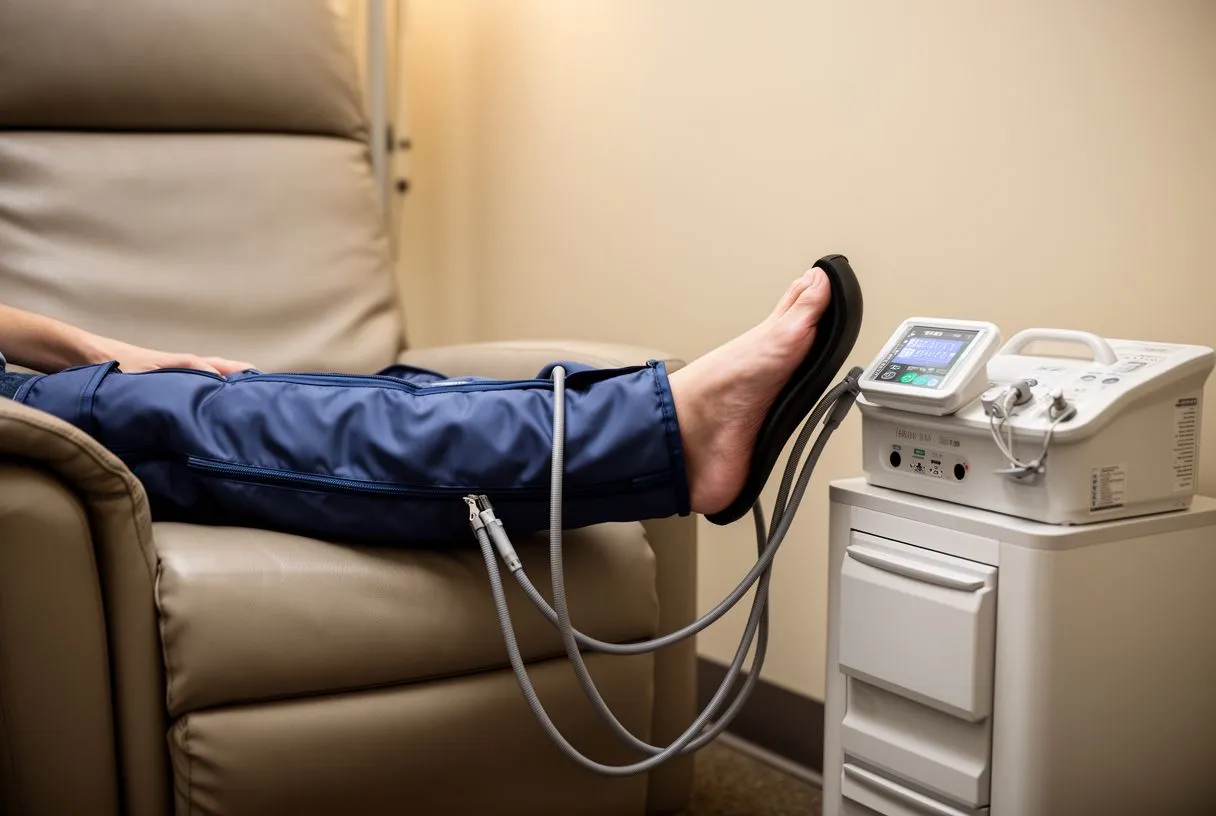
Compression and movement: Graduated compression stockings DVT management and intermittent pneumatic compression sleeves improve venous return and relieve swelling. Once anticoagulation has started, early walking is encouraged — it does not dislodge the clot and it actively helps recovery. Prolonged bed rest is no longer recommended beyond what the primary operation requires.
Procedures for selected cases: A small minority of patients with very extensive clots, or with clots that threaten the limb's circulation, may be considered for catheter-directed clot removal or thrombolytic medication. These decisions are individual, weigh bleeding risk against clot burden, and are made by a multidisciplinary team. If the underlying factor is a narrowed vein, treatment may include relieving that obstruction, in some cases with a venous stent — though stent thrombosis is itself a recognised complication that requires careful follow-up.
How Can You Prevent Blood Clots After Surgery?
Prevention is the most effective strategy, and it begins before the operation. The single most reliable way to prevent blood clots surgery-related is a layered plan that combines mechanical measures, medication, and early movement — and patients who understand the plan can participate in their own protection rather than relying on the ward alone.
Mechanical measures: Intermittent pneumatic compression sleeves wrap around the calves and inflate rhythmically, mimicking the muscle pump while you lie still. Graduated compression stockings maintain baseline venous return. These carry no bleeding risk, which makes them the mainstay when anticoagulants cannot be used, and most high-risk patients receive both mechanical and pharmacological protection.
Pharmacological prophylaxis: Low-dose anticoagulation, usually a once-daily injection, is standard for moderate- and high-risk patients. It typically starts within hours of surgery and continues for ten to fourteen days, sometimes longer after major orthopaedic procedures. Our multidisciplinary team reviews every case against international practice guidelines before recommending the plan, and the patient receives a clear proposal with the alternatives, so the final decision is always theirs.
What you can do yourself: The most powerful free intervention is early ambulation — walking within twenty-four hours of surgery, as soon as your team permits it. Drink enough fluids to stay well hydrated, follow the full course of any prescribed injections even after discharge, and keep wearing the stockings as directed until you are fully mobile.

What Is the DVT Recovery Timeline?
Recovery from a clot follows a rhythm of weeks and months, and knowing the DVT recovery timeline helps you pace your return to normal life without expecting the leg to feel normal overnight. The clot does not vanish; it is gradually reabsorbed and the vein slowly reopens, a process called recanalisation.
Days do go away: This answers the question patients ask most often — do deep vein thrombosis go away? In most cases, yes: with proper anticoagulation, the body breaks down the clot over weeks to months, and many patients recover fully. Some are left with residual vein changes and aching, a condition called post-thrombotic syndrome, which is why ongoing compression and follow-up matter.
The first weeks: Symptoms usually improve noticeably within the first week of treatment as swelling subsides. You will walk daily, increasing distance gradually, and your team will monitor for bleeding from the anticoagulant and adjust the dose. Most patients are managed at home with outpatient review.
The first three months: This is the window during which the vein recanalises, often confirmed with a repeat ultrasound. The question of whether deep vein thrombosis can be cured has a nuanced answer: the acute episode is treated successfully in the great majority of patients, but some underlying vein damage persists, which shapes decisions about how long to continue anticoagulation. Evidence on how thrombotic complications are prevented and managed after hospitalisation continues to evolve — for example, COVID-19 and Thrombotic or Thromboembolic Disease: Implications for Prevention, Antithrombotic Therapy, and Follow-Up: JACC State-of-the-Art Review summarises how prolonged prophylaxis is tailored to individual risk rather than applied uniformly.
Long-term leg health: After treatment ends, keeping the calf pump active matters most — regular walking, weight management, and compression during long journeys. Clots in certain deep veins deserve specific mention: thrombosis involving the femoral vein or the iliac veins carries a higher long-term burden than isolated calf-vein clots, and these patients are followed more closely.
When Should You Seek Help From a Cardiac Team in Mexico?
For patients recovering from cardiac or major surgery in Mexico — including international patients who travelled for their operation — knowing exactly when and how to reach a specialist prevents a small problem from becoming a serious one. The plan is simple: some symptoms need emergency care tonight, others need a scheduled review this week.
Emergency signs: Sudden shortness of breath, chest pain, coughing blood, or a fast irregular heartbeat may indicate pulmonary embolism and require emergency evaluation, not a routine appointment. A leg that swells rapidly, becomes hard, cool, or bluish, or develops severe pain despite elevation and rest also needs same-day assessment. Do not wait to see whether these signs resolve on their own.
Non-urgent reasons to book a consultation: Persistent mild swelling, aching beyond the expected recovery window, questions about stopping anticoagulation, or planning a long flight after surgery are all appropriate for a scheduled review. International patients should confirm in advance which telemedicine options are available and how imaging can be coordinated locally so results reach the treating team without delay.
How we work with patients: We are a multidisciplinary team of cardiac surgeons led by Dr Alejandro Molina, with consulting rooms in Guadalajara, Querétaro and Hermosillo, and the first contact is a free video consultation in which we get to know the patient, talk through the condition, and identify exactly which studies are still needed so no unnecessary ones are ordered. We encourage second opinions and treat seeking one as a normal part of deciding about heart surgery, because a well-informed patient makes the best decisions.
A final word: This article is a guide, not a diagnosis. Every recovery is individual, and the signs described here are reasons to talk to a qualified team rather than to self-diagnose. If you have had recent surgery and noticed any of the symptoms in this article, contact the practice, book a consultation, and let experienced clinicians assess your risk and recovery directly.