
Hospital Length of Stay After Heart Surgery
Length of stay heart surgery: know what to expect, how to shorten recovery time, and plan your stay in Guadalajara.
What Is the Length of Stay After Heart Surgery?
The length of stay after heart surgery is the number of days you spend in hospital from the moment you arrive for your operation until the day you are discharged home. It sounds like a simple number, but it carries real weight for you and your family. It shapes your travel plans, your budget, and the support you need to arrange at home. It also reflects how well your recovery is going.
Length of stay is measured differently from the patient's perspective. The clock starts on admission, not on the surgery itself. If you arrive the morning of the operation and go home five days later, your length of stay is five days. If you were admitted two days earlier for additional tests, those days count too. Understanding this distinction helps you interpret any estimate your surgical team gives you.
For families, this number matters as much as for the patient. Someone needs to be nearby, especially in the first days. Knowing the expected duration of a cardiac surgery hospital stay lets you plan time off work, book accommodation, and prepare your home for the return. It is one of the most practical questions you can ask your surgeon, and you should ask it directly.
How Long Is the Average Hospital Stay After Bypass Surgery?
Coronary artery bypass surgery, often called bypass or CABG, is one of the most common heart operations in the world. Many patients ask: how long is the hospital stay after bypass surgery? The honest answer is that it varies, but for most patients the pattern is similar. You spend a day or two in the intensive care unit, then a few more days in a regular ward, waking up, walking, and regaining your strength before discharge.
Why the numbers vary. Two hospitals in the same city can report different averages. Training, protocols, patient health, and the definition of "ready to go home" all play a role. This is why it is more useful to ask your own team for their expected range than to compare yourself with a national average. A healthy, younger patient recovering from straightforward bypass surgery may leave sooner than someone with diabetes or reduced heart function.
- Day of surgery: admission, the operation itself, and transfer to intensive care.
- First two days: waking in intensive care, breathing tube removed, first steps with help.
- Days three to five: moving to the ward, walking independently, wounds checked, discharge planning.
In our practice, every case is reviewed by the multidisciplinary team against international practice guidelines before a recommendation is given, and that includes a clear estimate of how long we expect you to be in hospital. When you receive your proposal, the expected hospital stay is part of it, alongside the alternatives and their trade-offs.
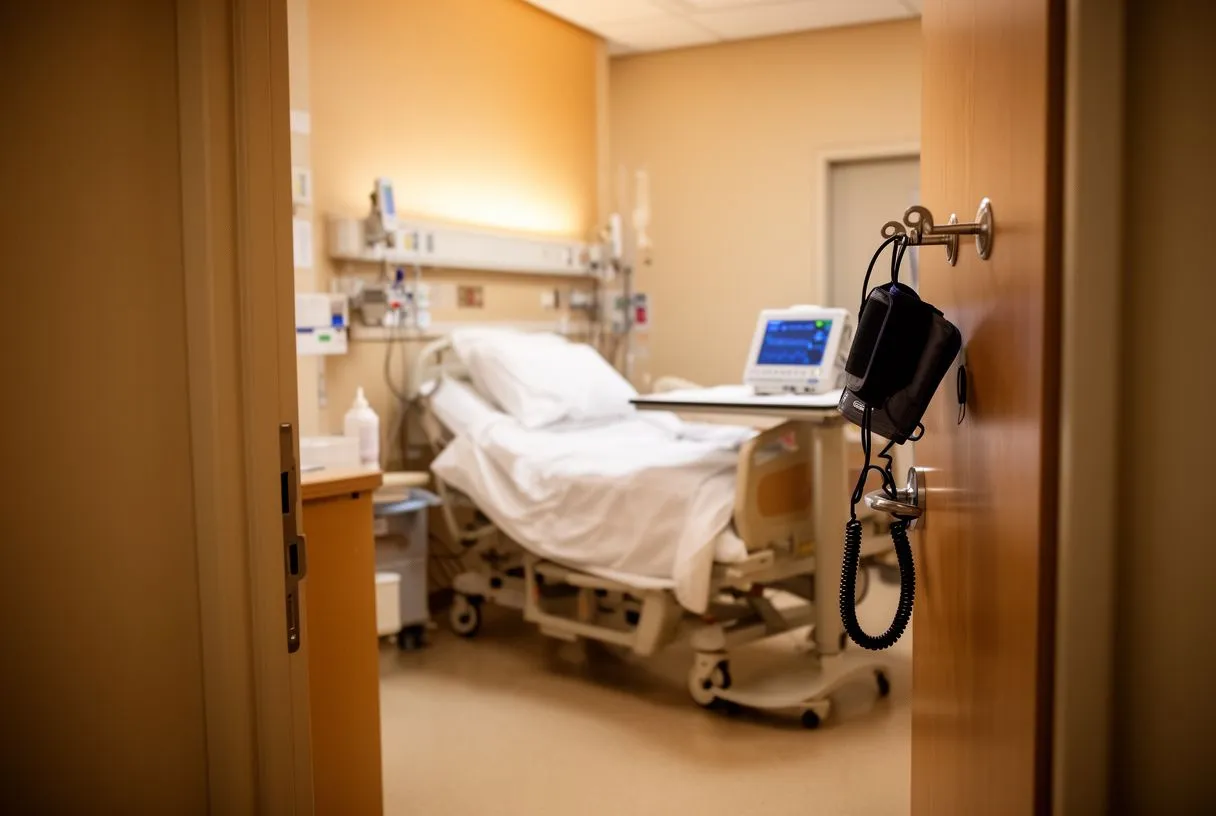
What Happens in the Intensive Care Unit After Heart Surgery?
The intensive care unit, or ICU, is where every heart surgery patient spends the first part of recovery. Many patients remember little of it, because the first hours after the operation are dedicated to sleep and careful monitoring. The heart surgery intensive care stay is not a sign that something went wrong. It is a standard part of the care pathway, designed to watch your heart rhythm, blood pressure, and breathing closely during the most delicate hours.
A breathing tube, then your own breath. Most patients arrive in the ICU still connected to a ventilator, the machine that breathes for you. Within a few hours, once you are awake and strong enough, the tube is removed and you breathe on your own. This moment is often a milestone patients ask about in advance. It is usually the same day as the operation, sometimes the following morning.
After the breathing tube is out, the focus shifts to moving. Sitting up, then standing, then walking a few steps with a nurse beside you. It may feel early to be on your feet, but early movement is one of the best-proven ways to prevent complications. Our team plans the first steps before the operation even happens, so you and your family know exactly what to expect in the ICU and on the ward. Most patients transfer out of intensive care within one or two days, and the ward stage follows.
Heart Surgery Discharge Criteria: When Can You Go Home?
Patients often ask: how many days in hospital after heart surgery before I can go home? The answer is not a fixed date. It is a set of goals, sometimes called discharge criteria. When you meet them, you go home. This is the logic behind heart surgery discharge criteria in every modern cardiac program.
The key criteria. Your team looks at several things before deciding you are ready. They are not boxes ticked by the calendar; they are signs that your body is coping well on its own.
- Stable heart rhythm: no dangerous arrhythmias on continuous monitoring.
- Independent movement: you can walk, use the bathroom, and manage basic tasks without help.
- Controlled pain: your pain is manageable with oral medication.
- Healing wounds: chest and leg incisions are clean, with no signs of infection.
- Understanding your care: you and your family know your medications and follow-up plan.
Before we discharge any patient, we take the time to explain what the studies and the hospital course actually show, in plain words, and to answer every question before the decision to go home. If a patient or family is not comfortable, we do not rush the process. Confidence matters as much as the medical checklist.

How Minimally Invasive Heart Surgery Shortens Recovery Time
One of the clearest trends in modern cardiac surgery is the shift toward less invasive approaches. Instead of opening the chest through the breastbone, a minimally invasive operation uses small incisions, often between the ribs. The heart surgery recovery time hospital teams report is usually shorter with these techniques, because the body has less to heal.
Why smaller incisions change the recovery. The breastbone, or sternum, takes weeks to knit back together. When it is not divided, patients can often return to light activity sooner, and some report less discomfort in the early days. This is also true for heart valve surgery length of stay, which tends to be shorter after minimally invasive or transcatheter approaches than after traditional open operations.
TAVR and other structural options. Transcatheter aortic valve replacement, known as TAVR, replaces the aortic valve through a thin tube, usually threaded from an artery in the groin, with no open chest at all. For suitable patients, TAVR can mean a hospital stay measured in days rather than a week or more. We perform conventional, minimally invasive, robotic and transcatheter procedures, and we recommend the less invasive route only where the evidence supports it for that specific patient. Less invasive is not automatically better; it is better when it fits your anatomy and your condition.
Factors That Affect the Length of Stay After Heart Surgery
Every patient asks a version of the same question: why does one person go home in four days and another in ten? The determinants of hospital length of stay are well studied, and most of them are known before the operation begins. Knowing them in advance helps you and your family set realistic expectations for your own stay.
Your starting health. Age, diabetes, lung disease, kidney function, and how weak your heart was before surgery all influence recovery speed. A patient who arrives in good overall condition usually recovers faster than one who arrives depleted. This is not a prediction of failure; it simply means your care plan may include extra attention in certain areas.
The operation itself. A straightforward coronary artery bypass hospital stay differs from one after complex valve repair combined with other procedures. Emergency operations almost always mean longer stays than planned ones, because the team must manage instability first. When Dr Molina and our team review your case, we look at all of these factors together, and we tell you honestly which ones we expect to influence your recovery and your stay. Transparency here is part of good planning, not pessimism.
Fast-Track Cardiac Surgery Recovery: How Hospitals Reduce Stay
Many hospitals around the world have adopted what is called fast-track cardiac surgery, a coordinated approach designed to reduce length of stay without cutting corners on safety. The idea is simple: remove the delays that used to keep patients in bed longer than medically necessary. Fast-track cardiac surgery recovery is not about rushing. It is about efficiency.
The elements that make it work. Fast-track pathways rely on several well-tested practices working together. Research on hospital quality and safety, including systematic reviews published in the Quality and Safety in Health Care journal, shows that structured, proactive care reduces complications, and fewer complications naturally mean shorter stays.
- Early mobilization: patients get out of bed within hours, not days.
- Early removal of lines and tubes: drains and catheters come out as soon as they are no longer needed.
- Planned pain control: discomfort managed so movement is possible from day one.
- Discharge planning from admission: the team decides the goals before surgery, not after.
Our team reviews every case against international practice guidelines, and part of that review is choosing the pathway that gets each patient home safely in the shortest reasonable time. The goal is always the same: the expected hospital stay heart procedure patients experience should be as short as safety allows, and no shorter.
What to Expect Day by Day: A Heart Surgery Recovery Timeline
Abstract numbers are harder to imagine than a concrete story. Here is a typical heart surgery recovery timeline hospital patients describe, in the sequence most experience after a planned bypass or valve operation. Your own course may differ, and that is normal, but this gives you a mental map.
Days one and two. You wake in intensive care. The breathing tube comes out within hours. You may feel a tube in your chest, a drain that removes fluid, and monitors attached to your skin. Nurses help you sit up and take your first few steps. The ICU stage is usually over within a day or two.
Days three to five. You move to the ward. Walking becomes the main job: a little longer each time, several times a day. Your incisions are checked. Your medications are adjusted. A physiotherapist may teach you breathing exercises. In our practice, the first contact is a free video consultation where we walk through the whole plan with you, and that plan includes the day-by-day milestones we expect, so nothing in the hospital surprises you. By day five, many patients are ready for discharge, and some take a day or two longer.

Are Complications the Main Reason for a Longer Hospital Stay?
Most patients who follow their planned pathway go home on schedule. When a stay runs longer than expected, the reason is usually a complication, meaning something that did not go as planned. A systematic review of in-hospital adverse events, published in The BMJ's Quality and Safety journal, found that such events are a recognized feature of hospital care worldwide, which is why teams monitor for them actively rather than assuming they will not happen.
The common ones. After heart surgery, the complications that most often extend a stay include an irregular heartbeat called atrial fibrillation, fluid collecting around the lungs or heart, and a wound that needs extra attention. Most of these are managed with medication, observation, or a small procedure, and recovery continues.
What you can do. You are not a passive participant in this. Walking early, doing your breathing exercises, keeping your wounds clean, and reporting anything that feels wrong all reduce the chance of complications. The most important thing is to follow the instructions your team gives you, even when they feel uncomfortable. Every step you take in the hospital is an investment in going home sooner.
Planning Your Stay in Guadalajara: Tips for International Patients
If you are traveling to Mexico for heart surgery, planning goes beyond the hospital itself. The hospital length of stay is the core of your trip, but it sits inside a wider window: days for pre-operative studies before, and a recovery period near your medical team after. Many patients find that the total time away from home is longer than the hospital stay alone.
Hotels and accommodation. A frequent question is the length of stay in a hotel near the hospital, and the answer depends on your operation. Many patients book a room or apartment for a few days before admission and a week or more after discharge, so that a follow-up visit with the surgeon is possible before the flight home. Choose accommodation close to the hospital, with an elevator and easy access, and ask your team for recommendations.
Choosing a team and a hospital. Look for hospital accreditation, which is a formal certification that the hospital meets international quality and safety standards. It matters because your recovery depends on the whole system around you, not just the surgeon. We are a multidisciplinary team of cardiac surgeons led by Dr Alejandro Molina, with consulting rooms in Guadalajara, Querétaro and Hermosillo, and we encourage second opinions and treat seeking one as a normal part of deciding about heart surgery. If you are considering surgery in Guadalajara, start with a free video consultation to understand your condition and your options before you travel.
In the end, the length of stay after heart surgery is not a number to fear. It is a sequence of goals you and your team work toward together, day by day. Ask your surgeon for the expected range, understand what could extend it, and prepare your family for the support you will need. If you have questions about your own heart condition, the right next step is a consultation with a qualified cardiac team rather than self-diagnosis. Book a video consultation and get the clarity you need to plan with confidence.