


J-Incision for Minimally Invasive Valve Surgery
J-incision valve surgery in Guadalajara offers faster recovery with a smaller chest opening.
If your cardiologist has told you that you need heart valve surgery, one of the first questions that usually follows is: how big will the incision be? For decades, the standard answer was a full sternotomy — a long cut down the middle of the chest with the breastbone divided completely. Today, many patients can be treated with a j-incision valve surgery approach, a partial breastbone cut shaped like a letter "J" that gives the surgeon direct access to the heart through a much smaller opening. This guide explains what the technique involves, which valves it suits, how recovery compares, and how you and your family can decide whether it is the right route for your situation.
What Is a J-Incision in Heart Surgery?
A j-incision is a modified form of sternotomy. Instead of dividing the entire breastbone (the sternum) from top to bottom, the surgeon makes an L-shaped or J-shaped cut through only the upper or lower portion of the bone, then curves sideways along the edge. The result is a smaller window into the chest that still allows a direct, open-chamber view of the valve — something that matters when precision inside the beating-off-bypass field is required.
Why the shape matters. The J-shape preserves the structural integrity of much of the sternum. Only part of the bone is divided, which means the chest wall keeps more of its natural strength and stability after surgery. For patients who use their chest wall heavily — lifting, driving, caring for grandchildren — this can make a real difference in early comfort and confidence.
The valve it reaches. Depending on which part of the sternum is opened, a j-incision can reach the aortic valve (the valve between the heart's main pumping chamber and the body's largest artery) or the mitral valve (the valve between the two left-sided chambers). It is one of several less invasive options that also include mini-thoracotomy (a small incision between the ribs) and catheter-based approaches. If you would like a refresher on the anatomy first, we explain it simply in our guides to the aortic valve and the mitral valve.
How J-Incision Valve Surgery Works Step by Step
Understanding what actually happens on the day helps many patients feel less anxious. Here is the usual sequence for a j-incision valve operation.
- Anaesthesia and preparation: you are placed under general anaesthesia, and monitoring lines are placed in your arteries and veins.
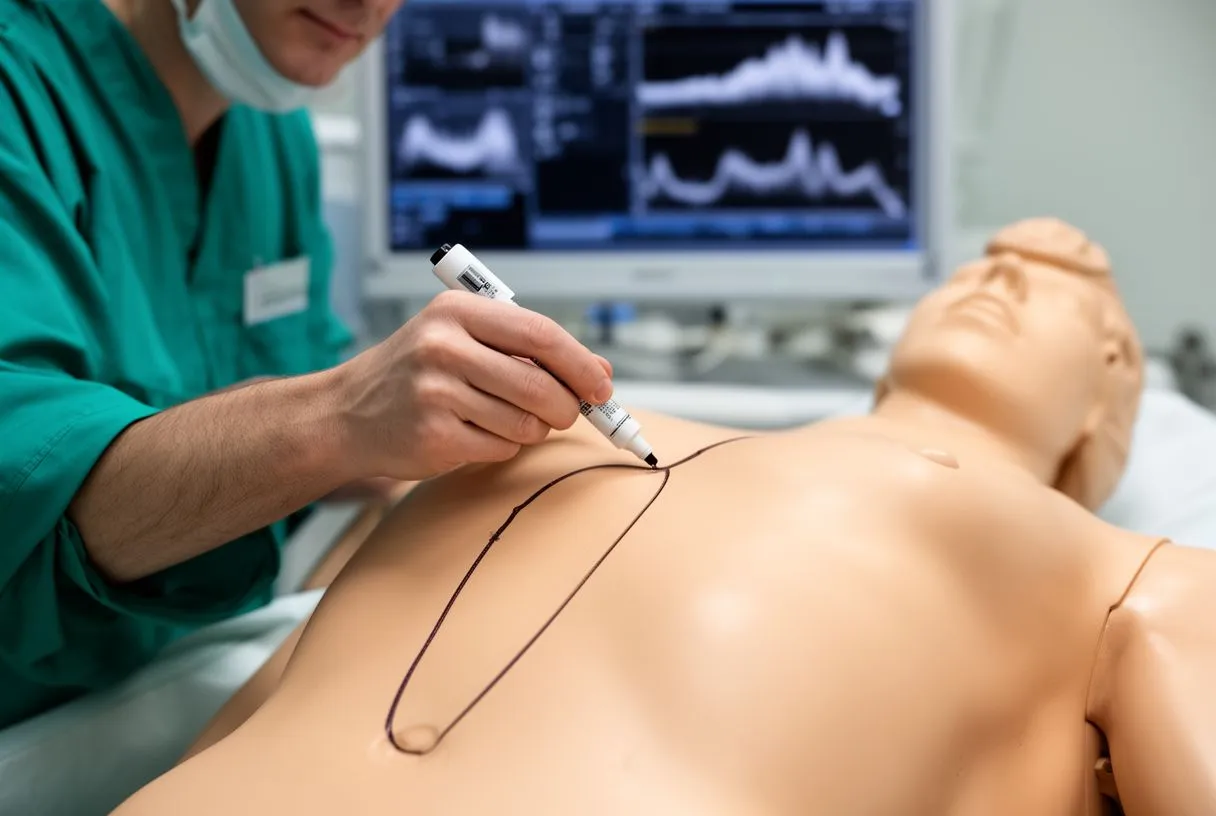
- The incision: the surgeon makes a 7–10 cm skin cut and performs the partial, J-shaped division of the upper or lower sternum — never the whole bone.
- Heart-lung support: in most cases the heart is deliberately stopped and a heart-lung machine takes over circulation, so the valve can be worked on in a still, blood-free field.
- The repair or replacement: the damaged valve is repaired or replaced with a tissue or mechanical valve, then the chest is closed with wires over the partially opened sternum.
Chamber access and visibility. Because the j-incision opens the chest directly, the surgeon sees and feels the valve the same way as in an open operation. This is different from a transcatheter procedure, where the new valve is delivered through a tube from the groin. Direct access means the surgeon can remove a worn-out valve, place supporting sutures, and address more than one problem in the same sitting if needed.
Special valve situations. Some operations are technically demanding regardless of incision. A valve-in-valve procedure (placing a new valve inside a previously implanted one that has failed), operations on an intra-annular valve position, or revision surgery after structural valve deterioration all benefit from a surgeon having direct vision. In our practice, we review every case as a multidisciplinary team against international guidelines before recommending any approach, and we explain the alternatives in plain words so the decision stays yours.
J-Incision vs Full Sternotomy: Which Is Better?
This is the comparison patients ask about most. The honest answer is that "better" depends on your anatomy, your valve problem, and your overall health — not on the incision alone.
What the evidence shows. Published experience with minimally invasive approaches, including partial upper sternotomy for aortic valve work, suggests that when performed by experienced teams it can be carried out safely with results comparable to conventional surgery, while offering less surgical trauma and faster early recovery. One centre's published series on minimally invasive aortic valve replacement concluded the technique was safe in their setting, which is the kind of real-world data that matters when weighing options (Cirugía y Cirujanos).
Trade-offs to discuss with your surgeon.
- Smaller cut, smaller scar: less bone divided and a shorter skin incision.
- Earlier return to activity: a partially divided sternum is generally more stable in the first weeks.
- Longer operating time in some hands: the technical demands are higher, so surgeon experience matters greatly.
- Conventional access still has its place: complex multi-valve operations, emergency situations, or unusual anatomy may be safer through a full sternotomy.
In our team, we perform both conventional and minimally invasive valve procedures, and we recommend the less invasive route only where the evidence supports it for that specific patient — if a full sternotomy is genuinely the safer option for you, we will say so.
J-Incision Aortic Valve Surgery: What to Expect
The aortic valve is the most common target for j-incision valve surgery. Because it sits at the top of the left ventricle, just behind the upper breastbone, a partial upper J-sternotomy gives excellent direct access without opening the lower chest at all.
When surgery is recommended. Aortic stenosis (a narrowed, stiff valve) and aortic regurgitation (a leaky valve) are the usual reasons. Surgery is generally advised once symptoms appear, or when measurements of heart function cross recognised thresholds. Decision-making also considers overall risk scores such as EuroSCORE II, which estimates surgical risk from factors like age, lung function and prior surgery — it is a guide for the team, not a verdict on you as a person.
What the operation involves. Through the J-incision, the diseased valve is removed and a replacement is sewn in. Your surgeon will discuss valve choices with you in detail: tissue valves (bovine pericardial valve or porcine valve options) versus mechanical valves, each with different durability and blood-thinner requirements. The choice depends on your age, lifestyle and preferences — there is no single right answer, only the right answer for you.
Special valve situations. Some operations are technically demanding regardless of incision. A valve-in-valve procedure (placing a new valve inside a previously implanted one that has failed), operations on an intra-annular valve position, or revision surgery after structural valve deterioration all benefit from a surgeon having direct vision. In our practice, we review every case as a multidisciplinary team against international guidelines before recommending any approach, and we explain the alternatives in plain words so the decision stays yours.
Choosing your valve type. If the operation is a replacement rather than a repair, you will discuss valve choices with your surgeon. Tissue valves (from bovine or porcine sources) avoid long-term blood thinners but may wear sooner; mechanical valves last longer but require anticoagulation. There is no universally "best" valve — only the valve that best matches your age, lifestyle and preferences.
J-Incision Mitral Valve Surgery Options
The mitral valve sits deeper and more to the side of the chest than the aortic valve, so its surgical access differs. For mitral work, surgeons may use a j-incision variant, a mini-thoracotomy between the ribs, or full robotic techniques with instruments guided through tiny ports.
Repair versus replacement. For conditions such as mitral valve prolapse (a valve that billows backward and leaks), repair is strongly preferred over replacement whenever the valve anatomy allows it — a repaired native valve usually functions better and lasts longer than any prosthesis. A skilled team will tell you honestly whether your valve is repairable; if it is not, a replacement with a tissue or mechanical valve is the fallback.
Why approach matters for the mitral valve. Because the mitral valve is harder to see, surgical experience with the chosen approach is the single most important predictor of a good result. This applies equally to a j-incision, a mini-thoracotomy, robotic repair, or a Transcatheter Mitral Valve Replacement (TMVR), which is reserved for patients too high-risk for surgery or with specific anatomies. Dr Molina performed the first robotic mitral valve repair in the Ángeles Health System and the first robotic heart surgery in Guadalajara, and trained in minimally invasive, robotic and structural surgery at the University of Montreal.
Tricuspid and other valve combinations. Sometimes more than one valve needs attention. A leaking tricuspid valve (the valve on the right side of the heart) is often addressed during the same operation, and this combination surgery is a situation where direct, open access through a j-incision can be particularly useful, since catheter-based options currently handle multi-valve problems in a more limited way.
J-Incision Heart Surgery Recovery Time and Hospital Stay
Recovery is where the difference between approaches becomes most tangible for patients and families. The broad picture with j-incision valve surgery is a shorter, more comfortable early phase than after a full sternotomy — though every individual recovers at their own pace.
The first days. Most patients are in intensive care for one to two nights, then on the ward. Published work on the early period after minimally invasive cardiac surgery describes specific features of this phase — including differences in pain patterns and chest-wall stability compared with conventional sternotomy — which the care team monitors closely (Reanimatology Review). Walking usually begins within a day or two, and the hospital stay commonly runs three to five days when all goes smoothly.
Weeks one to six. Because only part of the sternum is divided, movement restrictions may be lighter than after a full sternotomy, where sternal precautions (no lifting, no driving, no pushing) typically last six to eight weeks. Your own surgeon will give you precise limits — always follow your team's instructions rather than general timelines. Gentle walking builds steadily; heavier tasks return in phases.
What we monitor in clinic. Follow-up after valve surgery usually covers wound healing, the new valve, medication, and sleep, appetite and mood — because emotional recovery after heart surgery is real and deserves as much attention as the physical side. Family members are welcome at these visits; recovery goes better with support.
J-Incision Scar Size and Healing
For many patients — especially younger ones and women — the appearance of the scar is a genuine concern, and it is entirely fair to raise it.
What the scar looks like. A j-incision typically leaves a shorter skin cut (often around 7–10 cm) positioned at the top of the chest, where it is usually hidden by a shirt collar. A full sternotomy scar runs 25 cm or more down the centre. Neither disappears completely, but the difference in daily life — clothing, swimming, feeling comfortable — is often meaningful.
How healing progresses. The skin usually closes within two to three weeks; the divided part of the sternum knits over two to three months, similar to a fracture. Keeping the wound clean and dry, controlling diabetes and not smoking are the strongest things you can do for good healing. If you notice increasing redness, discharge, or fever, contact your surgical team promptly.
Scar care tips.
- Keep the incision clean and dry; follow your team's dressing instructions exactly.
- Stop smoking before and after surgery — smoking is the single biggest enemy of wound healing.
- Protect the healed scar from strong sun during the first year to help it fade evenly.
- Ask your team before using any creams or oils on a healing incision.
Who Qualifies for J-Incision Valve Surgery?
Not everyone is a candidate, and an honest assessment matters more than an enthusiastic sales pitch for any one technique.
Favourable factors. Good candidates generally have isolated aortic or mitral valve disease, a body build that allows adequate surgical access, no severe chest deformity, and reasonably mobile lung fields. Previous chest surgery, severe calcification of the aorta (the "porcelain aorta"), very poor lung function, or urgent/emergency presentation can push the balance toward conventional surgery or a catheter-based approach instead.
How the decision is made. At our practice, every case is reviewed by the multidisciplinary team against international practice guidelines before a recommendation is made, and you receive a clear proposal with the alternatives laid out, the final decision always remaining yours. Imaging such as echocardiography and CT scanning maps your anatomy before anything is promised.
The value of a second opinion. If you have been told you need surgery and the proposed approach does not feel right, seek another view. We actively encourage second opinions and treat them as a normal part of deciding about heart surgery — a confident surgical team is never threatened by one. Your heart is a one-time organ; the decision deserves care.
J-Incision Cardiac Surgery Risks and Safety
Every heart operation carries risk, and candid discussion of it is a sign of a trustworthy team — not a reason to be alarmed.
General cardiac surgery risks. These include bleeding, infection, stroke, heart rhythm disturbances (particularly atrial fibrillation in the first weeks), kidney effects, and complications of the heart-lung machine. Overall risk depends strongly on age, other conditions, and how urgent the operation is. Your team should quantify your individual risk with a validated score and explain it in plain language.
Risks specific to the smaller approach. J-incision work involves a restricted view and longer technical demands in some hands. Possible specific concerns include conversion to a full sternotomy if anatomy proves unfavourable, difficulties with peripheral cannulation (the tubes that connect you to the heart-lung machine through the groin), and inadequate exposure if the approach is stretched beyond what it suits. These risks fall sharply with surgeon and team experience — this is the main reason to ask directly how many of these operations your surgeon performs each year.
How we keep it safe. In our consultations we take the time to explain what the studies actually show, in plain words, and to answer every question before any decision — including an honest account of what could go wrong and what we would do in that case. Choosing the lowest-risk approach for your situation, rather than the newest or smallest one, is the principle that guides everything.
J-Incision vs TAVR: Choosing the Right Approach
Transcatheter Aortic Valve Implantation — which in this practice and for our patients we simply call TAVR — is the catheter-based alternative in which a replacement valve is delivered through an artery, usually in the groin, without opening the chest at all. It is natural to ask why anyone would choose surgery over a "keyhole" procedure.
Where TAVR shines. TAVR is well established for older or frailer patients, and for those in whom open surgery carries high or prohibitive risk. It avoids a chest incision entirely and typically involves a shorter hospital stay.
Where surgical replacement still matters. Surgical aortic valve replacement through a j-incision allows the surgeon to directly remove and inspect the diseased valve, address the aortic root or nearby coronary arteries if needed, and gives highly predictable, durable long-term results in appropriate patients. For younger patients — particularly those in their fifties and sixties with long life expectancy — surgery remains a firmly guideline-supported choice, and durability of the treatment matters more than the size of the incision.
How the choice is made for you. The decision weighs your age, anatomy, valve type, other medical conditions, and personal priorities. There is also the question of valve strategy: some patients today receive a tissue valve surgically, knowing that years later a valve-in-valve TAVR inside the worn surgical valve can extend durability without reopening the chest — a combined strategy your team should be able to discuss. Ongoing research continues to refine which patients do best with which approach, and you can explore registered studies at ClinicalTrials.gov.
One last thought on choosing your team. Whether you are weighing a j-incision valve repair, a full sternotomy, TAVR, or the option of doing nothing yet, the most important factor is a team that explains every option plainly and lets you decide. We are a multidisciplinary team of cardiac surgeons led by Dr Alejandro Molina, with consulting rooms in Guadalajara, Querétaro and Hermosillo, and our first contact is a free video consultation: we get to know you, talk through your condition, and tell you which studies are genuinely still needed — so no unnecessary tests are ordered. If you are facing valve surgery and want to understand your options, book a consultation with a qualified cardiac team rather than deciding alone; j-incision valve surgery may be the right route for you, but it should be chosen for the right reasons, with all the alternatives on the table.






