
On-Pump Bypass Surgery: How the Heart-Lung Machine Works
On-pump bypass surgery temporarily replaces your heart and lung function so surgeons can operate safely.
If your cardiac team has mentioned on-pump bypass surgery, you are probably facing a decision about coronary artery disease — the narrowing of the arteries that feed the heart muscle. The phrase itself can sound alarming: a machine taking over the job of your heart and lungs. In reality, the heart-lung machine is one of the most dependable technologies in modern medicine, and it is what makes it possible for a surgeon to operate on a still, quiet, blood-free heart. This guide walks you through what the machine actually does, why some patients need it while others do not, what recovery realistically looks like, and which questions are worth bringing to your own surgical consultation.
What Is On-Pump Bypass Surgery?
On-pump bypass surgery is the traditional form of coronary artery bypass grafting — the operation that reroutes blood around blocked coronary arteries using grafts, usually taken from veins in the leg or arteries from the chest wall and arm. The word "on-pump" refers to the cardiopulmonary bypass machine, commonly called the heart-lung machine, which temporarily performs the work of the heart and lungs while the surgeon operates.
Why the machine matters: to sew tiny grafts onto arteries only a millimetre or two wide, the surgeon needs a field with no movement and very little blood. That means deliberately stopping the heart. A stopped heart cannot circulate blood, and non-beating lungs do not oxygenate it — so the machine takes over both jobs for the duration of the operation.
It is worth knowing that "on-pump" is a technique choice, not a different disease treatment. The goal — restoring blood flow to the heart muscle — is identical whether the operation is done on or off the pump. What differs is how the operating field is managed, and that choice depends on your anatomy, your overall health and the surgeon's judgment. In our practice, every candidate for bypass is reviewed by the multidisciplinary team against international practice guidelines before any recommendation is made, and the patient receives a clear proposal with the alternatives so the final decision is always theirs.
What Is a Heart-Lung Machine and How Does It Work?
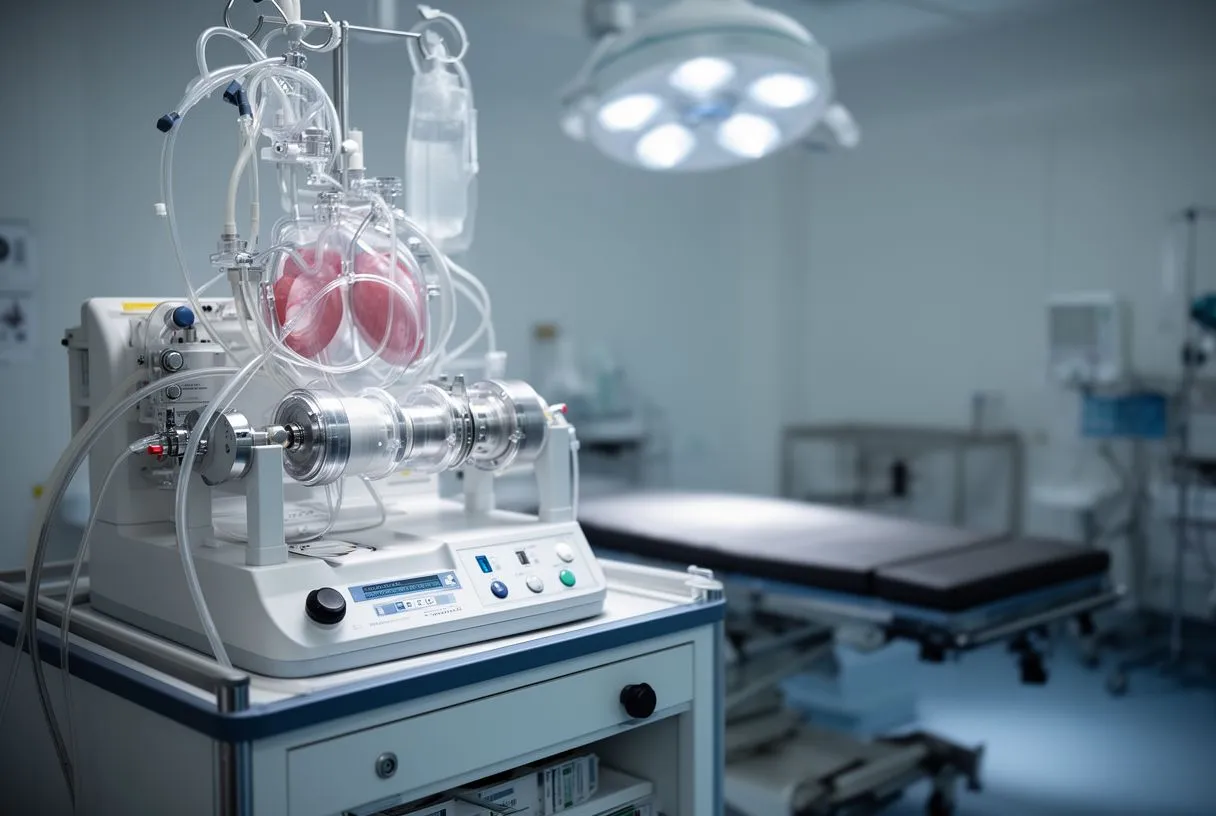
A heart-lung machine is a set of pumps and an oxygenator — an artificial lung — connected to your circulation through plastic tubing inserted into the large vessels near the heart. Understanding the loop helps take away much of the fear around it.
The circulation loop: blood is drained by gravity from the veins returning to the heart, enters the reservoir, passes through the oxygenator where it picks up oxygen and releases carbon dioxide, is filtered, warmed or cooled as needed, and is pumped back into the aorta — the main artery leaving the heart. From there, normal circulation carries oxygenated blood to the whole body. The machine therefore completely bypasses the heart and lungs, which are rested and isolated for surgery.
Who runs it: the machine is operated throughout by a specially trained professional — a perfusionist — who continuously monitors flow, pressure, blood gases and temperature. The pump team adjusts everything in real time, much like an anesthesiologist manages anesthesia. In the decades since cardiopulmonary bypass was first used clinically in the 1950s, the equipment and safety monitoring have been refined enormously, and it is now used routinely in hospitals worldwide. National Heart, Lung, and Blood Institute describes the heart-lung machine as standard, well-established equipment for open-heart operations.
Who Needs On-Pump Bypass Surgery?
On-pump bypass is typically recommended when coronary artery disease — blockages in the arteries supplying the heart muscle — is extensive enough that stents or medication alone cannot adequately protect the heart. Common indications include significant blockage of the left main coronary artery, disease in all three major coronary vessels, or narrowed arteries unsuitable for angioplasty.
Situations where the pump is often the preferred route:
- Multi-vessel disease: when several arteries need grafts, the still, bloodless field the pump provides allows precise placement of every anastomosis — the surgical connection between graft and coronary artery.
- Combined procedures: when bypass is done together with valve repair or replacement, the heart-lung machine is essential, because valve work also requires a motionless heart.
- Difficult anatomy or urgent cases: reduced heart function, unusual artery positions or emergency operations often favor the controlled environment the pump provides.
None of these factors alone decides the matter. The right approach is chosen case by case. When patients come to us for a first consultation — which is a free video visit where we talk through the condition and identify exactly which studies are still needed — we explain what each test actually shows, in plain words, before any decision about the surgical approach is even discussed.
How the Cardiopulmonary Bypass Procedure Unfolds, Step by Step
Knowing the sequence of a coronary artery bypass on pump helps patients and families visualize the day rather than imagine an unknown void. The operation usually takes three to four hours.
Before the pump starts: after anesthesia is established, the surgeon opens the chest through the breastbone (sternotomy) and gives heparin, a medication that prevents clotting in the circuit. Tubes are placed in the aorta and in the veins returning to the heart, and the patient is gradually connected to the machine. Full flow is established smoothly over a minute or two — the transition is deliberately gentle.
During the operation: the heart is slowed and stopped with a specialized solution called cardioplegia, delivered into the coronary circulation. This is the "stopped heart bypass surgery" phase: with a still, blood-free field, the surgeon sews each graft in place. Meanwhile the machine keeps oxygenated blood flowing to the brain, kidneys and every other organ, and body temperature is often lowered slightly to add a margin of protection for the organs.
Coming off the pump: once all grafts are in place and checked, the heart is prepared to resume beating — a phase known as weaning from bypass. Flow on the machine is reduced in stages as the heart gradually takes over its own work. The heart may need gentle pacing wires or supportive medication at first, and in some situations an intra-aortic balloon pump — a small device in the aorta that assists the heartbeat — is used temporarily. Once the heart is reliably supporting the circulation, the cannulas are removed, the anticoagulant is reversed, and the chest is closed. Total bypass time is recorded precisely and varies with the number of grafts.
On-Pump vs Off-Pump Bypass: Which Approach Is Used?
Off-pump bypass — "beating heart" surgery — is the alternative in which grafts are sewn while the heart keeps beating, without the heart-lung machine. Surgeons stabilize the section of the heart being worked on with a positioning device, and the rest of the heart continues to circulate blood. Both are legitimate, well-studied techniques.
Arguments for staying off the pump: avoiding the machine means avoiding the body's whole-body inflammatory response to the circuit, and some patients — particularly those with severe lung disease, extensive aortic calcification, or prior stroke — may be better served without it. Interestingly, the pump's effects can occasionally show up in unexpected ways; thoracic surgery literature has even documented rare complications such as massive subcutaneous emphysema — air trapped under the skin — after off-pump coronary bypass, a reminder that both approaches carry their own specific, if uncommon, risks.
Arguments for the pump: on-pump surgery offers a perfectly still field and precise control of circulation and temperature, which many surgeons prefer for complex multi-vessel grafting. Large comparative studies have found that for most patients, long-term graft patency and survival are similar between the two approaches, so the decision usually rests on the patient's specific anatomy and risk profile rather than on one technique being universally superior. In our team's practice, we recommend the less invasive or off-pump route only where the evidence supports it for that particular patient — never as a blanket policy.
What Happens While Your Heart Is Stopped?
For patients, one of the most anxiety-provoking ideas is the stopped heart itself. It helps to understand precisely what the body experiences during that time.
Protection for the organs: the heart is not the only organ at stake. The brain, kidneys and liver all depend on continuous perfusion, and the heart-lung machine maintains that circulation at controlled pressure and temperature throughout. Mild cooling of the blood reduces the metabolic demands of every organ, adding a layer of protection. Research into the body's response to the bypass circuit — including studies of inflammatory markers such as interleukin-35 in patients undergoing coronary artery bypass graft surgery — continues to refine how teams manage this inflammatory response and improve organ protection.
What you experience: nothing. You are under general anesthesia, unaware of the entire period. The heart is restarted — usually by restoring blood flow to its own coronary arteries — before you wake. Many patients ask whether the heart "remembers" being stopped; it does not. It simply resumes the rhythm it had, often with the help of temporary pacing wires that are removed before discharge.
When we sit with patients and their families before surgery, this is one of the questions we take the most time to answer, because understanding that the machine is doing your heart's job — competently and continuously — usually replaces fear with a more grounded sense of trust in the process.
On-Pump Bypass Recovery Time: The First Days to the First Months
On-pump bypass recovery time follows a predictable arc, though individual progress varies with age, fitness and other conditions.
The hospital stay: most patients spend one night in an intensive care unit, where breathing support is removed within hours and staff monitor heart rhythm and output closely. The following days are spent on a regular ward, sitting up, walking short distances, and regulating breathing exercises. A typical hospital stay is five to seven days if no complications arise.
The first six weeks: the breastbone, which was divided to access the heart, needs about six to eight weeks to knit. During this period there are firm rules: no lifting anything heavier than a few kilograms, no driving until cleared, and careful attention to the healing wound. A structured cardiac rehabilitation program — supervised, gradual exercise — is strongly recommended and meaningfully improves outcomes.
Return to work: for desk-based jobs, many patients return within six to eight weeks; physically demanding work may take three months or longer. The honest answer is that recovery is gradual and personal — it is better to judge progress by what you can comfortably do, not by a fixed calendar date.
On-Pump Bypass Risks and Benefits
An honest discussion of on-pump bypass risks and benefits is part of good consent, and no responsible surgical team should reassure without evidence.
The risks: because the machine circulates blood through artificial surfaces, it triggers a temporary inflammatory response, and blood exposure to the circuit requires anticoagulation, which carries a small bleeding risk. Rarer risks include stroke, kidney impairment, and temporary cognitive changes — often called "pump head" in colloquial terms — which for most patients resolve over weeks to months. Atrial fibrillation, a temporary rhythm disturbance, is also more common after any open-heart operation. All of these risks are weighed against the risk of leaving significant coronary disease untreated.
The benefits: the pump provides a precise, controlled environment that has enabled more than half a century of successful heart surgery. It allows complete revascularization — every significant blockage bypassed — in a single operation, and it supports the circulation reliably even in patients whose heart is already weak. For patients with complex disease, that control can be decisive.
The honest framing is this: the risk profile of on-pump surgery is well mapped, modern perfusion technology has reduced circuit-related complications substantially, and in experienced hands the overall risk of a planned bypass operation is low relative to the danger of untreated coronary disease. We review each patient's individual risk profile — including calculated scores such as EuroSCORE II, which estimates operative risk from age, function and prior history — with the multidisciplinary team before proposing any approach, and we actively encourage patients to seek a second opinion as a normal part of deciding about heart surgery.
On-Pump Bypass Long-Term Outcomes and Quality of Life
Most patients who undergo bypass surgery experience a genuine improvement in quality of life: less chest pain, better exercise tolerance, and reduced reliance on medication for angina. Long-term success, however, depends heavily on what happens after the operating room.
Graft longevity: arterial grafts, particularly the internal mammary artery taken from inside the chest, have excellent long-term durability. Vein grafts can develop narrowing over the years. Lifestyle factors — smoking cessation, blood pressure and cholesterol control, diabetes management — influence graft longevity as strongly as surgical technique does.
Life after surgery: most patients return to normal daily activities, travel, and a full range of work. The surgery treats the consequences of coronary disease, but the underlying disease process continues, so lifelong follow-up with a cardiologist, continued medication and cardiac rehabilitation habits are part of the package. It helps to see the operation as one chapter in a longer story of heart health, with structured follow-up afterward.
How to Choose Your Surgical Team and Ask the Right Questions
For many patients — especially those considering treatment abroad or far from home — the choice of surgeon and hospital matters as much as the technique itself. Here is a practical checklist worth working through.
- Volume and specialization: ask how many bypass operations the surgeon and hospital perform per year and what their results are for patients like you.
- Multidisciplinary review: the strongest programs review every case as a team — surgeons and cardiologists together — before recommending an approach.
- Clarity of communication: a good team explains your studies in plain language, presents alternatives honestly, and never pressures a decision.
- Practical support for international patients: clear coordination of studies, transparent costs, and help with logistics reduce stress enormously when traveling for surgery.
Our team, led by Dr Alejandro Molina with consulting rooms in Guadalajara, Querétaro and Hermosillo, covers the full range of cardiac surgery — conventional, minimally invasive, robotic and transcatheter procedures, including TAVR for aortic valve disease. Dr Molina trained in cardiothoracic surgery at the Universidad de Guadalajara, in cardiac, minimally invasive, robotic and structural surgery at the University of Montreal, and in structural cardiology and TAVR at CHU Bordeaux. The first contact with us is a free video consultation: we get to know you, talk through your condition, and identify exactly which studies are still needed — so no unnecessary ones are ordered — before any face-to-face visit. We encourage second opinions and treat them as a normal, healthy part of deciding about heart surgery.
On-pump bypass surgery remains the backbone of coronary artery treatment worldwide: a well-understood, well-refined technique in which the heart-lung machine does the work of your heart and lungs for a few hours while a surgeon rebuilds the blood supply to your heart muscle. Knowing how the machine works, why it is sometimes chosen over a beating-heart approach, what recovery realistically involves, and which risks and benefits matter for your specific situation puts you in a far stronger position to decide. If you have been told you need bypass surgery — or you are simply trying to understand what it would mean — the right next step is a conversation with a qualified cardiac team, not a self-diagnosis. Book a consultation, bring your questions, and make the decision with clear information and time to think.