Chest Compressions: Doing CPR Well in a Cardiac Arrest
Chest compressions CPR can double survival in cardiac arrest.
When someone collapses suddenly, the seconds that follow can decide whether they recover fully or suffer lasting harm. Chest compressions — the rhythmic pressing on the breastbone that replaces the heart's own pumping action — are the single most important thing a bystander can do before professional help arrives. This guide explains, in plain terms, what happens during a cardiac arrest, why pushing hard and fast on the chest matters, and how you can perform each step correctly even if you have never been formally trained. We will cover hand placement, depth, rate, the role of rescue breathing, and how an automated external defibrillator fits into the chain of survival.
What Are Chest Compressions and Why Do They Matter in Cardiac Arrest
A cardiac arrest is not the same as a heart attack. In a heart attack, a blocked artery starves part of the heart muscle of blood, but the heart usually keeps beating. In a cardiac arrest, the heart's electrical system malfunctions and the heart stops pumping effectively — sometimes quivering chaotically in a rhythm that resembles atrial flutter but originates in the ventricles. Blood flow to the brain halts within seconds, and irreversible brain damage begins after roughly four to six minutes without circulation.
Chest compressions mimic the heart's squeezing action manually. By pressing down on the lower half of the sternum, you push blood out of the heart into the aorta — the large artery that arches off the ascending aorta — and onward to the brain and vital organs. When you release, the chest wall recoils and the heart refills, ready for the next compression. This mechanical pumping buys time until a shock can be delivered or blood flow restored. According to MedlinePlus, immediate bystander CPR can double or triple the chance of survival after cardiac arrest.
The key principle is that doing something is far better than doing nothing. Even imperfect compressions move some blood, and that small amount of circulation keeps brain tissue viable. Waiting for the ambulance because you fear doing it wrong costs precious minutes. The actions described here are aimed at adults; children and infants need modified technique and, often, rescue breaths.
How Hands-Only CPR Works to Keep Blood Circulating
Hands-only CPR means continuous chest compressions without mouth-to-mouth rescue breathing. For the first several minutes of a witnessed adult collapse, the blood already circulating in the body still carries enough oxygen to sustain the brain — provided you keep it moving. This is why guidelines now recommend hands-only CPR for untrained bystanders: it removes the hesitation around mouth contact and keeps the rescuer focused on the task that matters most, maintaining flow.
The mechanics rely on chest recoil. Each time you press down you squeeze the heart between the sternum and the spine, forcing blood forward through the aortic valve and into the arterial tree. Each time you let go, the negative pressure inside the refilling heart draws blood back from the venous side. If you lean on the chest between compressions — a common mistake — you block that refilling and defeat the purpose of all your effort.
Good technique also protects the rescuer. Keeping your arms straight and using your body weight from the shoulders means you are not pushing with arm muscles, which tire within a minute. Bending at the hips and rocking slightly, elbows locked, lets gravity and your core do the work so you can sustain the rate long enough for help to arrive.
Proper CPR Hand Placement on the Chest
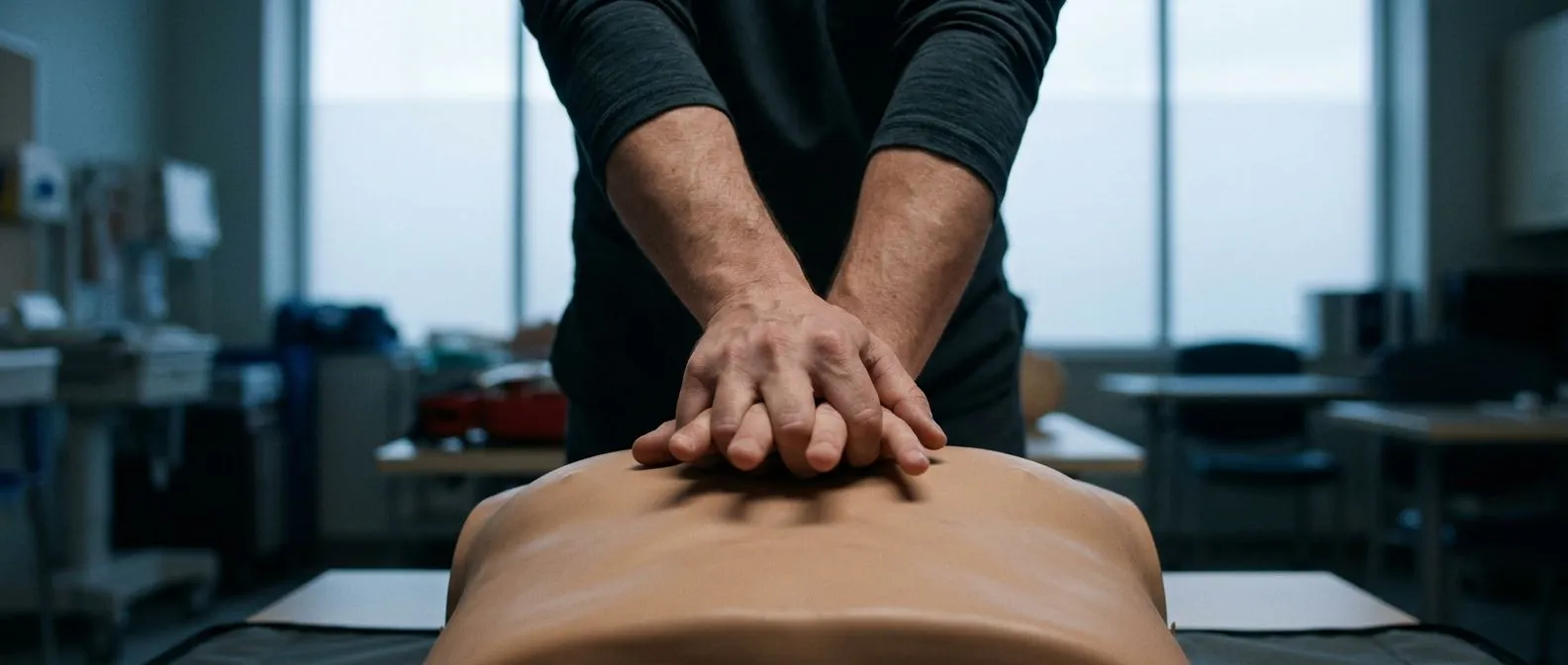
Finding the right spot on the sternum: Place the heel of one hand on the centre of the chest, on the lower half of the breastbone — roughly between the nipples. Put your other hand on top and interlock the fingers so they do not press on the ribs. Keeping the hands on the lower sternum avoids pushing on the xiphoid, the small pointed bone at the base, which can injure underlying organs.
Body position over the victim: Position your shoulders directly above your hands, arms locked straight. This vertical alignment transfers your upper-body weight straight down with each compression. If you are off to the side, force is wasted and compressions become shallow. On a hospital ward you might see staff check the arterial line waveform to confirm adequate circulation; at the roadside you rely on feeling the chest move and knowing your depth.
Common placement errors to avoid: Hands too high on the upper chest compress poorly and risk rib injury. Hands too low press on the soft abdomen. Fingers pressing the ribs, rather than the heel of the hand on the sternum, cause fractures. If you hear a crack on the first compression, do not stop — ribs may break during effective CPR, but stopping is far more dangerous. Reposition quickly and continue.
CPR Compression Depth and Rate for Adults
Current international guidelines recommend pushing down at least 5 cm but no more than 6 cm for an average adult. Shallower compressions do not eject enough blood; excessively deep ones increase the risk of internal injury without adding benefit. You should aim to compress the chest about one third of its anterior-posterior depth — the same principle used when an atheromatous plaque ruptures and causes an atypical infarction, where rapid restoration of flow limits muscle death.
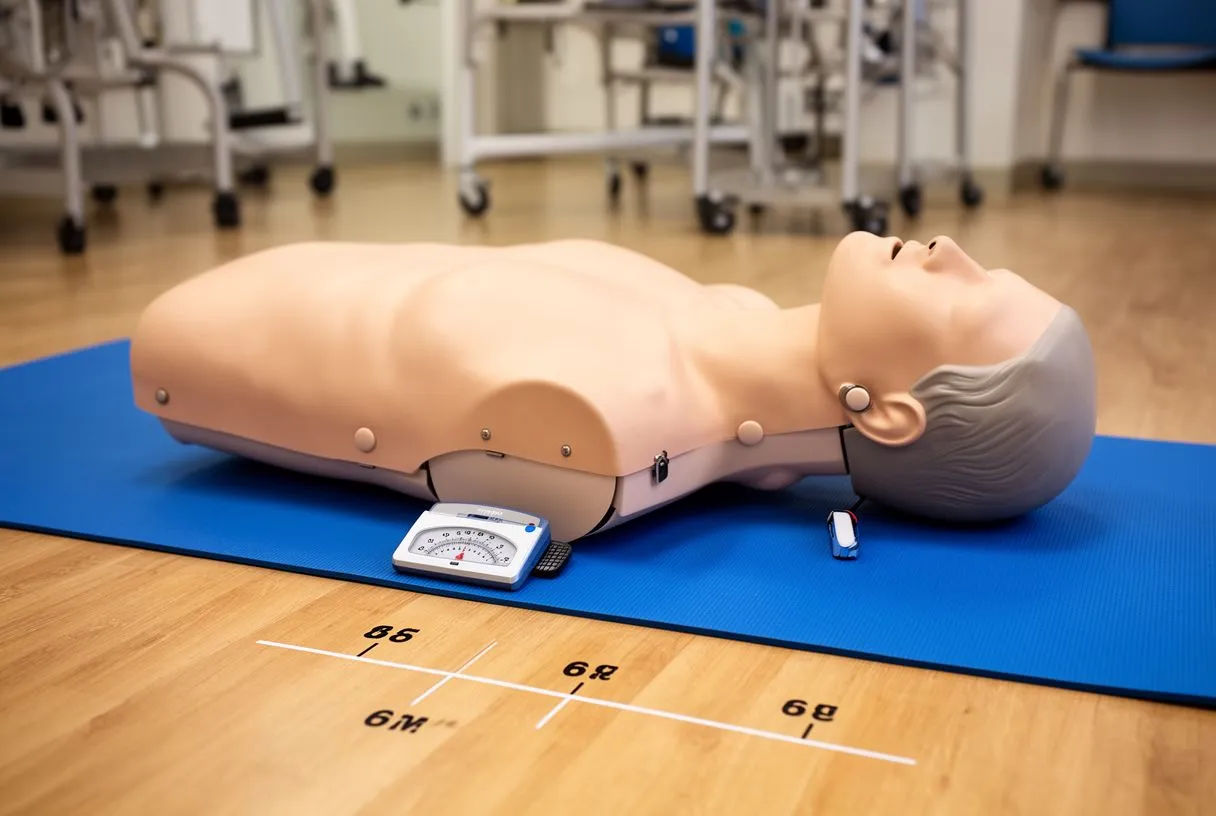
Rate matters as much as depth. The target is 100 to 120 compressions per minute. Slower than 100, blood flow drops off sharply. Faster than 120, the heart does not have time to refill between compressions, so output falls again. Many people find it helpful to match the beat of a familiar song that sits at this tempo; the important thing is to keep a steady, metronomic rhythm without long pauses.
Minimising interruptions: Every second you stop compressing, blood pressure collapses and has to be rebuilt from scratch. Pauses to check a pulse, reposition, or attach a defibrillator should be as brief as possible — under ten seconds for any single interruption. If someone else is present, swap roles every two minutes to avoid fatigue, because exhausted rescuers push more shallowly without realising it.
Bystander CPR Guide: Recognising a Cardiac Arrest
The first challenge is recognising that an arrest has actually happened. The classic signs are sudden collapse, no response when you shake and shout, and absent or abnormal breathing — gasping, slow, or agonal breaths that look nothing like normal respiration. A person who is snoring loudly after collapsing may be in a cardiac arrest, not simply asleep.
- Sudden collapse with no warning: the person drops without bracing.
- No normal breathing: chest still, or only gasping, agonal breaths.
- No response to shout or shake: no eye opening, no movement.
Checking for response safely: Tap the person firmly on the collarbone and shout, "Are you all right?" Look at the chest for breathing for no more than ten seconds. Do not waste time fumbling for a pulse if you are not trained to find one — even professionals miss pulses under stress. If there is any doubt, assume arrest and start chest compressions. In hospital settings, auscultation with a stethoscope or a quick cardiac monitor confirms the rhythm, but in the street you act on what you see.
Calling for help first versus starting immediately: If you are alone with an adult who has collapsed suddenly, call emergency services and put the phone on speaker before you start compressions. If another person is with you, send them to call and fetch an automated external defibrillator while you begin. The exception is a witnessed drowning or a child, where you should give a minute of CPR before calling, because the arrest is usually driven by lack of oxygen rather than a primary heart problem.
CPR Without Mouth-to-Mouth: Is Rescue Breathing Still Needed
For many years, bystanders were taught to give two rescue breaths after every 30 compressions. That 30:2 cycle is still recommended for trained rescuers, children, and drowning cases — all situations where the arrest is primarily respiratory. But for a sudden adult collapse where the cause is presumed to be the heart, hands-only CPR is now preferred for untrained bystanders.
The reason is pragmatic. Hesitation over mouth-to-mouth costs time, and many bystanders simply do nothing. Studies of real arrests show that compressions alone, started promptly and continued well, produce survival outcomes comparable to full CPR in the early minutes. The residual oxygen in arterial blood sustains the brain long enough that delaying breaths does not usually change the outcome. Patients who have taken aspirin as advised for chest pain, or who have known coronary disease, are exactly the group most likely to benefit from immediate compressions.
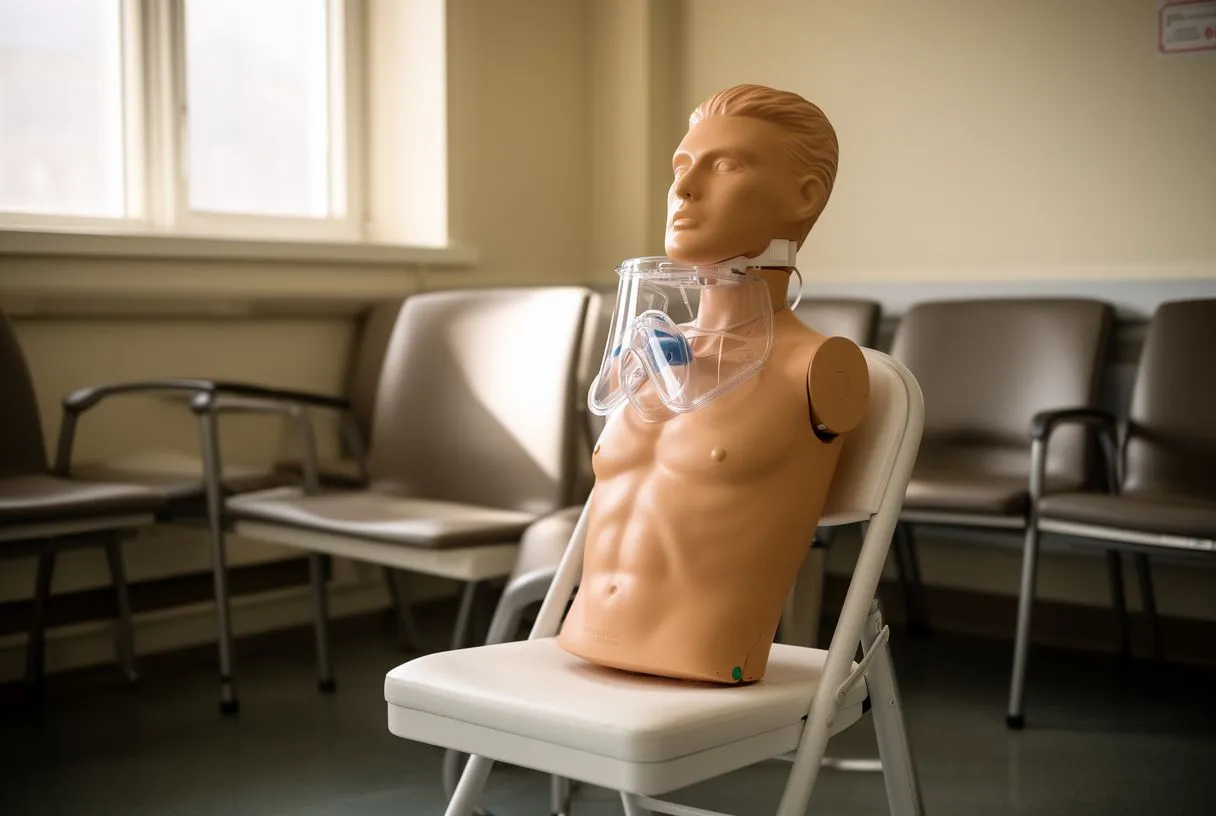
Rescue breathing becomes important after the first few minutes, once the body's oxygen stores are depleted, and for any arrest not caused by a primary heart rhythm problem. If you are trained and confident, switch to 30:2. If you are not, keep going with hands-only until an AED arrives, a professional takes over, or the person starts breathing normally.
How Long Should You Continue Chest Compressions
There is no fixed timer for how long CPR lasts. You continue until one of several clear endpoints: the person starts breathing normally, a defibrillator is ready to analyse the rhythm, trained help takes over, or you are physically exhausted with no one to relieve you and no further help expected. In hospital, teams may run an arrest for longer because they can use advanced interventions such as an arterial graft or autologous blood transfusion support, but for a single bystander the practical horizon is fatigue.
Rotating with a second rescuer: If two people are present, swap every two minutes or about five cycles of 30:2. The handover should take under five seconds. The fresh rescuer announces they are ready, the current one slides off, and compressions resume immediately. This keeps depth and rate consistent; quality drops sharply after the first two minutes of solo compressing.
Do not stop to recheck a pulse or breathing every minute — that pause breaks the momentum and the benefit. Only stop if the person clearly wakes, moves, or breathes normally, or when a defibrillator prompts you to stand clear. If you must stop because you cannot continue, try to guide someone else to take over rather than simply walking away.
Using an Automated External Defibrillator With Chest Compressions
An AED is a portable device that analyses the heart's rhythm and, if it detects a shockable pattern, delivers a controlled electric current to try to reset it. Public models are designed for untrained users: they talk you through each step with voice prompts. The moment an AED arrives, one rescuer keeps doing chest compressions while the other opens it and applies the pads.
Pad placement on the bare chest: One pad goes below the right collarbone, the other below the left armpit, on a dry, bare chest. Shave excessive chest hair if it prevents good contact, and move any medication patch away from the pad area. The AED will tell you when to stop compressions so it can analyse — everyone must stand clear during analysis and shock delivery. After a shock, or if no shock is advised, resume compressions immediately without checking a pulse.
The AED and compressions are complementary, not alternatives. The shock may reset the rhythm, but the heart often needs the mechanical boost of compressions to start pumping effectively again. In a hospital, a balloon aortic valvuloplasty or a balloon-expandable valve procedure may restore flow mechanically, but outside, the AED and your hands are the tools that buy time until definitive care.
CPR Survival Rates and What Influences Outcomes
Survival after out-of-hospital cardiac arrest varies widely and depends on factors the bystander can influence and some they cannot. The strongest predictors of a good outcome are witnessed collapse, immediate bystander CPR, early defibrillation, and the initial rhythm being shockable. Each minute without CPR reduces survival by roughly 7–10%, which is why the response of the first person on the scene matters so much.
- Witnessed arrest: someone sees the collapse and starts CPR at once.
- Early defibrillation: AED applied within the first few minutes.
- High-quality compressions: correct depth, rate, and minimal pauses.
- Post-arrest care: specialised hospital management and rehabilitation.
Factors that improve survival: Starting compressions within the first minute, using an AED within three to five minutes, and maintaining high-quality depth and rate throughout. Coexisting conditions matter too — a patient with high apolipoprotein B levels or a complex atherosclerotic burden may have a more fragile circulation. After return of spontaneous circulation, structured cardiac rehabilitation, such as the kind examined in a study on the Effects of a cardiac rehabilitation course on psychological stresses in an Iranian population, supports longer-term recovery.
Outcomes are also shaped by what happens after the heart restarts. Hospital care — temperature control, coronary intervention, treating infection, and avoiding complications like those described in research on the impact of hospital infections on patients undergoing cardiac surgery — all influence whether the patient leaves hospital neurologically intact. As a bystander, your role is the foundation on which all of this rests.
When to Stop CPR and Hand Over to Emergency Services
Knowing when to stop is part of doing CPR well. You stop when the person begins to breathe normally, opens their eyes, or moves purposefully. You stop when a defibrillator is ready to analyse the rhythm and instructs you to stand clear. You stop when professional rescuers arrive and take over, or when you are alone and physically unable to continue despite trying to recruit help.
If the person starts breathing but remains unconscious, roll them gently onto their side into the recovery position and monitor closely. If breathing stops again, immediately return them to their back and resume compressions. Stopping too early — to check a pulse that is hard to feel, or because the person gasps once — is a common and costly mistake.
Finally, if you are a family member of someone with known heart disease, learning CPR before an emergency arises is one of the most valuable things you can do. A person with arm pain, known coronary disease, or a recently placed arterial cannula may be at elevated risk. Discussing your individual situation with a qualified cardiac team, such as the practice of Dr Alejandro Molina in Guadalajara, Querétaro and Hermosillo, gives you a plan tailored to your circumstances rather than generic advice. Book a consultation to talk through your risks and what your family should know — preparation is the best form of reassurance.
Chest compressions performed well keep oxygenated blood moving to the brain and other vital organs during the critical minutes of a cardiac arrest. Remember the essentials: call for help, place the heel of your hand on the centre of the lower chest, push hard and fast at 100–120 compressions per minute, allow full chest recoil, minimise interruptions, and use an AED as soon as it arrives. Hands-only CPR is appropriate and effective for a sudden adult collapse; rescue breathing matters for children, drowning, and prolonged arrests. Doing something is always better than doing nothing. If you or a loved one live with heart disease, take the next step and discuss your personal risk and emergency plan with a qualified cardiac team, and book a consultation so you are prepared long before you ever need these skills.