ESC Guidelines on Heart Valve Disease for Patients
ESC guidelines valve disease decoded for patients: diagnosis, treatment timing, TAVR vs surgery, and follow-up.
If you or a family member has just been told you have a heart valve problem, you will quickly meet a phrase that doctors use constantly: the ESC guidelines on valve disease. These are the written recommendations that cardiology teams across Europe, and increasingly around the world, use to decide when a leaky or narrowed valve needs treatment, which treatment fits which patient, and how you should be followed afterwards. This guide translates those recommendations into plain language, so you can read your own diagnosis with more confidence and ask better questions at your next appointment.
What Are the ESC Guidelines on Valve Disease?
What are ESC guidelines for heart valves, exactly? They are consensus documents written by panels of leading cardiologists and surgeons who review all the available evidence — large clinical trials, registry data, and expert consensus — and then issue practical recommendations. The current cornerstone is the joint ESC/EACTS document on the management of valvular heart disease, updated most recently in 2021, which is what people usually mean when they search for the esc valve disease guidelines 2024 or the latest edition. They cover every heart valve: aortic, mitral, tricuspid, and pulmonary.
The guidelines do not replace your doctor's judgement. They are a shared framework. When your cardiologist says your aortic valve has "severe stenosis" and you should be considered for treatment, that language comes directly from these documents. When a surgeon recommends surgery before symptoms appear, it is because the guideline panel judged that waiting would do more harm than good.
For patients, the practical value is enormous. The guidelines define the measurements that matter, the thresholds that trigger action, and the options on the table. Understanding them turns a confusing consultation into a conversation between equals. In our practice, every valve case is reviewed by the multidisciplinary team against these international practice guidelines before any recommendation is given, and the patient always receives a clear proposal together with the alternatives.
What Does ESC Stand For and Why Does It Matter to Patients?
ESC stands for the European Society of Cardiology, the largest cardiovascular professional body in Europe. It publishes clinical practice guidelines on a wide range of topics — heart failure, coronary disease, pregnancy, cholesterol — and it partners with EACTS, the European Association for Cardio-Thoracic Surgery, on the valve documents. That partnership matters: valve decisions are made jointly by cardiologists and surgeons, so the guidelines are written jointly too.
Where can you find the ESC guidelines in PDF format? The European Society of Cardiology publishes every guideline document, and a patient-friendly "patient version" of each, on its official website, free of charge. If you want to read the source material, search the ESC website for the valve disease guideline; the patient version is written without medical jargon. You do not need to read the full document to benefit — but knowing it exists means you can check anything your own team tells you.
Why should a patient in Mexico or Latin America care about a European document? Because the ESC guidelines and the American ACC/AHA Guidelines agree on most of the fundamentals, and the ESC/EACTS documents are the international reference many teams cite when they explain their reasoning. Our team reviews each patient against both sets of guidelines, so that a recommendation made in Guadalajara rests on the same evidence base as one made in Paris or Montreal.
How Do the ESC Guidelines on Aortic Stenosis Explain Your Diagnosis?
How severe is severe? The ESC guidelines on aortic stenosis define severity using measurements taken at echocardiography — the ultrasound scan of your heart. Aortic stenosis means the aortic valve, the exit door from the heart's main pumping chamber, has become stiff and narrow. Severity is graded by the valve area (normal is roughly 3 cm²; severe is under 1 cm²), by the pressure the heart must generate to push blood through (the "gradient"), and by blood flow velocity across the valve.
The guidelines also recognise subtypes that confuse many patients. "Low-flow, low-gradient" stenosis means the valve looks severely narrowed even though pressures seem modest — often because the heart muscle is weakening. This matters because these patients still benefit from valve replacement, and they are the ones most often told to "wait and see" when they should not be. If you have been given this label, it deserves a proper discussion with a specialist team.
Timing is the other key message. Once stenosis is severe, the guidelines generally recommend valve replacement when symptoms appear — breathlessness on exertion, chest discomfort, dizziness or fainting. In some patients with declining heart function on scans, intervention is advised even before symptoms. The message is that severe aortic stenosis is a mechanical problem; medication eases the journey but does not open the valve. When we meet a patient with severe aortic stenosis, we take the time to explain in plain words what the echocardiogram actually shows and which of these thresholds apply to them specifically.
What Do the ESC Guidelines Say About Mitral Regurgitation?
Mitral regurgitation is a leak, not a blockage. The mitral valve sits between the left atrium and the left ventricle, and when it does not close fully, blood flows backwards with every heartbeat. The ESC guidelines split the condition into two very different problems: primary regurgitation, where the valve leaflets themselves are diseased — a prolapsing leaflet, a torn chord — and secondary regurgitation, where the valve is structurally normal but the heart muscle has stretched and pulled it apart.
This distinction drives everything. For primary regurgitation, the guidelines are unusually firm: once it is severe, mitral valve repair is recommended even in patients without symptoms, because the results of expert repair are excellent and the heart is protected before damage becomes permanent. For secondary regurgitation, treatment of the heart muscle itself comes first, and valve procedures — including repair with a clip delivered through a catheter — are recommended in selected patients who remain symptomatic despite medication.
Why does repair beat replacement for many mitral valves? A well-performed repair preserves your own valve tissue, avoids the lifelong considerations of an artificial valve, and generally offers excellent durability in experienced hands. This is one area where surgical skill and volume genuinely change outcomes, so the guidelines emphasise referral to teams with proven mitral repair expertise. Dr Molina performed the first robotic mitral valve repair in the Ángeles Health System, and our team therefore discusses repair-first options with most patients who have primary mitral regurgitation.

When Do the Guidelines Recommend TAVR Instead of Open Surgery?
TAVR — transcatheter aortic valve replacement — is a way of replacing the aortic valve without opening the chest. A new valve, mounted on a slim tube (catheter), is usually delivered through an artery in the groin and expanded into position inside the old valve. Randomised trials published in the New England Journal of Medicine and elsewhere have shown that for many patients, TAVR matches or exceeds the results of open surgery, and the treatment landscape has shifted accordingly.
How do the ESC guidelines on transcatheter valve repair and replacement decide who qualifies? The decision rests on three questions asked in order. First: is the valve disease severe enough to warrant treatment at all? Second: can the procedure be done safely through the patient's arteries (the "transfemoral" route)? Third: what is the patient's age and surgical risk? Broadly, TAVR is the default for older patients and those at higher surgical risk, while open surgery remains the standard for younger, lower-risk patients, largely because long-term durability data for TAVR is still maturing.
The word "default" matters less than the word "individual". The guidelines explicitly frame the choice as a shared decision between the heart team and the patient, weighing anatomy, age, other conditions, and personal preference. Our team performs both conventional and transcatheter procedures, and we recommend the less invasive route only where the evidence genuinely supports it for that particular patient — never as a blanket rule.
How Do the ESC Guidelines Guide Surgical Valve Replacement?
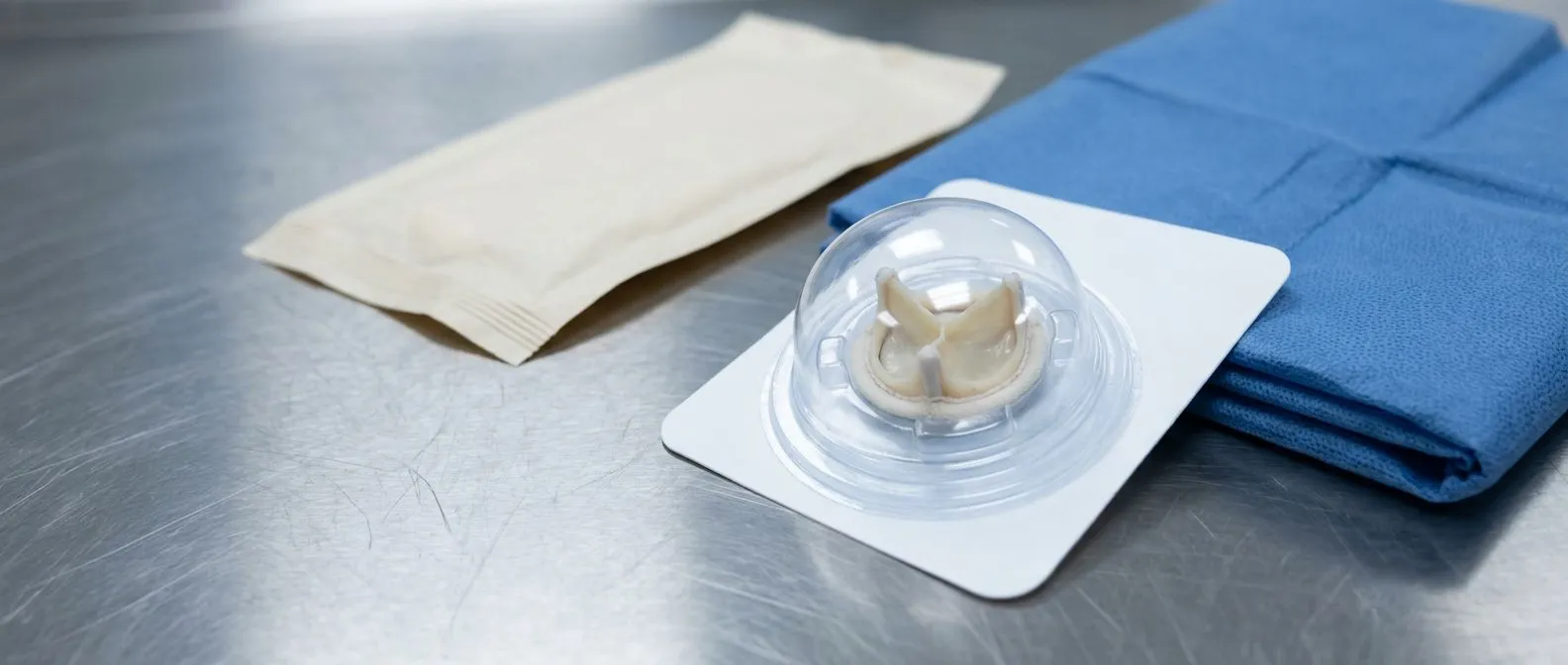
When open surgery is the right route, patients often ask: which replacement valve? The ESC guidelines on surgical valve replacement describe the main families rather than prescribing one product. Understanding the categories helps you follow the conversation.
- Stented valve: a tissue valve mounted on a fabric-covered frame; the most common choice, with reliable long-term performance and straightforward implantation.
- Stentless valve: a tissue valve without a frame, implanted close to the natural valve position; used selectively where haemodynamics are the priority.
- Sutureless valve: a rapid-deployment tissue valve that needs minimal stitching, shortening operation and cross-clamp time in selected patients.
Mechanical or biological — which should you choose? Mechanical valves last a lifetime but require blood-thinning medication, usually warfarin, permanently. Biological (tissue) valves avoid long-term anticoagulation but carry a realistic expectation of re-intervention years later as valve degeneration progresses. The guidelines frame this mainly as a function of age and patient preference, with mechanical valves generally favoured for younger patients and tissue valves for older ones — always subject to the patient's own priorities.
Anatomy also plays a role. The size and shape of your valve annulus — the ring where the valve sits — determines which valve sizes and positions are possible, whether the valve is placed within the ring (intra-annular) or slightly above it (supra-annular). In our consultations we walk patients through these valve options with the actual trade-offs — durability, medication, future procedures — so the final choice of valve is always theirs.
What Do the ESC Guidelines Say About Tricuspid Valve Disease?
The tricuspid valve, on the right side of the heart, has long been the overlooked valve. The guidelines now address it directly, and their central message is that tricuspid regurgitation is rarely an isolated problem — it almost always reflects pressure or volume overload from the left side of the heart or from the lungs. Treatment therefore starts with treating the underlying cause.
When is tricuspid valve repair or replacement advised? The guidelines recommend intervening on the tricuspid valve at the time of left-sided valve surgery when it is moderately or severely leaking — even without symptoms — because re-operation on the tricuspid valve later in life carries real risk. For patients with severe regurgitation and symptoms despite medication, catheter-based tricuspid valve repair techniques are now an option in selected cases, a field evolving quickly.
One rare cause deserves a specific mention: carcinoid heart disease, where hormones from certain neuroendocrine tumours scar the right-sided valves. In these patients the guidelines support earlier surgical referral, because the valve damage is progressive and medication cannot reverse it.
What Follow-Up Do the ESC Guidelines Recommend After Valve Treatment?
Having a valve replaced or repaired is not the end of the story — it is the start of a different kind of story. The guidelines on prosthetic valve follow-up set out a schedule: an initial assessment some weeks after the procedure to establish your new baseline, then regular echocardiographic reviews, with the intervals stretched out as the years pass if the valve remains stable.
What are the warning signs after valve surgery? New breathlessness, a new heart murmur heard on examination, unexplained fevers, or a drop in your energy that you cannot account for all warrant prompt evaluation. Fevers matter particularly because prosthetic valve endocarditis — infection of the artificial valve — is a serious complication that the guidelines address in detail, including which patients need antibiotic prophylaxis before dental procedures.
Blood thinning is the other pillar of follow-up for mechanical valves and for TAVR patients who need anticoagulation. The guidelines stress keeping the anticoagulation level in the therapeutic window, because both under-treatment and over-treatment cause harm. Contact your team about any new symptom rather than waiting for the next scheduled visit.
How Do the ESC Guidelines Approach Risk Assessment Before Surgery?
Before recommending any valve procedure, your team estimates the risk of the operation. The guidelines endorse formal risk scoring tools such as the EuroSCORE II, which combines factors like age, lung function, kidney function, previous operations and frailty into an estimated operative risk. These scores are imperfect — they predict population averages, not individual destinies — but they give the heart team a common language.
What does the heart team actually weigh? Risk assessment is broader than a calculator. The guidelines ask teams to consider frailty, the state of the aorta and other vessels, chest anatomy, prior radiation therapy, and the patient's own goals. One specific threshold is worth knowing: in patients with an enlarged aorta, surgery on the aorta is generally advised at a diameter above 5.5 cm, or earlier with a family history of aortic disease — a recommendation rooted in the 2014 ESC Guidelines on the diagnosis and treatment of aortic diseases and carried forward in later editions.
Why is a multidisciplinary review worth insisting on? Because the guidelines say so, quite literally: complex valve decisions should be taken by a heart team — cardiologist, surgeon, imaging specialist — not by a single opinion. Every case we review is examined by our multidisciplinary team against these international guidelines, and we actively encourage patients to seek a second opinion, treating it as a normal part of deciding about heart surgery.
How Can You Use Heart Valve Disease ESC Recommendations in Your Own Decision?
Armed with an understanding of the guidelines, you can participate in your own care in concrete ways. Bring your latest echocardiogram report and ask which measurements drove the recommendation. Ask whether your case was discussed by a heart team. Ask which options were considered and why the favoured one was chosen. Ask what happens if you wait six months.
What questions separate a good consultation from a rushed one? The best conversations cover four territories: what the studies actually show about your valve, what the treatment options are, what recovery realistically looks like, and what the alternative to treatment would mean. The ESC heart valve disease management framework gives your team a structure for answering all four. The first contact with our team is a free video consultation: we get to know you, talk through your condition, and identify which studies are still needed so no unnecessary tests are ordered; a face-to-face visit at our consulting rooms in Guadalajara, Querétaro or Hermosillo follows when you decide to go ahead.
To summarise: the ESC guidelines on valve disease exist so that patients everywhere receive care based on evidence rather than habit. They define severity precisely, favour early repair of the mitral valve when appropriate, position TAVR as the preferred route for many older patients, insist on multidisciplinary decision-making, and set out lifelong follow-up after any intervention. If you have a valve diagnosis, the most useful next step is a calm, well-prepared conversation with a qualified cardiac team — bring your questions, bring your scans, and make the decision yours. Do not self-diagnose from any article, including this one; book a consultation and let the evidence be applied to you.