


Left Anterior Descending Artery Blockage: Treatment Options
Left anterior descending artery blockage treatment options in Guadalajara: stents, bypass, robotic surgery.
A blockage in the left anterior descending artery is one of the most consequential findings in cardiology, and it is also one of the most treatable. This artery supplies a large, hard-working portion of the heart muscle, so when it narrows, the decisions you and your cardiac team make matter. The good news is that today there is a full spectrum of options — from medication and stents to minimally invasive and robotic bypass surgery — and the right choice depends on where the blockage sits, how severe it is, and how the rest of your heart is doing. This guide walks you through the anatomy, the symptoms, the tests, and each treatment route in plain language, so you can walk into your consultation informed and calm.
What Is the Left Anterior Descending Artery?
The left anterior descending artery (often shortened to LAD) is one of the two main branches of the Left Main Coronary Artery, which itself arises from the aorta — the body's largest artery — just above the heart. The LAD runs down the front surface of the heart in a groove between the two ventricles, the heart's main pumping chambers. Along the way it gives off branches, most importantly the septal perforating arteries (which feed the wall between the ventricles) and the diagonal branches (which supply the outer wall of the left ventricle).
Why does the LAD get so much attention? Because it supplies roughly the front and the septum of the left ventricle — the muscle that does most of the work of pumping blood to the entire body. The Right Coronary Artery and the Circumflex Artery cover other territories, but the LAD territory is central to cardiac function. If the LAD fails suddenly, a large portion of the pumping muscle is starved at once. That is why cardiologists treat LAD disease with particular seriousness and why treatment decisions are rarely one-size-fits-all.
Other vessels matter too. A full picture of coronary anatomy includes the Left Internal Mammary Artery — a vessel that runs inside the chest wall and is the gold-standard graft used in bypass surgery for the LAD — as well as the Subclavian Artery, from which the mammary artery originates, and the Femoral Artery and Radial Artery, which are the usual access routes for catheter-based procedures. Understanding this map helps you follow any conversation about your own coronary angiogram.
Is a Left Anterior Descending Artery Blockage Serious?
In short: it depends on the degree of narrowing, its location, and whether it is causing symptoms — but a significant LAD blockage is never something to watch from the sidelines. A narrowing that restricts 70% or more of the vessel's diameter (50% or more in the Left Main Coronary Artery) is generally considered significant, and in the proximal LAD — the first segment before the major branches — even a moderate-looking lesion can be clinically important because so much muscle depends on it downstream.
Chronic narrowing vs sudden occlusion. A slowly developing blockage often gives warning in the form of chest pain or breathlessness on exertion, because smaller vessels gradually grow around it (a process called collateral circulation). A sudden complete occlusion, by contrast, causes an anterior myocardial infarction — a heart attack affecting the front wall of the heart — which is one of the larger heart attacks a person can have. This is why a stable LAD narrowing still warrants a firm treatment plan: the goal is partly to relieve symptoms, but mostly to prevent that sudden event.
Seriousness also depends on the rest of the picture. A single proximal LAD lesion in an otherwise healthy heart is managed differently from LAD disease combined with disease in the Circumflex Artery or Right Coronary Artery — the so-called double vessel disease or triple vessel disease patterns. In our practice every case is reviewed by the multidisciplinary team against international practice guidelines before a recommendation is made, and the patient receives a clear proposal with the alternatives — the final decision is always theirs.
LAD Artery Blockage Symptoms: What Patients Feel
The most common symptom of an LAD blockage is chest discomfort — typically a pressure, tightness, or burning sensation in the centre or left side of the chest that appears with exertion (walking uphill, climbing stairs, carrying shopping) and eases within minutes of resting. Doctors call this stable angina. It is your heart muscle telling you that its blood supply does not quite meet demand.
Symptoms that look different in real patients. Not everyone experiences classic chest pain. Women, older adults, and people with diabetes frequently describe breathlessness, unusual fatigue, jaw or back discomfort, nausea, or simply "not feeling right" during activity. Some patients have no warning symptoms at all and the blockage is discovered on a stress test or scan done for another reason. If you experience chest pressure that lasts more than a few minutes at rest, occurs at night, or comes with sweating, nausea, or breathlessness, treat it as an emergency and seek immediate medical care — that pattern can signal a heart attack in progress.
Because LAD symptoms overlap with those of blockages in other coronary arteries, no one can tell you which vessel is involved from symptoms alone. Imaging and testing are essential. In the consultation we take the time to explain what the studies actually show, in plain words, and to answer every question before any decision is made.
What Causes LAD Artery Blockage?
LAD blockage is almost always caused by coronary atherosclerosis — the gradual buildup of cholesterol, inflammatory cells, and fibrous tissue inside the artery wall, forming plaques. This process begins decades before symptoms appear and is driven by a combination of factors you cannot change (age, family history, sex) and factors you can influence.
The modifiable drivers of plaque growth. Smoking is perhaps the single most damaging habit for the coronary arteries. High LDL cholesterol, high blood pressure, poorly controlled diabetes, obesity, physical inactivity, and chronic stress all accelerate plaque formation. Some people also carry an inherited tendency toward high cholesterol (familial hypercholesterolemia) that causes early and aggressive disease, which is why a family history of early heart attacks matters so much when a team assesses your risk.
It is worth knowing that plaques are not all equally dangerous. A stable, calcified plaque that slowly narrows the artery causes predictable exertional angina. A soft, inflamed plaque can rupture suddenly, triggering a clot that blocks the artery within minutes — the mechanism behind most heart attacks. This is why treatment always has two goals: opening or bypassing the existing narrowing, and medically stabilising the rest of the artery wall to prevent new events.
How Is LAD Blockage Diagnosed?
Diagnosis usually begins with a story and an ECG, then moves to imaging. Your doctor will ask about your symptoms, your risk factors, and your family history, and a resting electrocardiogram (ECG) may show changes suggestive of reduced blood flow — though a normal ECG does not rule out significant disease.
Non-invasive tests first. A stress test — either exercise-based or with medication — shows how the heart responds to demand. A coronary CT angiogram uses a contrast dye and a CT scanner to visualise the coronary arteries directly and can measure plaque volume. A common scoring tool derived from CT is the SYNTAX-style assessment, and a frequently asked question is what constitutes a "bad LAD score": in general, a high score reflects extensive, complex disease across multiple vessels or a heavily calcified, difficult-to-stent LAD, and such scores typically point the team toward bypass surgery rather than stenting.
Left Heart Catheterisation — the definitive test. When non-invasive tests suggest significant disease, the next step is a coronary angiogram, performed via Left Heart Catheterisation. A thin catheter is advanced (usually through the Radial Artery at the wrist or the Femoral Artery at the groin) to the heart, contrast is injected, and X-ray video shows exactly where and how severely each coronary artery is narrowed. This test tells you the precise location of the blockage, whether the proximal LAD, a diagonal branch, or multiple vessels are involved, and it directly informs the choice between stent and surgery.

What Percentage of LAD Blockage Requires a Stent?
There is no single magic percentage, but the usual thresholds are these: a narrowing of 70% or more of the vessel diameter (or 50% or more in the Left Main Coronary Artery) is considered angiographically significant. Yet the percentage alone does not decide treatment. What matters just as much is whether the narrowing is actually restricting blood flow in a way that causes symptoms or threatens heart muscle — which is why cardiologists increasingly measure blood flow across a stenosis with a wire-based pressure measurement called FFR (fractional flow reserve) before deciding.
When a stent makes sense. A stent — a small metal mesh tube expanded inside the artery — is typically the right choice for one or two discrete, non-complex lesions that are causing symptoms despite medication, or for the emergency treatment of a heart attack. Importantly, in the proximal LAD, a landmark randomised trial found that in selected patients with single-vessel proximal LAD disease, modern drug-eluting stents achieved outcomes comparable to bypass surgery at five years. The key phrase is "selected patients" — favourable anatomy, no diabetes, no extensive calcification, and a lesion that is not excessively long.
When a percentage is not the point. Conversely, a 60% lesion that measures well on FFR and causes no symptoms may be treated with medication alone and simply monitored. And a 70% lesion in a small diagonal branch may never need intervention at all. This is why you should be wary of anyone who quotes you a percentage over the phone without having seen your angiogram. The honest answer is: the stent question is answered by looking at the whole heart, not one number. Our team reviews the actual angiographic images and functional data together before proposing any intervention, and we encourage patients to seek a second opinion — we treat that as a normal part of deciding about heart surgery.
LAD Stent vs Bypass Surgery: Which Is Better?
This is the central decision for many patients with LAD disease, and the honest answer is: it depends on your anatomy, your overall health, and your goals. Both approaches restore blood flow. They differ in durability, invasiveness, and suitability for complex disease.
Why bypass surgery is often preferred for the LAD. Coronary artery bypass grafting (CABG) for the LAD classically uses the Left Internal Mammary Artery as a graft, connected to the LAD beyond the blockage. This arterial graft has exceptional long-term durability — many remain open for decades — and large studies and international guidelines consistently show that for patients with extensive or complex disease (triple vessel disease, significant Left Main disease, diabetes with multivessel disease, or reduced heart function), bypass surgery offers better long-term survival and freedom from repeat procedures than stenting. Modern trials have also shown that for patients who need multivessel revascularisation but want to avoid a full sternotomy, less invasive surgical approaches can be considered when the anatomy allows.
When stenting is the better route. Stenting wins on speed and comfort of the procedure itself: no chest incision, no heart-lung machine, recovery in days rather than weeks. It is the standard of care in acute heart attack, and for single-vessel disease with favourable anatomy it is a fully legitimate long-term option. The trade-off is that stents are more prone to re-narrowing over the years than an internal mammary graft, and complex LAD lesions — long, calcified, or at a bifurcation — may not be ideal stent candidates.
- Choose a stent when: you have one or two straightforward blockages, you are having a heart attack, surgery carries high risk for you, and you understand the possibility of future re-narrowing.
- Choose bypass when: the disease is extensive (double or triple vessel), the LAD lesion is complex or calcified, you have diabetes with multivessel disease, and you want the most durable long-term result and are willing to accept a longer recovery.
- Consider a hybrid or staged approach when: one vessel is best served surgically and another by stent, and your team can coordinate both.
We are a multidisciplinary team of cardiac surgeons led by Dr Alejandro Molina, with consulting rooms in Guadalajara, Querétaro and Hermosillo; we perform conventional, minimally invasive, robotic and transcatheter procedures, and we recommend the less invasive route only where the evidence supports it for that specific patient. That last clause matters: "less invasive" is not automatically "better for you" — it is better when the evidence says so for your anatomy.
What Is the Widow Maker Artery?
You may have heard the LAD called the "widow maker." The nickname refers to the fact that a complete, sudden blockage of a proximal LAD — before its major branches — cuts off blood to a large territory of pumping muscle with little warning, and historically many such events were fatal before the patient reached hospital. The label is dramatic and we would rather retire it, because it creates unnecessary fear: with modern emergency systems, rapid primary angioplasty, and experienced cardiac surgery backup, most people who reach hospital in time survive and do well.
What the nickname should teach you instead. The real lesson of the "widow maker" is about prevention and preparedness. First, control the risk factors that create soft, rupture-prone plaques: stop smoking, manage cholesterol aggressively, control blood pressure and diabetes. Second, know your own anatomy — if you have been told you have proximal LAD disease, do not leave it untreated, because the treatment window for a planned, elective revascularisation is far safer than an emergency. Third, know the warning symptoms and act on them immediately.
A related point for patients with advanced disease: when the heart's pumping function has been severely damaged by previous infarctions and medications and revascularisation are no longer enough, specialists may discuss advanced options such as a Left Ventricular Assist Device — a mechanical pump that supports the failing left ventricle. This is a small minority of patients, but it illustrates how much can now be done even in late-stage disease. For the vast majority, the story is far more ordinary: a stent or a graft, medication, and a normal life.
Minimally Invasive and Robotic LAD Surgery
Traditional bypass surgery involves opening the chest through the breastbone (a sternotomy). It is a well-proven operation, but recovery takes several weeks and the scar is significant. For suitable patients, alternatives now exist.
Minimally invasive direct coronary artery bypass (MIDCAB). In this approach, the surgeon reaches the heart through a small incision on the left chest — sometimes described as a Right Anterior Thoracotomy when a right-sided approach is used for other vessels — and connects the Left Internal Mammary Artery to the LAD without opening the breastbone. For isolated proximal LAD disease in a patient with good lung function and favourable anatomy, this offers the durability of a surgical arterial graft with a far faster recovery and a small scar.
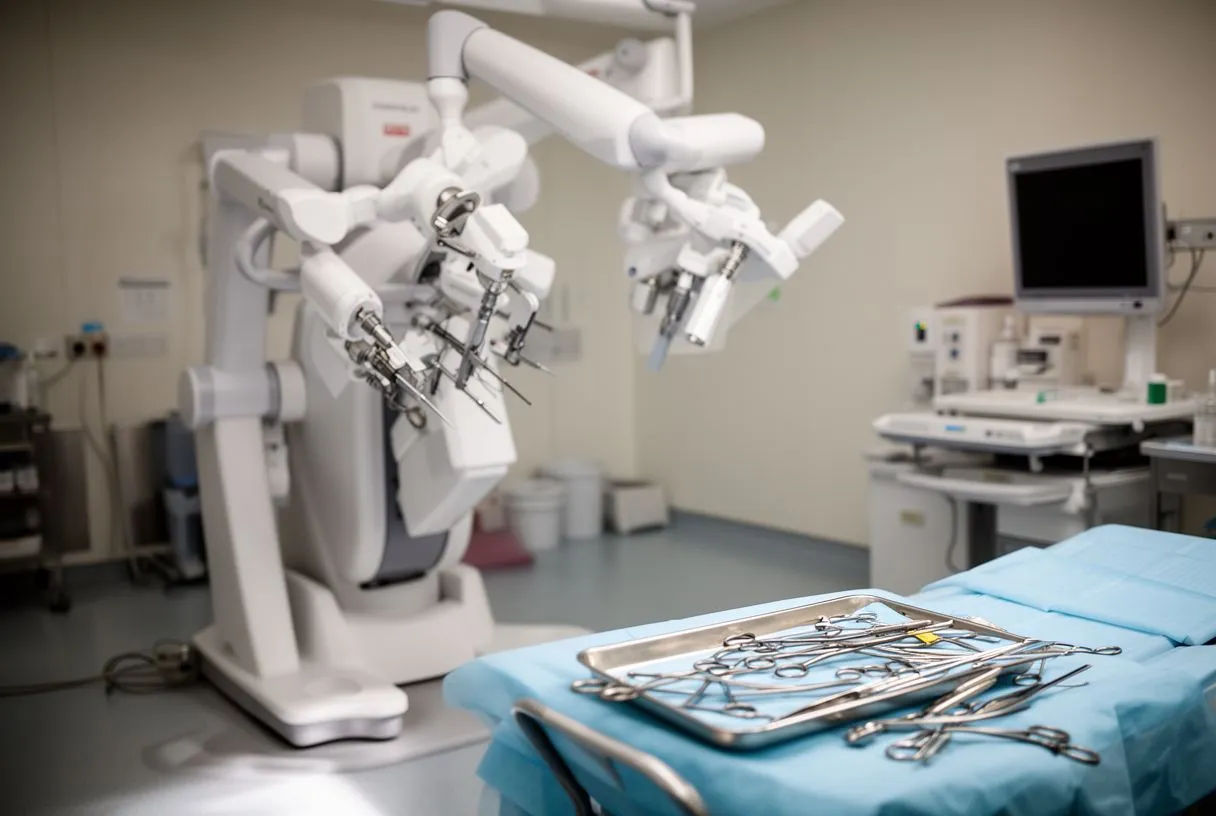
Robotic-assisted LAD bypass. Robotic surgery takes this further: the surgeon operates through a few keyhole ports, guided by a high-definition 3D camera, with instruments whose movements the robotic system translates into extremely precise actions inside the chest. Robotic techniques can be used to harvest the internal mammary artery and, in some centres, to perform the bypass connection itself, often combined with a small incision for the final anastomosis. Dr Molina performed the first robotic mitral valve repair in the Ángeles Health System and the first robotic heart surgery in Guadalajara, and his training in robotic and minimally invasive surgery in Montreal informs which patients are offered these techniques. The candid note: robotic and minimally invasive approaches require specific patient anatomy, and the team will tell you plainly when conventional surgery is the safer choice for you.
Recovery and Life Expectancy After Treatment
Recovery after a stent. Most patients go home the next day or within 48 hours, resume walking within days, and return to desk work in about a week. You will take dual antiplatelet medication (two blood-thinning drugs that prevent clot forming inside the stent) for a period your cardiologist specifies — usually six to twelve months — and you must not stop these drugs without medical advice. Cardiac rehabilitation and risk-factor control are not optional extras; they are the treatment.
Recovery after bypass surgery. Conventional CABG through the breastbone involves a hospital stay of five to seven days and a breastbone that takes roughly six to eight weeks to knit solidly; driving, lifting, and returning to work follow that timeline. Minimally invasive and robotic approaches typically shorten the hospital stay and allow a return to normal activities sooner, though the heart's healing needs are the same. Walking is encouraged from the first days; a structured cardiac rehabilitation programme significantly improves long-term outcomes and should be part of every recovery plan.
What about life expectancy? This is the question everyone asks and honest doctors answer carefully. Coronary artery disease is a chronic condition, not a single event, and outcomes depend heavily on what is done after the procedure: whether smoking stops, whether cholesterol and blood pressure reach guideline targets, whether diabetes is controlled, and whether the patient stays active. Large studies show that patients with treated coronary disease who control their risk factors can live for decades, and many older patients eventually die with coronary disease rather than from it. The realistic framing is this: treatment removes the immediate threat and buys you years in which medication and lifestyle determine the trajectory. Ask your own team for your individual risk profile rather than an average from the internet. In our first contact — a free video consultation — we get to know the patient, talk through the condition, and say which studies are still needed so that no unnecessary ones are ordered; a face-to-face visit follows when the patient decides to go ahead.

When to seek help urgently. Call emergency services if you have chest pressure lasting more than a few minutes at rest, pain radiating to the arm, jaw, or back with sweating or nausea, sudden severe breathlessness, or fainting. Do not drive yourself to hospital in that situation, and do not wait to see if it passes. If you have known LAD disease and your pattern of angina changes — more frequent, easier to trigger, or occurring at rest — see your cardiologist promptly; that change is called unstable angina and needs same-day assessment.
The takeaway from all of this is straightforward. A left anterior descending artery blockage is a serious finding that modern medicine handles remarkably well — with medication, stents, bypass grafts, and increasingly with minimally invasive and robotic techniques, each with clear indications and trade-offs. The most important decision is not which technique, but who helps you decide: an experienced multidisciplinary team that reviews your images, explains your options in plain language, and tells you honestly when surgery is and is not needed. If you or a family member has been told there is a blockage in the LAD or another coronary artery, do not self-diagnose from articles like this one — bring your studies to a qualified cardiac team, ask every question you have, and book a consultation to discuss your specific situation. That conversation is the single most valuable step you can take next.






