

Stanford Classification of Aortic Dissection: Type A and B
Learn the Stanford classification aortic dissection for Type A and Type B. Understand symptoms, urgency levels, and treatment paths.
When a tear opens in the wall of the aorta, the body's largest artery, doctors must decide within hours how to respond. The Stanford classification aortic dissection system is the tool they use to make that decision quickly. It sorts every dissection into just two groups, Type A and Type B, based on one simple question: does the tear involve the first part of the aorta or not? That single distinction changes everything about treatment, urgency, and prognosis. This guide explains what each type means, how doctors diagnose and classify a dissection, what surgery involves, and what recovery realistically looks like — so you or your family can face these decisions with clarity instead of panic.
What Is the Stanford Classification of Aortic Dissection?
The Stanford classification divides aortic dissection into two categories. Type A means the tear involves the ascending aorta, the first segment that leaves the heart. Type B means the tear is confined to the descending aorta, the segment that runs down through the chest and abdomen. The system was developed at Stanford University in the 1960s and 1970s and has become the most widely used classification in emergency rooms worldwide.
The reason for such a simple system is urgency. An aortic dissection is a true cardiovascular emergency, and surgical teams need a language that works in minutes, not pages. Because the ascending aorta sits directly next to the heart and can rupture into the sac around it, any dissection that involves it demands urgent surgery. A dissection limited to the descending aorta can usually be stabilized with medication first.
It helps to understand what a dissection actually is. The aortic wall has three layers. When the inner layer tears, blood surges between the layers, creating a second channel called a false lumen. Blood still flows through the true channel, but the wall is now weakened and can rupture or cut off blood supply to organs. Classification tells the surgical team which segment is threatened and how fast they must act.
What Is a Type A Aortic Dissection According to the Stanford Classification?
The defining feature. In the Stanford classification aortic dissection system, Type A describes any dissection that involves the ascending aorta, no matter where the tear began. The tear may start in the ascending segment itself, or it may start further down the aorta and travel backward until it reaches the ascending portion. Either way, once the ascending aorta is involved, the case is Type A.
Why does this segment matter so much? The ascending aorta sits just above the heart's aortic valve, near the coronary arteries that feed the heart muscle, and just below the aortic arch — the curved segment that gives rise to the arteries supplying the brain and arms. A tear here can rupture into the pericardium, the sac around the heart, causing tamponade, a compression that stops the heart from filling. It can also cause immediate heart attack or stroke. This is why Type A is treated as an immediate surgical emergency.
One point of vocabulary worth knowing: doctors often distinguish between "acute" and "chronic" Type A dissection. Acute means the tear happened within the last two weeks, which is when the wall is most fragile and mortality is highest. Some patients also develop complications such as a Penetrating Aortic Ulcer, a deep ulcer in the aortic wall that can behave like a dissection and is part of what specialists call Acute Aortic Syndrome.
What Are the Symptoms of Stanford Type A Dissection?
The classic presentation. Most patients describe a sudden, severe pain in the chest or upper back, often described as tearing, ripping, or stabbing. It typically starts at maximal intensity, unlike a heart attack, where pain usually builds gradually. The pain may migrate as the dissection extends — from the chest to the back, then down toward the abdomen — which reflects the tear traveling along the vessel.
Warning signs beyond pain. Because the ascending aorta sits so close to critical structures, Type A dissections can produce alarming additional symptoms: fainting, symptoms of stroke such as weakness or slurred speech, pulse differences between the arms, or signs of heart attack when the dissection blocks a coronary artery. Anyone with these symptoms together with sudden severe chest pain needs emergency evaluation immediately — call emergency services, do not drive yourself.
The actor John Ritter died in 2003 from a Type A aortic dissection, initially mistaken for a heart attack. His case is often cited because it shows how easily the symptoms can be misread, and why emergency teams keep dissection on their checklist for any sudden severe chest pain, especially in people with high blood pressure or a family history of aortic disease.
What Is a Type B Aortic Dissection?
Type B dissection involves only the descending aorta, the segment that runs from the end of the aortic arch down through the chest and into the abdomen. The tear usually begins just beyond the left subclavian artery, which supplies the left arm. Because the ascending aorta and the heart are untouched, the immediate risk of tamponade and heart attack is far lower than in Type A.
Uncomplicated Type B. Most Type B patients are stable on arrival. The standard initial approach is intensive medical therapy: strong intravenous medication to lower blood pressure and heart rate, reducing the force pushing on the torn wall. The goal is a controlled, low-pressure circulation so the wall can stabilize. Surgery or stenting is reserved for cases that fail this approach.
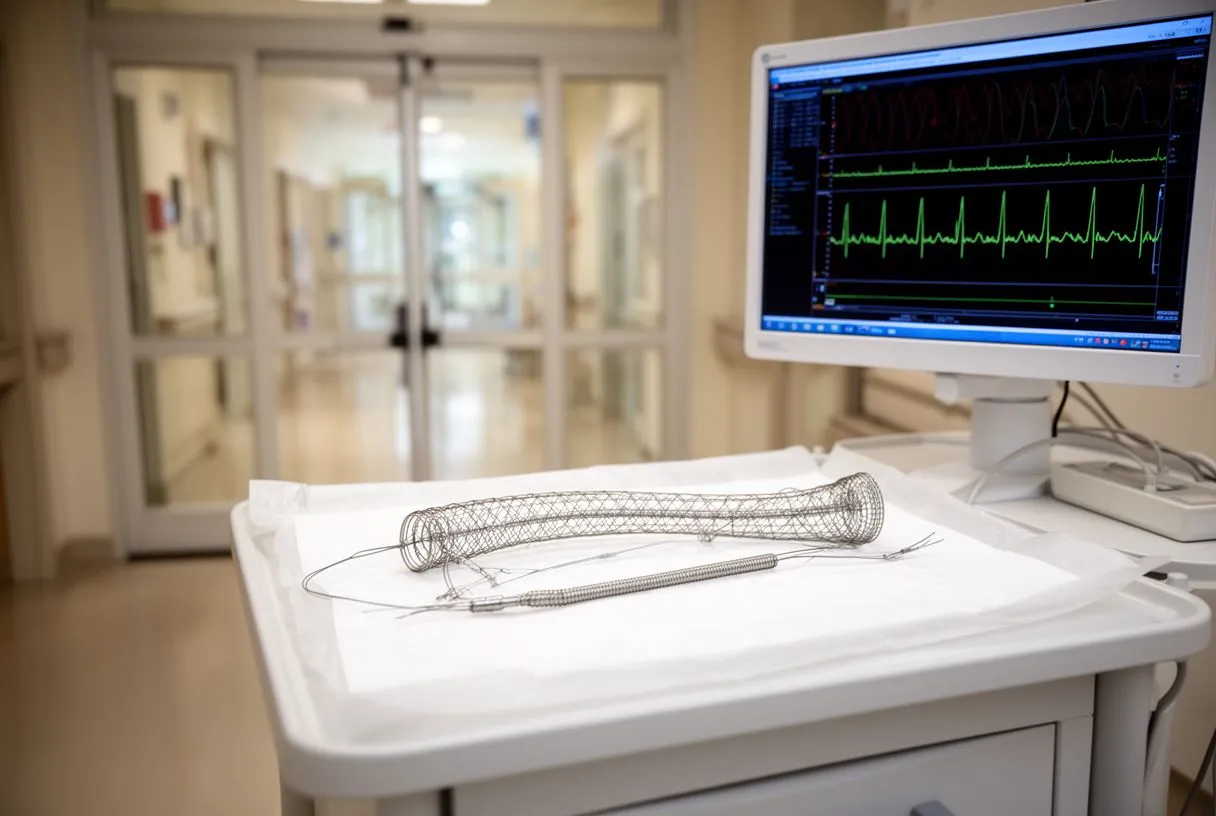
Complicated Type B. About a fifth to a quarter of Type B cases become complicated, meaning the dissection blocks blood flow to a leg, kidney, bowel, or spinal cord, or the aorta enlarges or ruptures. These cases need urgent intervention, usually with an endovascular stent graft — a fabric-covered tube inserted through an artery in the groin and deployed inside the aorta to seal the tear. Outcomes for complicated Type B dissection treated with stent grafts have improved considerably since this approach became standard.
What Are the Four Types of the Aorta? DeBakey vs Stanford
Some readers arrive at this question through the older DeBakey Classification, which divides dissections into types I, II, and III. DeBakey I is a tear starting in the ascending aorta that extends through the whole aorta; DeBakey II is confined to the ascending aorta; DeBakey III begins in the descending aorta, with IIIA limited to the chest and IIIB extending into the abdomen. The DeBakey system is more anatomically detailed, but the Stanford system answered the question surgeons actually need answered: does the ascending aorta need urgent repair, yes or no?
The "four types" question is best answered by thinking of the aorta's anatomy in four segments: the root and ascending aorta, the aortic arch, the descending thoracic aorta, and the abdominal aorta. Disease in each segment brings different risks. A Thoracic Aortic Aneurysm, for example, is a permanent widening of the chest aorta that can precede or complicate a dissection, while an Abdominal Aortic Aneurysm is usually monitored by diameter rather than by dissection criteria.
It is worth noting that classification continues to evolve. The Society for Vascular Surgery recently proposed a new classification that adds detail about which aortic segments are involved, aiming to guide decisions even more precisely than Stanford. For patients, the practical takeaway is unchanged: the Stanford classification remains the working language of every emergency team, and knowing whether your case is Type A or Type B tells you most of what you need to know about urgency.
How Is Aortic Dissection Diagnosed with Imaging?
CT angiography is the workhorse. A CT scan with contrast dye, called CT angiography, is the fastest and most widely available test. It shows the tear, the false lumen, which segments are involved, and whether organs are receiving blood. It is the test that almost always makes the diagnosis and assigns the Stanford type.
Other tests have specific roles. Transesophageal echocardiography — an ultrasound probe passed down the esophagus — can be used at the bedside when a patient is too unstable for CT, and is especially useful in the operating room to check the aortic valve. MRI gives excellent detail but takes longer, so it is rarely the first test in an emergency. Chest X-rays may suggest a widened aorta but can never exclude a dissection.
Doctors also measure the Aortic Diameter, because size drives decisions in aneurysm disease and in the follow-up of dissection patients. A normally sized aorta at the level where it passes through the diaphragm is around 2 to 3 centimeters; aneurysm surgery is generally considered once the diameter approaches or exceeds 5.5 centimeters, or lower in patients with genetic aortic conditions. In our practice we review every imaging study with the patient and explain what the measurements actually mean, in plain words, before any decision is made.
When Is Type A Aortic Dissection Surgery Needed?
Always, and urgently. Acute Type A dissection is one of the few diagnoses in medicine where surgery is indicated in essentially every patient who can tolerate it, and the sooner the better, because mortality rises by roughly one to two percent for every hour that passes. The operation replaces the damaged ascending aorta with a synthetic tube and, when the valve or coronary arteries are involved, repairs or replaces those too.
What the operation involves. The surgeon places the patient on a heart-lung machine, applies an Aortic Cross-clamp to stop blood flow through the segment being replaced, and may use deep hypothermic circulatory arrest — deliberately cooling the body and briefly stopping circulation — when the aortic arch is involved and the brain must be protected. In more extensive cases, an Aortic Arch Replacement replaces the arch itself, sometimes with branches reimplanted to preserve blood flow to the brain and arms. When the aortic valve cannot be preserved, options include a bioprosthetic valve conduit or Surgical Aortic Valve Replacement, while Transcatheter Aortic Valve Implantation (known as TAVR) is generally not the answer in an acute dissection, though it may be relevant later if valve disease coexists, as in Severe Aortic Stenosis.
Some patients need further operations years later, either because the original repair did not involve the whole aorta or because the remaining aorta dilates. Reoperation for acute type A aortic dissection is a real and studied phenomenon, and its frequency and outcomes have been examined in dedicated clinical studies of reoperation after Type A dissection. At our practice, every case — emergency or planned — is reviewed by the multidisciplinary team against international practice guidelines before a recommendation is made, and the patient receives a clear proposal with the alternatives, including a less invasive route only where the evidence supports it.
How Is Chronic Type B Aortic Dissection Managed?
Once a Type B dissection survives its first two weeks, it enters the "chronic" phase. Management then becomes a long game: lifelong blood pressure control, usually with beta-blockers and other agents; imaging of the entire aorta at regular intervals, typically with CT or MRI; and attention to risk factors such as smoking. The goal is to prevent the false lumen from enlarging and the aorta from dilating into an aneurysm.
When intervention becomes necessary. If the descending aorta grows beyond the threshold for safe observation — generally a diameter above 5.5 to 6 centimeters, or faster than about half a centimeter of growth per year — doctors consider repair. The modern default is a thoracic endovascular stent graft, which is far less invasive than open surgery. These repairs are not perfect: blood can leak around the graft and keep filling the false lumen, a problem called an endoleak. When a stent graft fails to seal an old dissection, specialist solutions exist, including modified scalloped endografts designed for the aortic arch, an approach documented in case reports of managing type Ia endoleaks after failed endovascular dissection repair.
Follow-up generally rests on the same principles: surveillance imaging on a regular schedule and strict blood pressure targets. We encourage second opinions as a normal part of deciding about any aortic procedure — chronic Type B management involves trade-offs between lifelong medication, stent grafts, and open surgery, and you deserve more than one expert view before choosing.
What Is the Life Expectancy After Type A Aortic Dissection?
It is important to be honest here without being either falsely reassuring or needlessly frightening. Acute Type A dissection has high early mortality — a significant share of patients die before reaching the hospital, and emergency surgery itself carries substantial risk — but patients who survive to leave the hospital do far better than those numbers suggest. Long-term survival after successful repair is meaningfully reduced compared with the general population, mainly because many patients have underlying hypertension, connective tissue conditions, or other vascular disease.
What drives long-term outcomes is mostly what happens after discharge: control of blood pressure, surveillance imaging of the residual aorta, and treatment of any remaining aortic disease. The residual false lumen and the rest of the aorta remain at risk of dilating for life. Follow-up is therefore not optional; it is the single strongest thing a survivor can control.
The NYHA Classification — a scale doctors use to grade breathlessness and exercise limitation from class I (no limitation) to class IV (symptoms at rest) — is often recorded in follow-up because it predicts quality of life and, in some contexts, the need for interventions. In our practice we see patients years after emergency dissection repair who are living full lives, and the difference between them usually comes down to disciplined follow-up and blood pressure control, not luck.
What Should You Do If You Suspect Aortic Dissection?
If you or someone near you has sudden, severe chest or back pain — especially pain described as tearing, or pain that moves — treat it as an emergency. Call emergency services. Do not wait to see whether it passes, and do not drive to the hospital yourself. In the emergency department, say the words "I think this could be an aortic dissection" if the pain is sudden and severe; that sentence changes how the team triages you.
For people with known aortic disease — a Thoracic Aortic Aneurysm, a family history of dissection, Marfan or similar connective tissue conditions, or a previous dissection — the rules are even simpler: any new, different, severe pain in the chest, back, or abdomen is an emergency until proven otherwise, at any time of day.
And if your question is not an emergency but a decision — whether to have surgery for an aneurysm, how to follow up after a dissection, or whether a second opinion makes sense — start with a conversation. At our practice, led by Dr Alejandro Molina, the first contact is a free video consultation: we get to know the patient, talk through the condition, and say which studies are still needed so no unnecessary ones are ordered. Consulting rooms are in Guadalajara, Querétaro and Hermosillo, and we are happy to review your case and explain every option in plain language. Aortic dissection is frightening; facing it with a clear plan is not. Book a consultation with a qualified cardiac team rather than trying to answer these questions alone.






