

Plaque Rupture: How a Heart Attack Starts
A plaque rupture heart attack begins when a fatty deposit cracks open and triggers a clot.
Most heart attacks do not begin with a sudden blockage that appeared out of nowhere. They begin with a plaque rupture heart attack — an event where a fatty deposit inside a coronary artery breaks open and triggers a clot. Understanding how this happens helps patients and families make sense of symptoms, tests and treatment decisions. In this guide, we explain the mechanism in plain language, the warning signs, and what can be done to lower the risk.
What Is Plaque Rupture?
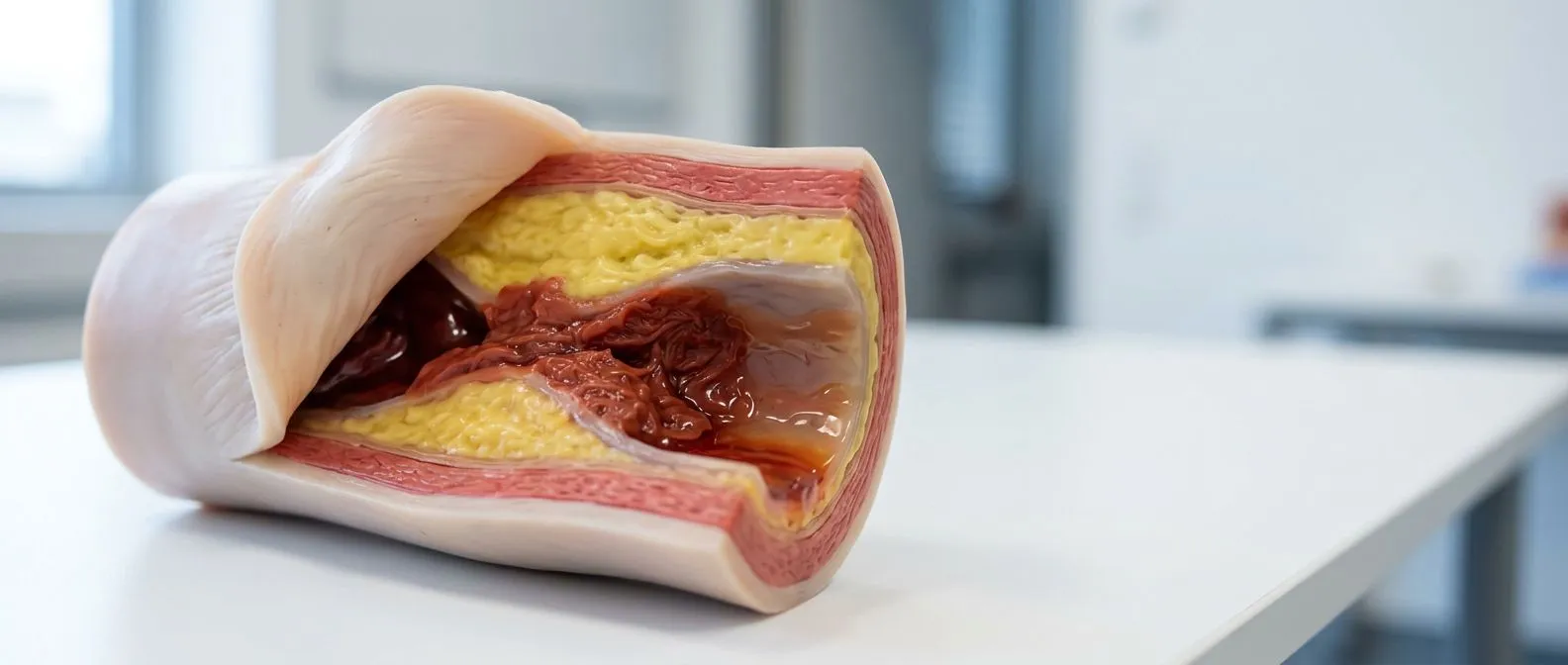
Atherosclerosis begins silently. Over decades, cholesterol, fats, cells and debris accumulate in the wall of an artery, forming an atheromatous plaque — a soft centre of lipid-rich material covered by a thin, fibrous lid. The medical term for this lining is the fibrous cap. When that cap tears or breaks apart, the event is called plaque rupture.
Think of a plaque as a small, soft-boiled egg pressed into the artery wall. The shell is the fibrous cap; the yolk is the lipid core. As long as the shell stays intact, blood flows past without trouble. The danger comes from the moment the shell cracks and the contents spill into the vessel.
The biological processes behind these plaque events — including how inflammation changes the plaque structure — have been studied extensively, and reviews such as Biological properties of extracellular vesicles and their physiological functions describe how cell-to-cell signalling drives inflammation inside the vessel wall. Rupture is not random; it is the end result of a long inflammatory process.
How Does Plaque Rupture Cause a Heart Attack?
The clot is the culprit. The plaque rupture mechanism follows a clear sequence. When the fibrous cap tears, the lipid core — which the body treats as a foreign, harmful substance — comes into contact with blood. Platelets, the small cell fragments that stop bleeding, rush to the site and stick together. A clot begins to grow.
Within minutes, the clot can grow large enough to block the artery completely. In a coronary artery plaque rupture, the heart muscle downstream suddenly loses its blood supply. This is the essence of how plaques cause heart attacks: it is not the plaque itself that kills the muscle, but the clot that forms on top of it.
Heart muscle cells begin to die within roughly 20 minutes to a few hours of total blockage. That is why emergency services treat chest pain as a time-critical event. Every minute of delay costs muscle, and lost muscle is permanent.
What Causes Plaque Rupture?
Inflammation is the engine. If you are asking what causes plaque rupture, the short answer is that the cap weakens until it can no longer hold. Inflammation inside the plaque releases enzymes that digest the collagen fibres that give the cap its strength. The cap thins, and physical stress — the pulsing of blood with every heartbeat — finally tears it.
Several triggers can tip a weakened plaque over the edge. Sudden spikes in blood pressure, intense physical exertion, severe emotional stress, heavy meals, smoking, and even early-morning hormonal surges have all been associated with rupture events. None of these alone causes a rupture; they act on a plaque that is already vulnerable.
Where the plaque sits matters. Plaque at bends, branches or junctions of the coronary arteries experiences more mechanical stress. The fact that rupture happens where the plaque is under the most strain is one of the better-established findings in Springer-published cardiovascular research on plaque biomechanics.

Plaque Rupture Symptoms: What Does It Feel Like?
The classic warning signs. Plaque rupture symptoms are, in practice, the symptoms of a heart attack. These include chest pressure, tightness or squeezing pain, often in the centre or left side of the chest, lasting more than a few minutes. The pain can spread to the left arm, jaw, neck, back or stomach.
Other symptoms are less dramatic but just as important: shortness of breath, cold sweats, nausea, sudden dizziness, and overwhelming fatigue. These may come on at rest or with minimal activity. Some people, especially women, older adults and people with diabetes, experience "silent" presentations with little or no chest pain at all.
- Call emergency services immediately: if chest discomfort lasts more than five minutes, or comes with sweating, nausea or breathlessness.
- Note the time: when symptoms started, because clot-dissolving and stent treatments are most effective early.
- Do not drive yourself: to hospital if you suspect a heart attack — symptoms can worsen suddenly.
Plaque Rupture vs Erosion: What Is the Difference?
Two different failure modes. Understanding plaque rupture vs erosion helps explain why some heart attacks happen in people with only mild blockages. In classic rupture, the fibrous cap tears open and exposes the lipid core. In erosion, the surface layer of cells over the plaque wears away, and the clot forms on that roughened surface — without the cap ever breaking.
Erosion behaves differently. Plaque erosion is more common in women and younger smokers, and it often occurs on plaques that are smaller and less loaded with lipid. Because the underlying plaque is less severe, erosion-related clots are sometimes more responsive to medication-only treatment, while rupture-type clots usually require urgent stent placement.
For patients, the practical takeaway is this: a heart attack can occur even when a coronary artery is only mildly narrowed beforehand. This is why doctors look at the whole artery and the plaque's characteristics, not only the percentage of blockage.
What Makes a Plaque Vulnerable to Rupture?
Three features define danger. Cardiologists use the term vulnerable plaque to describe plaques with a high chance of causing problems. Vulnerable plaque rupture risk rises with three main features: a large lipid core, a thin fibrous cap, and heavy inflammation inside the plaque. Imaging can now identify many of these traits.
Not every blockage is dangerous. Conversely, some heavily narrowed arteries carry stable plaques with thick caps and little inflammation. These can cause stable angina — chest pain on exertion — but they are far less likely to rupture suddenly. This is why a "70% blockage" is not automatically more dangerous than a "30% blockage" with a thin cap.
Healed ruptures are common. Researchers have found that many plaques show signs of a rupture that healed on its own. The rupture may have been small, the clot may have dissolved, and the plaque resealed with a thicker, sturdier cap. Some heart attacks, however, follow a rupture that the body cannot contain.

Plaque Rupture Treatment: What Happens in Hospital?
Emergency reopening of the artery. Standard plaque rupture treatment for a heart attack is emergency angioplasty: a catheter is threaded to the blocked artery, the clot is dealt with, and a stent — a small metal scaffold — is placed to hold the artery open. Primary angioplasty, done within the first hours, is the treatment of choice in most modern heart centres.
Medication is part of every plan. Before, during and after the procedure, patients receive antiplatelet drugs and anticoagulants to stop the clot from growing or recurring. Afterward, most patients continue a combination of a statin, aspirin, and a second antiplatelet agent. Statins do more than lower cholesterol; they stabilise the remaining plaques and reduce inflammation.
In our team, every case is reviewed by the multidisciplinary group against international practice guidelines before a treatment recommendation is made, and the patient receives a clear proposal with the alternatives — the final decision is always theirs. We favour the least invasive route only where the evidence supports it for that specific patient.
How Can You Prevent a Plaque Rupture Heart Attack?
Prevention targets the plaque itself. The most reliable way to prevent plaque rupture heart events is to change the plaque's biology. Intensive lipid-lowering — especially with statins — has been shown to reduce the lipid content of plaques and thicken the fibrous cap. An ongoing clinical trial is studying the effect of intensive lipid-lowering therapy on coronary plaque progression in young and middle-aged patients with chronic coronary syndrome (NCT06896708).
Lifestyle still matters. Stopping smoking is the single most powerful change an individual can make. Control of blood pressure, blood sugar and body weight all reduce the inflammation that weakens plaque caps. Regular moderate exercise, a Mediterranean-style diet, and good sleep are the pillars of long-term vascular health.
- Know your numbers: LDL cholesterol, blood pressure, blood sugar, and waist size are the four figures worth memorising.
- Take statins seriously: if prescribed, because plaque stabilisation is a proven effect of long-term use.
- Quit smoking: it is the strongest modifiable risk factor for both rupture and erosion events.
Plaque Rupture Risk Factors: Which Ones Can You Change?
The risk factors you inherit. Some plaque rupture risk factors cannot be changed: age, family history of early heart disease, and sex. Men tend to develop significant plaque earlier; women's risk rises after menopause. These factors explain why some people develop vulnerable plaques despite healthy habits.
The risk factors you control. Smoking, high LDL cholesterol, untreated high blood pressure, diabetes, obesity, physical inactivity and chronic stress are all modifiable. Each one feeds the inflammatory process that thins the fibrous cap and grows the lipid core. Addressing them genuinely lowers the chance of a plaque rupture heart attack over the following years.
It is a marathon, not a sprint. The plaques that rupture usually took decades to form. The good news is that the same long timeline works in your favour: even modest, sustained changes to cholesterol, blood pressure and smoking status reshape the plaque's composition and shift the odds away from rupture.
When Should You Talk to a Cardiac Team?
Suspicion is the trigger. Any new chest discomfort, unexplained breathlessness, or a family history of early heart attacks is reason enough to be evaluated. No one should self-diagnose — the tools that distinguish a stable plaque from a vulnerable one require proper testing, including coronary CT angiography and, in some cases, invasive imaging of the artery.
The first contact with our team is a free video consultation: we get to know the patient, talk through the condition in plain words, and identify exactly which studies are still needed so no unnecessary ones are ordered. A face-to-face visit at our consulting rooms in Guadalajara, Querétaro or Hermosillo follows when the patient decides to go ahead. We encourage second opinions and treat seeking one as a normal part of deciding about heart care.
In the consultation, our team takes the time to explain what the studies actually show, and to answer every question before any decision is made. Plaque rupture is frightening to read about, but it is a well-understood process with proven ways to prevent it, detect it, and treat it. If you are concerned about your own risk, the most valuable next step is a conversation with a qualified cardiac team — not a wait-and-see approach.






